
The Giant’s Tiny Problem
The green leaf letter looked huge in Emily’s hands. Inside was a problem that sounded silly at first. How hard could it be to find one tiny button? Then Emily read where it was lost.
A Leaf in the Mailbox
Emily padded onto the porch in her purple sneakers and found the midnight mailbox waiting under the porch light.
Its little flag was down. Its door was shut. But a big green leaf stuck out from the side like it had been tucked in with a hurry.
Mailwhisk popped up from behind the flowerpot, his tiny blue mailbag bumping against his side. “One blink, no leaf,” he squeaked. “Next blink, leaf.”
Emily opened the mailbox. The silver star mark gleamed inside the little door. She pulled out the leaf.
“Listen to this,” she said.
She read aloud, “Dear Helpful Finder, I am a giant with a very tiny problem. My smallest blue coat button fell into the tall grass on Hilltop Lane. I cannot see it from up here. I do not want to step on it. Can you help me think small?”
Mailwhisk sat down hard on the porch board. “A giant who needs help looking for something tiny. That is almost rude.”
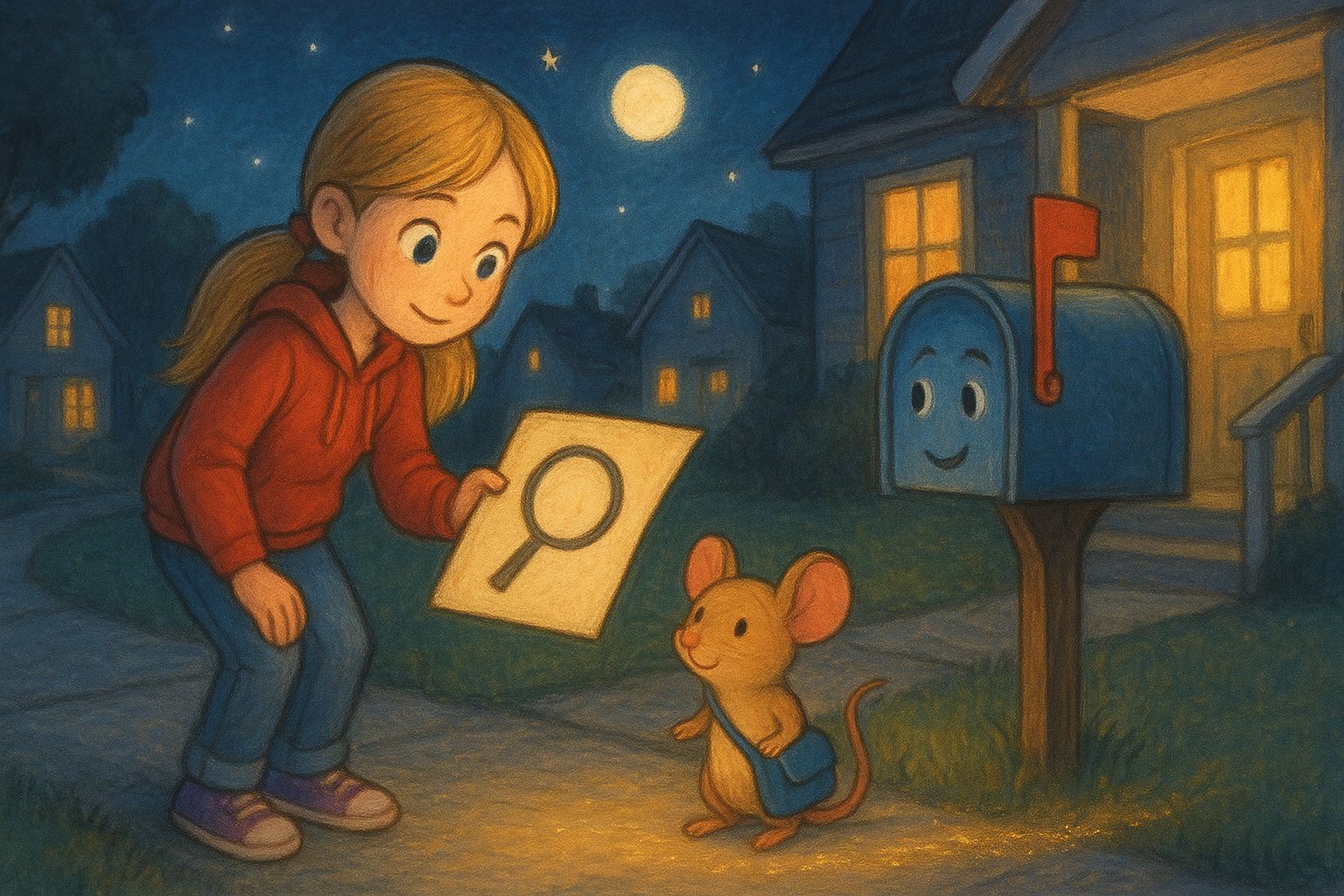
She turned the leaf over. On the back was a picture of a round blue button beside three long grass blades and a little drawing of a magnifying glass.
“So the button is real,” Emily said. “And the clue says looking closer matters.”
The Hard Part
Emily hurried inside and spread the leaf letter on the kitchen table. Mailwhisk climbed onto the salt shaker so he could see better.
“We could tell the giant to crawl around until he finds it,” he offered.
Emily shook her head. “That would squish half the hill.”
Emily got her pencil and a sheet of paper. She drew tall lines for grass. Then she drew one tiny dot in the middle.
“The problem is not just finding the button,” she said. “The problem is searching without getting lost.”
Mailwhisk tapped the paper with his tail. “So the giant needs a plan.”
Emily nodded, but she did not know the plan yet.
She went to the sewing jar and poured a few loose buttons onto the table. One was tiny and blue.
Mailwhisk leaned close. “That one disappears if I look away.”
Emily set three pencils upright like grass around the little blue button. Then she stood back.
“From far away, the grass wins,” she said.
Thinking Small
They tried one idea after another. Emily made a paper cone. It flopped.
Mailwhisk suggested tying ribbons to every blade of grass. Even he admitted that was too many ribbons.
Then Emily drew a box around the button on her paper.
Then another box.
Then a row of boxes all across the page.
Mailwhisk climbed down from the salt shaker and scampered across the drawing. “You made little yards!”
“Not yards,” Emily said. “Search squares.”
Now her brain felt warm and clicky in the good way. She drew a hill. On top of it she marked a patch of tall grass. Then she divided the patch into small squares.
“The giant can search one square at a time,” she said. “No rushing. No stomping. No forgetting where he already looked.”
Mailwhisk’s whiskers twitched. “That is clever.”
Emily added a little magnifying-glass picture beside the first square. Then she drew a stick with a string tied to it.
“He can lay string on the ground to make lines,” she said. “That will turn the giant patch into smaller pieces.”
Mailwhisk pointed to the sewing jar. “And include the sample button.”
Emily copied the final plan neatly onto fresh paper: make squares, search slowly, compare with the sample, move one row at a time.
Still, she did not seal the answer yet. “If I were a giant, I might still miss it,” she said.
The Test
So they made a test patch on the rug.
Emily stood books on end for tall grass. She dropped the tiny blue button between them. Then she used yarn to make little squares.
“You be the giant,” she told Mailwhisk.
Mailwhisk puffed up proudly. “At last.”
He searched the first square only. No button. Second square only. No button. Third square-
“Found it!” he squeaked, pulling the blue button out with both paws.
Emily clapped once. “It works.”
Emily tucked the plan, the magnifying-glass drawing, and the sample button picture into a clean envelope.
Only now, after all the trying and testing, did the answer feel ready.
Back Through the Slot
They hurried to the porch. The mailbox seemed to be waiting.
Emily slid the envelope through the slot. For one second, nothing happened.
Then the box gave a soft thump.
A new leaf drifted out.
Inside was a picture of a huge smiling hand holding one tiny blue button on the tip of a finger.
“He found it!” Emily said.
Mailwhisk hopped so high he nearly tipped over backward. “The squares worked!”
Emily turned to look at the porch floor.
Thin golden dust now trailed away from the mailbox, across the boards, and down the steps. It curled once near the doormat in the shape of a star with a little wave under it-the same secret mark they had seen before.
Then the dust drifted farther, as if a quiet breeze was leading it down the path.
Mailwhisk’s voice dropped to a whisper. “Do you think that is the sender?”
Emily slipped the thank-you leaf into her pocket. “I think it might be the closest clue yet.”
She looked at the glowing trail, then at Mailwhisk.
“Come on,” she said. “Let’s see where kindness goes when it leaves the mailbox.”
Follow-Up Questions
- Why was a search pattern better than rushing through the grass?
- What did Emily and Mailwhisk do to test their plan before mailing it?
- Where do you think the golden dust trail will lead next?