
You know that moment when your kid spills cereal, snaps at you, and then you hear your own voice getting louder than you wanted—again? Most parents do not plan to yell. It usually happens when everyone is late, someone ignores the same direction for the fourth time, and your own patience is hanging by a thread. If you want discipline that actually teaches without turning the whole house into a shouting match, there is a better way.
Disciplining without yelling does not mean being permissive. It means staying clear, steady, and believable. Kids need limits. They also need parents whose correction makes sense instead of sounding like pure frustration. When yelling becomes the main tool, children often hear the volume more than the lesson. They may stop for a moment, but they do not always learn what to do differently next time.
The good news is that calmer discipline is not about becoming endlessly patient. It is mostly about having a plan before the hard moment hits. When you know what you will say, what consequence fits, and how you will stay regulated, you do not have to improvise while your blood pressure is rising.
Why This Happens
Yelling usually starts long before the actual yelling. It builds when children test a limit, parents repeat themselves, nobody changes course, and tension stacks up. By the time a parent raises their voice, they are often reacting to the whole day, not just the toy on the floor or the ignored bedtime instruction.
Children also do not naturally respond to every direction quickly and calmly. Younger kids get absorbed in play. Tired kids move slowly. Overstimulated kids can look defiant when they are really overwhelmed. None of that means you should let bad behavior slide. It does mean that discipline works better when it matches a child’s developmental stage instead of expecting instant adult-style self-control.
Another reason yelling becomes a habit is that it sometimes works in the short term. A loud voice can interrupt behavior fast. But over time, many kids either become more reactive or start tuning it out. That is why it helps to build discipline around connection, consistency, and follow-through. If you need a stronger foundation, this guide on setting clear boundaries and expectations with young children is a useful place to start.
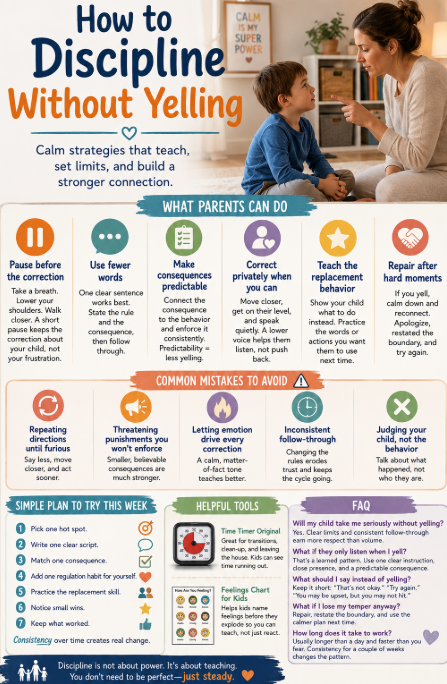
What Parents Can Do
Pause before the correction
If you feel your volume rising, buy yourself five seconds. Take one breath. Lower your shoulders. Walk closer instead of calling across the room. A short pause is not weakness. It is how you keep the correction about your child’s behavior instead of your own frustration.
You can say things like, “I’m going to say this once clearly,” or “Try that again in a respectful way.” Calm words often land better than dramatic ones because they sound like you mean them.
Use fewer words
Long lectures usually pour gasoline on a tense moment. Kids who are upset, distracted, or embarrassed stop listening fast. Instead of explaining for two minutes, aim for one clear sentence: “Blocks stay on the floor. If you throw them again, I’m putting them away.” Then follow through.
This is where strong parent-child communication matters. If you want to sharpen that skill, effective communication with kids pairs well with calmer discipline because it helps children hear the message without all the extra noise.
Make consequences predictable
Consequences do not need to be harsh to be effective. They need to connect to the behavior and happen consistently. If your child keeps splashing water out of the tub, bath ends early. If they refuse to put markers away after one reminder, the markers rest on a shelf until tomorrow. Predictability lowers the urge to yell because you are not trying to invent justice in the moment.
A useful test is this: can you explain the consequence in one sentence, and can you actually enforce it? If the answer is yes, you are probably on the right track.
Correct privately when you can
Children often escalate more when they feel watched or embarrassed. If a sibling audience is feeding the moment, move closer, get on your child’s level, and speak quietly. A lower voice can be surprisingly powerful because it makes a child lean in instead of pushing back.
Teach the replacement behavior
“Stop yelling at your brother” is only half the lesson. The other half is what to do instead. Try: “Say, ‘I’m still using that,’” or “Put your hands on the couch and tell me you’re mad.” Discipline sticks better when kids practice the exact behavior you want next time.
This is one reason self-regulation matters so much. Teaching children how to calm their bodies, name feelings, and recover after mistakes makes discipline more effective. This article on teaching self-regulation can help if your child melts down fast or struggles to reset.
Repair after hard moments
If you do yell, do not decide the whole approach failed. Calm down, reconnect, and repair. You can say, “I was too loud. I should have handled that differently. The rule still stands, and next time I’m going to say it more calmly.” That kind of repair teaches accountability without erasing the boundary.
Children do not need flawless parents. They need parents who can recover, be honest, and keep showing them what respectful leadership looks like.
Common Mistakes to Avoid
One common mistake is repeating directions until you are furious. By the fifth reminder, your child has learned that the real instruction is not the first one. It is the one that comes with a sharper tone. Say less, move closer, and act sooner.
Another mistake is threatening giant punishments you do not intend to enforce. “No TV for a month” may fly out of your mouth in anger, but it usually creates a second problem later when you walk it back. Smaller, believable consequences are much stronger.
Parents also get trapped when every correction sounds emotional instead of matter-of-fact. Discipline works better when your tone says, “I know what happens next.” Routines help with that. If the same flashpoints keep happening, look at the power of routine and tighten the parts of the day that always go sideways, like mornings, transitions, and bedtime.
Finally, avoid turning every mistake into a character judgment. “You’re so rude,” “You never listen,” or “Why are you always like this?” can make a child defensive instead of reflective. Talk about the behavior, not your child’s identity.
Simple Plan to Try This Week
If your house has fallen into a yell-repeat-yell loop, do not overhaul everything at once. Try this one-week reset:
Day 1: Pick one hot spot
Choose the moment when yelling shows up most: getting shoes on, leaving the park, homework, sibling fights, or bedtime. One target is enough.
Day 2: Write one clear script
Decide in advance what you will say. Example: “It’s time to brush teeth. If you choose not to start now, there will be no extra story.” Simple beats clever.
Day 3: Match one consequence
Choose a consequence you can enforce calmly and right away. Not huge. Not dramatic. Just consistent.
Day 4: Add one regulation habit for yourself
Stand closer before speaking. Exhale before correcting. Put your hand on the counter instead of pointing. Pick one physical cue that helps your body stay calmer.
Day 5: Practice the replacement skill when nobody is upset
Role-play what your child can say when they are frustrated: “Can I have a turn next?” “I need help.” “I’m mad.” Practicing outside the crisis makes it easier to use inside the crisis.
Day 6: Notice small wins
Maybe the problem was not solved, but the yelling started later, ended faster, or happened once instead of three times. That still counts.
Day 7: Keep what worked
Do not chase perfect. Keep the script, the consequence, and the calmer tone that helped most. Real discipline improves through repetition, not one dramatic breakthrough.
Related:
Helpful Tools
You do not need to buy anything to stop yelling, but a couple of simple tools can make calmer discipline easier to stick with.
- Time Timer Original can help during transitions, cleanup, or leaving-the-house moments because your child can see time running out without hearing constant verbal reminders.
- Feelings Chart for Kids can be useful for kids who go from fine to furious in seconds and need help naming what is happening before you correct the behavior.
FAQ
Does disciplining without yelling mean my child will not take me seriously?
No. Kids take parents seriously when the limit is clear and the follow-through is real. Volume can feel powerful in the moment, but consistency has more staying power.
What if my child only listens when I raise my voice?
That usually means yelling has become part of the pattern, not that it is your only option. Start using one clear instruction, a closer physical presence, and a predictable consequence. It can take time, but children do learn the new pattern.
What should I say instead of yelling?
Keep it short. Try: “That is not okay.” “Try again.” “You may be upset, but you may not hit.” “If you throw it again, I’ll put it away.” Clear beats dramatic.
What if I lose my temper anyway?
Repair, then reset. Apologize for the yelling, restate the boundary, and use the calmer plan next time. One bad moment does not cancel your effort.
How long does it take for calmer discipline to work?
Usually longer than one day and faster than parents fear. If you stay consistent for a couple of weeks, many children begin responding to the calmer pattern because they know you mean what you say.
Learning to discipline without yelling is really about trading urgency for steadiness. You are still the parent. You are still setting the limit. You are just doing it in a way your child can actually learn from. If sibling conflict is one of the places things blow up fastest, this article on handling sibling rivalry is a practical next read.