
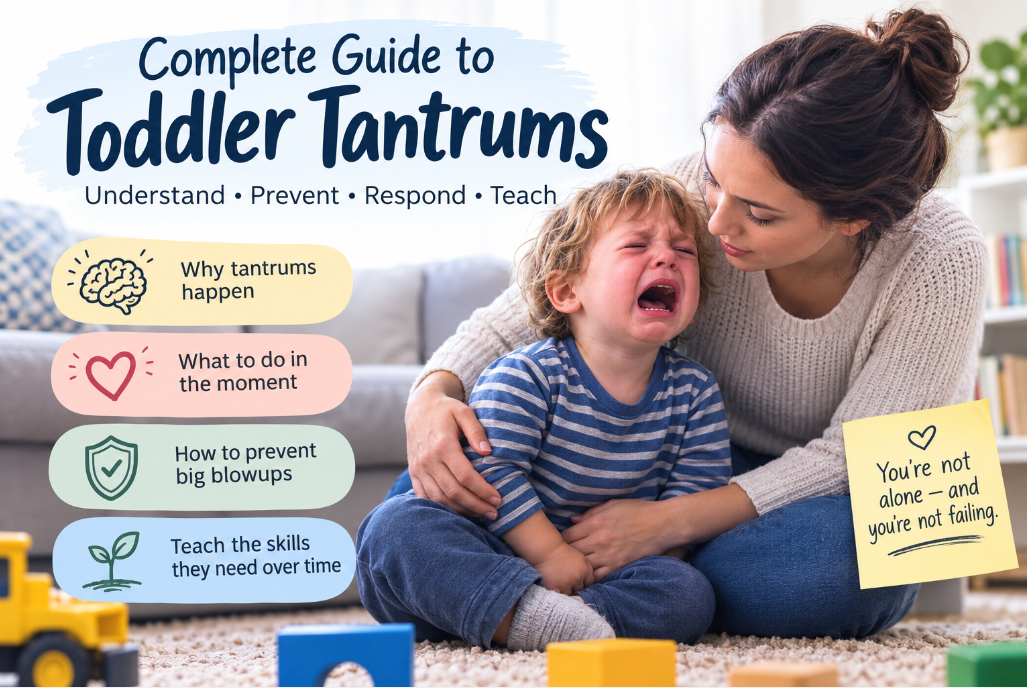
Toddler tantrums can make even a calm parent feel rattled. One minute your child is happily eating crackers, and the next they are on the floor because the banana broke in half, the blue cup is in the sink, or it is time to leave the park. It is exhausting, especially when it happens in public or during the busiest part of the day.
If you are living through this stage, you are not alone, and you are not failing. Tantrums are a common part of toddler development. Young children feel things intensely, but they do not yet have the language, impulse control, or emotional skills to handle every disappointment smoothly. That mismatch is what makes toddlerhood both important and, frankly, chaotic.
The goal is not to stop every tantrum forever. That is not realistic. The goal is to understand why tantrums happen, reduce the ones you can prevent, respond in a way that keeps everyone safe, and gradually teach your child the skills they do not have yet. That is how families move from constant meltdowns toward more predictable, calmer days.
This guide brings the big picture together. You will find practical ways to handle tantrums in the moment, prevent some of the biggest blowups, and teach the emotional skills that help toddlers cope better over time.
Why Toddler Tantrums Happen
Tantrums are not usually a sign that a toddler is manipulative or spoiled. More often, they are the visible result of a child being overwhelmed. Toddlers want independence before they have the ability to manage all the frustration that comes with it. They want to decide, move fast, keep playing, and get what they want right now. When reality gets in the way, their feelings can crash over them all at once.
Common triggers include hunger, fatigue, overstimulation, transitions, frustration with communication, and being told no. Some toddlers also melt down when they feel rushed, embarrassed, or physically uncomfortable. Others struggle most when they are asked to stop something fun or do something they were not expecting.
If you want a focused look at what these blowups can look like and how to start responding calmly, managing tantrums and meltdowns with calm techniques is a useful companion article. It covers the immediate storm. This guide goes wider so you can see the full pattern around it.
It also helps to remember that not every outburst is the same. A tantrum driven by a denied cookie may look different from a meltdown driven by exhaustion or sensory overload. The response does not need to be dramatic, but it should fit the moment.
What Parents Should Do in the Middle of a Tantrum
When a tantrum hits, your first job is not to lecture. It is to stay as steady as you can and keep the situation safe. Toddlers do not learn well when they are completely overwhelmed. In the heat of the moment, your calm matters more than your perfect words.
Start by lowering the intensity instead of raising yours. Get close if your child accepts that. Move unsafe objects away. Use a simple voice. Keep directions short. Something like, “I will help you stay safe,” or “You are upset. I’m right here,” usually lands better than a long explanation.
Validation can help, as long as it does not turn into giving in. You can acknowledge the feeling without changing the limit: “You are mad because we had to leave,” or “You really wanted that toy.” Feeling understood often helps a toddler settle faster than arguing about whether their reaction makes sense.
For a more specific in-the-moment toolkit, these calming strategies for taming tantrums are especially helpful when you need practical language and simple ways to de-escalate.
During the peak of a tantrum, try to avoid these traps:
- asking too many questions
- giving a long lecture
- threatening consequences you will not use
- arguing about logic with a flooded toddler
- matching their volume with your own
If your child is hitting, kicking, throwing, or trying to run, step in physically only as much as needed for safety. Keep your response firm and as calm as possible. If a tantrum seems unusually extreme, happens far beyond toddler years, or includes safety concerns you cannot manage, it is worth bringing it up with your pediatrician.
The Difference Between Calm and Permissive
One reason tantrums wear parents down is that it can feel like you have only two choices: stay calm and let everything slide, or set a limit and become harsh. That is a false choice. Calm and firm can exist together.
You can hold the boundary while still being supportive. “You can be mad, but I won’t let you hit.” “I hear that you want another show, and screen time is done.” “You do not like this, and it is still time to leave.” Those kinds of responses teach something important: feelings are allowed, but not every behavior is.
This is where many families get stuck in a yelling cycle. The limit is reasonable, but the parent is tired, repeats it five times, and then explodes. If that pattern feels familiar, how to discipline without yelling is one of the most useful articles to pair with a tantrum plan. It shows how to stay clear and believable without making the whole moment louder.
Being calm does not mean being endlessly soft. It means your limit is clear, your tone is controlled, and your follow-through makes sense.
How to Prevent Some Tantrums Before They Start
You cannot prevent every tantrum, but you can absolutely reduce the number of them. Prevention usually comes down to noticing patterns before your child falls apart.
Ask yourself:
- Does my child melt down most when they are hungry or tired?
- Are transitions the biggest problem?
- Does too much noise, activity, or waiting push them over the edge?
- Do tantrums happen when expectations are unclear?
Once you see the pattern, the fixes get more practical. Snacks before errands. Fewer stops in one outing. Earlier bedtime. Transition warnings. Simpler plans. More recovery time after busy days. None of this is glamorous, but it works.
One of the strongest prevention tools is consistency. The power of routine for better behavior and smoother transitions matters so much during toddler years because predictable rhythms reduce surprise, stress, and power struggles. Toddlers often cope better when they know what comes next.
That does not mean you need a rigid all-day schedule. It usually means having a few anchors your child can count on, such as regular meals, a familiar bedtime routine, and consistent ways of leaving the house, cleaning up, and winding down.
Why Big Emotions Need Coaching, Not Shame
After enough tantrums, parents can start seeing every blowup as bad behavior that needs stronger correction. Sometimes correction is part of it. But often what a toddler needs most is help making sense of a body and brain that feel out of control.
That is why emotional coaching matters. Outside the tantrum, teach your child words for what they feel: mad, sad, frustrated, disappointed, tired, scared. Show them that emotions are normal, even when certain behaviors are not. The more language a toddler has, the less likely every hard feeling is to spill out through screaming.
Supporting your child through big emotions fits naturally here because tantrums are often the loudest version of a broader emotional skill gap. Kids do better when parents treat emotions as something to guide, not something to mock, dismiss, or fear.
Simple coaching can sound like:
- “You are frustrated because the block tower fell.”
- “You feel mad that your brother got the red cup.”
- “You wanted to keep playing. Stopping feels hard.”
This kind of language will not magically end the tantrum in ten seconds. What it does is build understanding over time. Toddlers gradually learn that feelings have names, those feelings can be survived, and adults can help without panicking.
Teach Self-Regulation When Things Are Calm
Tantrums improve over time when children build self-regulation skills, but those skills do not develop in the middle of an emotional explosion. They are taught and practiced during calmer moments.
That is why teaching self-regulation to help kids manage big emotions is such an important child post in this topic cluster. It covers the long game: helping children notice feelings early, calm their bodies, and recover more smoothly.
For toddlers, self-regulation practice should stay simple and concrete. Try:
- deep breaths with a playful cue like smelling a flower and blowing out a candle
- a calm-down corner with a pillow, stuffed animal, or board book
- naming feelings during picture books or daily routines
- modeling your own calm-down steps out loud
- role-playing what to do when something feels unfair
The key is repetition without pressure. You are not trying to create a tiny Zen master. You are helping your child build a few familiar tools so that, eventually, they have something besides screaming to reach for.
Transitions Are a Major Tantrum Trigger
Many toddler tantrums are really transition tantrums. Ending play, getting into the car seat, leaving the playground, turning off a show, starting bedtime, and switching activities can all feel abrupt and unfair to a young child.
Parents often know this and still get caught because everyday life moves fast. The easiest fix is to stop treating transitions like surprises. Give warnings. Be concrete. Keep the wording consistent. “Five more minutes, then shoes.” “After this book, bath.” “Two more slides, then we leave.”
Visual and physical cues help too. Hold up the shoes. Start the cleanup song. Point to the next activity. Walk over instead of shouting instructions from another room. Many toddlers need the transition shown to them, not just announced.
If you notice the same daily battle again and again, make that one transition more predictable first. Small changes there often lower stress across the whole day.
What Consequences Actually Help
Parents sometimes wonder whether tantrums should always have a consequence. Not always. A toddler melting down because they are exhausted does not need a moral lecture. A toddler who throws a toy at someone does need a limit and a response.
The best consequences are connected, simple, and immediate. If your child throws crayons, crayons get put away for now. If they hit while fighting over a toy, the toy is removed and you stay close to help them reset. If they refuse to leave the park and fall apart, the consequence may simply be that leaving still happens, even while they are upset.
What usually does not help is a delayed, oversized punishment. Toddlers do not connect “No dessert tonight” to a screaming episode from hours earlier very well. They learn better from short, predictable responses tied to what just happened.
That is also why yelling tends to backfire. It can stop behavior for a moment, but it does not reliably teach the missing skill. Calm follow-through is less dramatic and far more useful.
Common Mistakes That Make Tantrums Worse
Most parents are doing the best they can, especially when they are tired. Still, a few patterns tend to keep tantrums going longer or make them happen more often.
Giving in after saying no
If a child learns that screaming long enough changes the answer, tantrums become more powerful. Compassion matters, but so does consistency.
Talking too much during the storm
Toddlers in full meltdown mode are not taking in a five-minute explanation. Shorter is better.
Expecting skills your child does not have yet
A two-year-old who struggles to leave the playground is not acting like a bad teenager. They are acting like a very young child with limited impulse control.
Skipping the basics
Many behavior problems look bigger when sleep, meals, downtime, and routine are falling apart.
Taking every tantrum personally
It is hard not to, especially in public. But most tantrums are about overwhelm, not a calculated attack on you.
A Practical Tantrum Plan Parents Can Actually Use
If you want a simple reset, focus on a plan you can remember under stress:
- Notice the pattern. Track when tantrums happen most often.
- Prevent what you can. Protect sleep, snacks, downtime, and transitions.
- Stay calm and brief. Safety first, fewer words, steady tone.
- Validate without giving in. Name the feeling, keep the limit.
- Teach skills later. Practice breathing, feeling words, and routines when calm.
- Repair after hard moments. If you yell, reset and reconnect instead of giving up.
You do not need to do every step perfectly for it to help. What matters most is becoming more consistent over time. Toddlers learn through repetition, and parents do too.
When to Ask for Extra Help
Most toddler tantrums are developmentally normal. Still, it is wise to ask for support if tantrums are unusually intense, last a long time very frequently, involve serious aggression, happen well beyond what seems typical for your child’s age, or are affecting daycare, preschool, family life, or safety in a major way.
Your pediatrician can help you think through whether the issue is mainly developmental, behavioral, sensory, sleep-related, or connected to something else. If needed, they may recommend talking with an early childhood specialist, therapist, or other qualified professional.
Asking questions early is not overreacting. It is part of good parenting.
Conclusion
Toddler tantrums are exhausting, but they are also temporary. Your child is not giving you a hard time as much as they are having a hard time, and that shift in perspective can change the whole tone of your response. You are not trying to win a battle with a tiny opponent. You are helping a very young person build emotional skills they do not have yet.
Over time, the combination of calm limits, predictable routines, emotional coaching, and repeated practice really does add up. Some days will still be messy. That is part of the stage. But when you stay steady, look for patterns, and teach the next skill instead of only reacting to the last blowup, tantrums become more manageable and your child becomes more capable.
If this helped, read these next:
- Managing tantrums and meltdowns with calm techniques
- Teaching self-regulation to help kids manage big emotions
- How to discipline without yelling during hard moments
Explore more parenting advice here: