
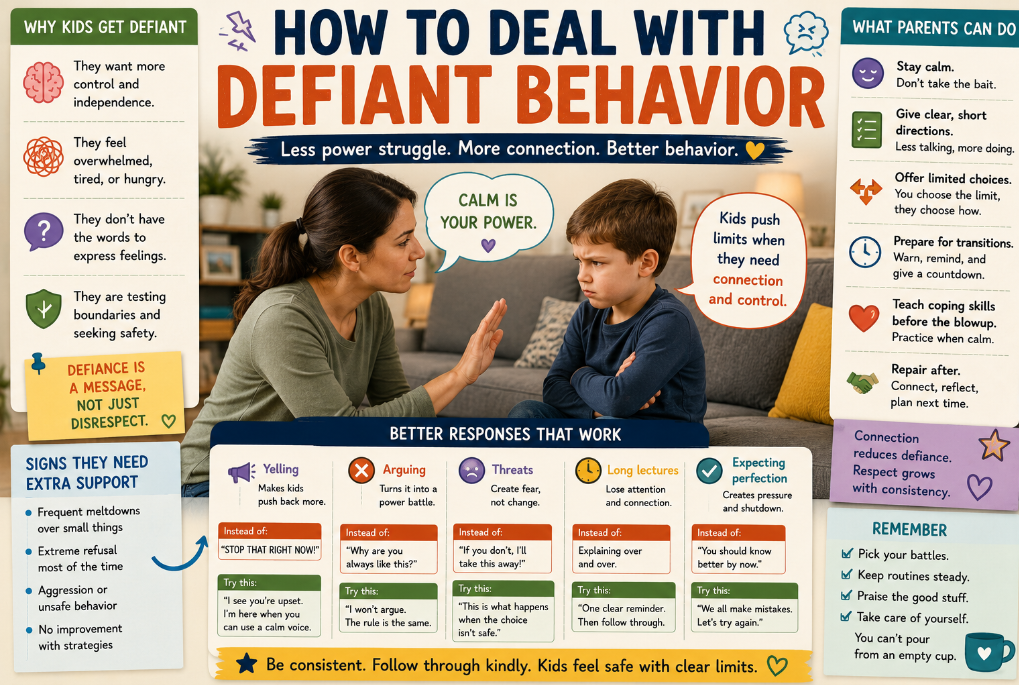
How to Deal With Defiant Behavior
You say, “Please put your shoes on,” and your child somehow hears it as the opening line of a courtroom drama. Five minutes later, you are both dug in, nobody is wearing shoes, and the whole morning feels hijacked by one hard no.
Defiant behavior is exhausting because it rarely shows up as one big dramatic moment. More often, it looks like arguing over getting dressed, refusing to turn off the TV, shouting “You can’t make me,” or doing the exact opposite of what you just asked.
The hard part is that defiance often pulls adults into reacting bigger and faster than they wanted to. You raise your voice because you are late. Your child pushes harder because they feel controlled. The good news is that defiant behavior usually becomes more manageable when parents stop treating every moment like a test of authority and start looking at what the child is trying to communicate through the pushback.
Why This Happens
Defiance is not always about disrespect. Sometimes it is a child’s clumsy way of saying, “I want more control,” “I am overwhelmed,” “I do not like being interrupted,” or “I cannot shift gears as fast as you want me to.” Kids often show those feelings through arguing, refusing, stalling, or escalating because they do not yet have the maturity to say it more clearly.
Some children are also more strong-willed by temperament. They notice fairness fast, react strongly to being directed, and push back harder when they feel cornered. That can be frustrating, but it is not automatically a bad trait. The same child who argues about putting on socks may grow into a teenager who thinks independently and is harder for peer pressure to push around. The goal is not to crush that spirit. It is to teach the child how to handle frustration, limits, and disappointment without turning every moment into a battle.
Defiance also tends to spike when basic needs are off. A hungry child, a tired child, or a child who has been rushed all day is much less likely to respond well to even reasonable instructions. If your child argues most during transitions, mornings, homework, or bedtime, that usually tells you where the support needs to change. If you need a starting point for everyday structure, the power of routine can help make expectations feel less personal and more predictable.
What Parents Can Do
Stay calm enough to avoid feeding the fire
When a child gets defiant, the fastest way to make it worse is to match their intensity. That does not mean being passive. It means sounding steady instead of offended. Try saying, “You do not have to like this, but it is still time to leave,” or “I hear that you are mad. The limit is the same.” A calm tone tells your child you are not entering a debate tournament. If you are working on a broader approach, positive discipline offers a useful frame for holding limits without piling on shame.
Give clear directions instead of long speeches
Many defiant moments get worse because the adult keeps talking after the child has already said no. Long explanations can sound like negotiation openings. Short instructions work better: “Backpack on the hook,” “Teeth first, then story,” or “Screens off at 7:00.” If your child often argues with vague requests, being more concrete helps. So does making expectations clear ahead of time. Setting clear boundaries and expectations reduces the number of moments where kids can honestly say, “I did not know.”
Offer limited choices that still protect the limit
Kids who push back hard often do better when they can choose how to do something instead of whether it happens at all. “Do you want to brush teeth before pajamas or after?” works better than “Go brush your teeth right now,” if your child hears every instruction as a threat to independence. The key is to offer real choices inside a firm boundary. Too many choices can overwhelm a child; two is usually enough.
Watch for transition trouble
A lot of “defiance” is really rough transitioning. A child who explodes when playtime ends may not be plotting against you. They may need more warning, more help shifting, or a more consistent sequence. You can say, “Five more minutes, then cleanup,” followed by, “Two more minutes,” then, “It is cleanup time. Do you want to put away blocks or books first?” Children who struggle here often benefit from visual supports and predictable timing.
Teach regulation outside the hard moment
Trying to teach coping skills during a full argument is like teaching swimming in the middle of a storm. Practice calmer skills when everybody is fine. That might mean role-playing how to disagree respectfully, teaching a child to ask for help before yelling, or helping them notice body clues like clenched fists or a hot face. If your child tends to go from zero to sixty, teaching self-regulation gives you more to work with than repeating “calm down” ever will.
Repair after the blowup
Once things settle, come back to the moment without turning it into a lecture marathon. You can say, “You were really mad when it was time to leave. Next time you can say, ‘I need one minute,’ but yelling at me is not okay.” This helps your child connect the limit, the feeling, and the better replacement behavior. Kids learn more from a short repair conversation than from twenty minutes of heat.
Communication matters throughout all of this. A child who feels heard is not guaranteed to cooperate, but they are often less likely to escalate. If that is an area you want to strengthen, effective communication with kids can help you lower the volume without losing authority.
Common Mistakes to Avoid
Turning it into a win-or-lose contest. When parents get hooked by the attitude, they can start responding to the tone more than the behavior. Then the goal quietly shifts from solving the problem to proving who is in charge.
Giving consequences you cannot or will not enforce. Big threats like “No tablet for a month” often backfire because they are hard to carry out consistently. Smaller, immediate, realistic consequences work better.
Arguing in circles. Some children will debate for as long as you stay at the table. You do not have to answer every protest. State the limit, offer the next step, and stop reopening the conversation.
Expecting self-control your child has not built yet. A child may know the rule and still fall apart when frustrated. That does not mean you drop the rule. It means you keep teaching the missing skill along with the limit.
Only noticing the hard moments. Strong-willed kids hear correction constantly. Catching cooperation when it happens builds more progress than waiting for another explosion. A simple “You got in the car the first time I asked. That helped a lot,” goes further than generic praise.
Simple Plan to Try This Week
If defiant behavior has become part of the daily rhythm, do not try to fix everything at once. Pick one routine that blows up often and work on that first.
- Choose one repeat problem, such as shoes, bedtime, homework, or turning off screens.
- Write down the exact limit in one short sentence so every adult says it the same way.
- Add one support before the problem starts, such as a warning, a timer, or a simple choice.
- When your child pushes back, use one calm script: “You do not have to like it. It is still time.”
- Follow through with one realistic consequence or next step, without adding extra arguing.
- Notice one moment of cooperation each day and say it out loud right away.
- After three to five days, look for patterns. Is the problem really about the rule, or is it about transition, fatigue, hunger, or feeling rushed?
This plan works because it lowers the chaos around the behavior. You are making the moment simpler, more predictable, and less rewarding to fight about. Parents often see the biggest change when they stop chasing perfect obedience and start building steadier routines and clearer follow-through.
Helpful Tools
You do not need special products to handle defiant behavior, but a couple of simple tools can make everyday routines feel less personal and more visual.
- Visual Schedule for Kids can help when your child argues through predictable parts of the day like getting ready, cleanup, or bedtime. Seeing the steps often reduces repeated verbal reminders.
- Time Timer Original can be useful for transitions because kids can see time passing instead of hearing “two more minutes” over and over.
FAQ
Is defiant behavior normal?
Some pushback is very normal, especially in preschoolers and school-age kids who are testing independence. What matters is the pattern, intensity, and whether it is disrupting daily life in a major way.
Should I punish defiance right away every time?
Not always. First look at what the behavior is attached to. If your child is escalating during a transition, a clearer routine or calmer follow-through may help more than a harsh punishment. Consequences still matter, but they work best when they are predictable and connected to the situation.
What if my child says rude things when upset?
You can stay firm without making the moment bigger. Try, “You are angry, and I will talk when your words are respectful.” Then return to the issue once things cool down. Later, teach what to say instead.
When should I worry that it is more than a phase?
If defiance is intense across many settings, keeps getting worse, or comes with aggression, severe school problems, or family stress that feels unmanageable, it is worth talking with your pediatrician, your child’s teacher, or a licensed child therapist for more guidance.
What if I already feel stuck in a power struggle pattern?
That is common. Start small. Pick one routine, use fewer words, hold one clear limit, and focus on staying calm enough to follow through. You do not have to reset your whole household in one day.
Defiant behavior can make good parents feel like they are failing, especially when every ordinary request seems to turn into an argument. But pushback is not proof that your child is impossible or that you are doing everything wrong. Often it means your child needs firmer structure, clearer limits, and less emotional fuel around the conflict. Start with one repeat battle, simplify your response, and stay consistent long enough to let the new pattern take hold. If you want another practical next step, clear boundaries and expectations are one of the best places to begin.