
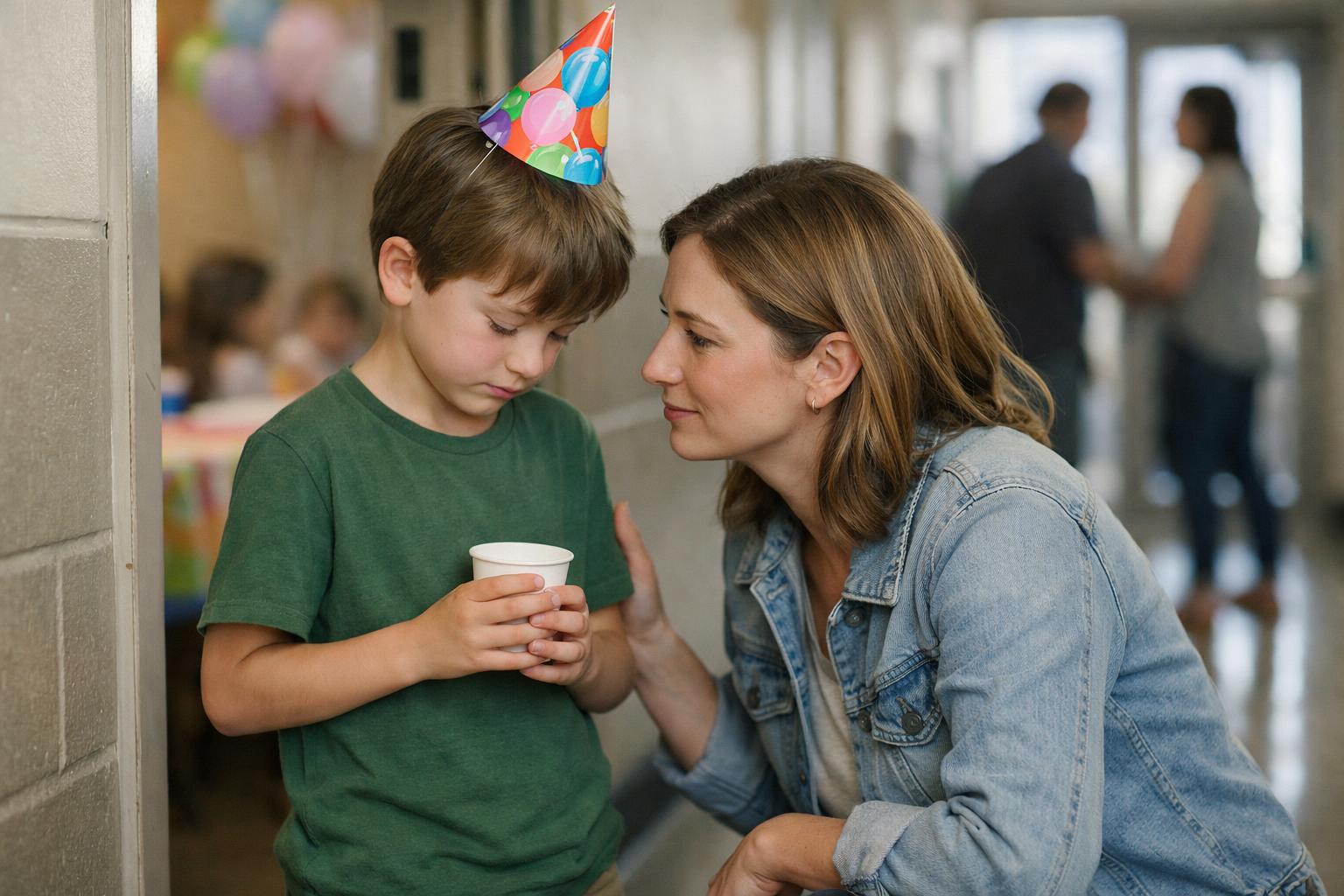
Your child knocks over a drink at a birthday party, says something blunt in front of other adults, or freezes when a coach calls on them, and suddenly every eye in the room feels like it is on both of you. Public embarrassment can make kids shut down fast. It can also make parents react faster and louder than they meant to, mostly because being watched turns a small parenting moment into a very public one.
Most children feel embarrassed more often than adults realize. They may not always call it that. Sometimes it looks like hiding behind your leg, getting silly and loud, refusing to talk, snapping back, or insisting they want to go home right now.
The hard part for parents is that embarrassment often triggers two nervous systems at once. Your child feels exposed, and you feel pressure to fix the moment immediately. The good news is that children can learn how to recover from embarrassing moments, and parents can help without making the situation heavier than it already feels.
Why This Happens
Embarrassment is part self-awareness and part social awareness. As children grow, they get better at noticing what other people might be thinking. That is a normal developmental step, but it can feel rough in real life. A younger child may say exactly what is on their mind without blinking. A slightly older child may suddenly replay the same moment all afternoon because now they understand that other people heard it too.
Kids are also more likely to feel embarrassed when they are already stretched thin. Tired children, anxious children, highly sensitive children, and perfectionistic children often take small public mistakes especially hard. A child who is coping fine at home might unravel in front of peers because there is more social risk in the room.
Embarrassment can also overlap with fear, stress, and shaky communication skills. A child who blurts out something awkward in front of classmates may feel terrible about the reaction and then have no idea how to repair it. That is why related support skills matter. If your child struggles to find the right words after a hard social moment, effective communication with kids is a useful companion skill to build at home.
For some children, public embarrassment is not even about doing something wrong. It can happen when they are asked to perform, answer in front of a group, or walk into a social setting where they feel unsure. In those moments, embarrassment and fear often travel together.
What Parents Can Do
Regulate yourself before you correct or comfort
When your child has an embarrassing moment in public, your first job is not to deliver a perfect lesson. It is to keep your own reaction from turning the moment into a spotlight. If your face tightens, your voice gets sharp, or you start overexplaining to bystanders, your child usually feels even more exposed.
Try one steadying move first: exhale, lower your shoulders, move closer, and speak quietly. A calm parent helps signal, “This is manageable. We can get through this.” That alone reduces the emotional heat.
Protect your child’s dignity
Most kids can handle correction better than they can handle correction plus an audience. If the issue needs to be addressed, do it privately when possible. That may mean stepping a few feet away, kneeling beside them, or waiting until you are back in the car. Public shaming rarely teaches the lesson parents hope it will teach. It mostly adds a second wound on top of the first one.
You can still be clear. “We’ll talk about that in a minute.” “Let’s step over here.” “I’m with you.” Those short phrases buy time while protecting your child from feeling put on display.
Name what happened without dramatizing it
Children recover faster when the adult response is grounded and specific. Instead of, “Why would you do that?” or “That was so embarrassing,” try language that keeps the moment in proportion: “You spilled the juice. We can clean it up.” “That comment landed awkwardly. We’ll fix it.” “You got nervous when everyone looked at you.”
That kind of language helps kids separate the event from their identity. The message becomes, “Something awkward happened,” not, “You are the awkward problem.”
Teach a simple repair move
Embarrassing moments feel less scary when children know what to do next. Give them one or two small repair scripts they can actually remember. For example:
- “Oops, sorry about that.”
- “Can I try again?”
- “I didn’t mean it that way.”
- “Do you have a napkin?”
Kids do not need a speech. They need a bridge to the next moment. A simple repair script teaches that embarrassment is survivable and that mistakes can be followed by action, not panic.
Help them leave the moment when needed
Some children recover best by staying put. Others need a quick exit to reset. If your child is shutting down, tearing up, or becoming more reactive, it may help to step outside, walk to the car for two minutes, or take a quiet lap around the hallway. That is not “giving in.” It is helping an overwhelmed child get enough regulation back to function.
If public attention itself is the main trigger, this can overlap with fear responses. In that case, helping kids overcome fear can be useful because it covers how to support a child without pushing too hard or pulling back too fast.
Talk later, not in the emotional peak
After the moment has passed, circle back calmly. Ask what felt hardest. Was it making the mistake, having people look, not knowing what to say, or worrying others would laugh? Kids often need help sorting out what exactly embarrassed them.
You do not need a giant debrief. Ask: “What part felt big?” “What would help next time?” “Do you want a plan for that kind of moment?” The goal is to turn the experience into practice, not a lecture.
Normalize embarrassment as part of being human
Children can feel deeply alone in public embarrassment, especially if they believe everyone else handles social situations perfectly. It helps to tell the truth in a low-key way: everybody says the wrong thing sometimes, trips, spills, forgets, answers wrong, waves at the wrong person, or feels awkward in a room full of people.
This matters even more if your child struggles with reading the room, joining groups, or recovering after peer reactions. In that case, building social skills may help you support the social side of the experience too.
Common Mistakes to Avoid
One common mistake is rushing to control the optics instead of helping the child. When parents feel watched, they sometimes overcorrect in order to look like they are handling it. Unfortunately, kids usually experience that as betrayal, not leadership.
Another mistake is minimizing too hard. “It’s not a big deal” may be true from your perspective, but it can make a child feel misunderstood if their whole body is still buzzing. It is better to say, “It felt big to you, and it will pass.”
Parents also get tripped up by too much post-event analysis. If your child already feels ashamed, a long replay of the scene can make them feel trapped in it. Keep the follow-up brief and practical.
Finally, avoid making public embarrassment proof that your child is fragile, rude, dramatic, or “just too sensitive.” Children do better when adults respond to the moment in front of them instead of turning it into a label. If your child is carrying stress from other areas too, helping kids through family stress can help because overloaded kids often have less room to bounce back in social settings.
Simple Plan to Try This Week
If public embarrassment has become a pattern, you do not need a huge overhaul. Try this simple plan:
1. Pick one situation
Choose the setting where this happens most: school pickup, sports, family gatherings, stores, parties, or performances. One setting is enough to start.
2. Create one calm parent script
Decide now what you will say when the moment happens. Something like, “I’m with you. Let’s handle it,” or, “We can fix this,” works well because it is short and steady.
3. Practice one repair phrase with your child
Role-play the exact words they can use after a spill, awkward comment, or mistake. The simpler the better.
4. Plan one reset option
Decide whether your child does best with a quiet corner, a quick walk, a sip of water, or stepping outside for a minute. Having a reset plan helps you respond faster without scrambling.
5. Praise recovery, not perfection
At the end of the week, notice how your child came back from a hard moment. Maybe they used the repair phrase. Maybe they stayed in the room instead of leaving. Maybe they cried, then regrouped. Recovery is the real skill.
Helpful Tools
Most embarrassing moments do not need a product, but a couple of optional tools can help children practice emotional recovery and communication at home.
- How to Talk So Kids Will Listen can give parents practical language for handling awkward moments without turning them into power struggles.
- Feelings and Emotions Cards can help children who struggle to explain whether they felt embarrassed, nervous, ashamed, or frustrated after something public happens.
FAQ
Is public embarrassment normal for kids?
Yes. As children become more socially aware, embarrassment becomes more common. It is a normal part of growing, especially in school-age years.
Should I correct my child right away in public?
If safety is not involved, it is often better to protect dignity first and talk privately once your child is calmer. Public correction usually makes embarrassment worse.
What if my child cries every time people notice a mistake?
Stay calm, help them reset, and teach one simple repair step. Over time, repeated calm recovery helps many children feel less overwhelmed by public attention.
How do I know if it is embarrassment or anxiety?
The two can overlap. If your child consistently dreads social situations, avoids participation, or shows strong fear before events even begin, there may be an anxiety piece involved too.
What should I say after the moment is over?
Keep it simple: name what happened, ask what felt hardest, and make a small plan for next time. You do not need a big talk to make the lesson stick.
Public embarrassment feels huge when you are small and everybody seems to be looking. What helps most is not a perfect parent performance. It is a steady adult who can shrink the moment back down to human size. And if your child is especially sensitive to peer reactions, this guide on how to respond to bullying concerns may help you tell the difference between ordinary embarrassment and something more persistent happening around other kids.