
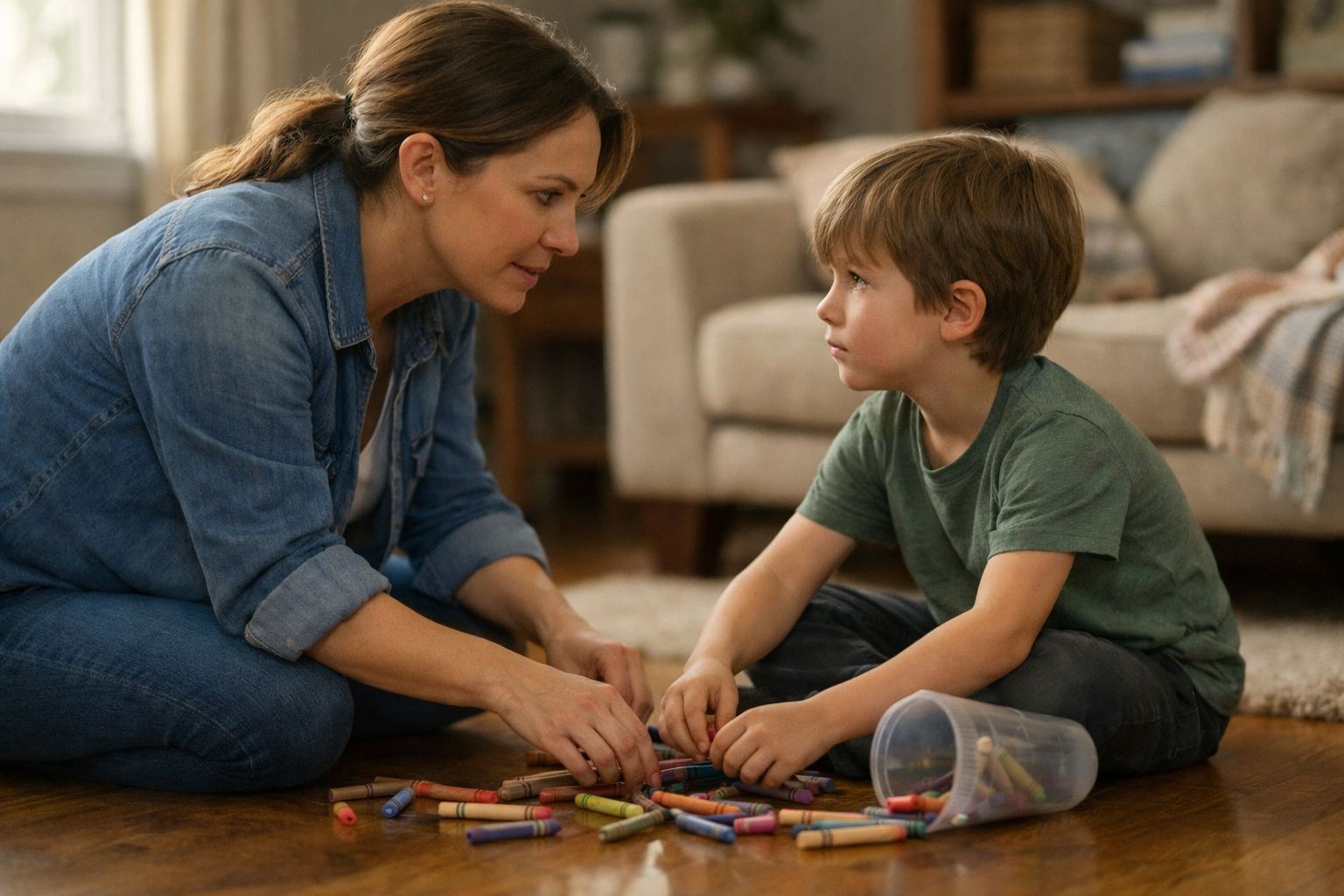
It usually happens fast. Your child snatches a toy, talks back, or knocks something over after you already asked three times for calm hands. You feel that hot urge to say something sharp so the message really lands. But a minute later, the behavior has stopped and your child looks crumpled, defensive, or angry instead of ready to do better.
Most parents do not want to correct behavior by making a child feel small. The hard part is knowing what to do instead when you are tired, embarrassed, or trying to stop a problem in the moment. The goal is not to ignore bad behavior or make excuses for it. The goal is to teach without attaching the lesson to your child’s worth.
That matters because shame sounds like, “What is wrong with you?” or “You are being bad again.” Correction sounds more like, “That choice is not okay. Let’s fix it.” One attacks the child. The other addresses the behavior.
If you are already working on staying steady during discipline, this guide on how to discipline without yelling can help. The same idea applies here: calm correction usually teaches more than harsh intensity.
Why This Happens
Children are still learning how to handle frustration, impulses, disappointment, and attention-seeking. That does not make hurtful or disruptive behavior okay, but it does explain why it shows up so often in everyday family life.
A preschooler may hit because words are not coming fast enough. A school-age child may lie because they want to avoid trouble. A tired child may become rude over something tiny because their self-control is already running low.
In those moments, parents often reach for shame without meaning to. Shame can sneak in when we are trying to create urgency. We want our child to understand that the behavior matters, so we raise our voice, lecture too long, or use labels that sting.
The problem is that shame does not just say, “I made a bad choice.” It makes children feel, “I am bad.” That feeling can trigger more defensiveness, hiding, blaming, or shutting down. Instead of learning, many kids move straight into self-protection.
That is one reason punishment alone rarely works. Fear or embarrassment might stop a behavior briefly, but it does not always build the skills a child needs for next time.
Kids also borrow their inner voice from the adults around them. If correction regularly sounds humiliating, they may start talking to themselves the same way. If correction is firm but respectful, they learn that mistakes can be faced, repaired, and grown from.
What Parents Can Do
1. Separate the child from the behavior
This is the heart of shame-free correction. Instead of labeling your child, name the action.
Try:
- “Hitting is not okay.”
- “Talking to me that way is disrespectful.”
- “You made a poor choice with the marker.”
Avoid:
- “You are so mean.”
- “Why are you always like this?”
- “You are acting like a baby.”
The message stays clear, but your child is not boxed into an identity. This also leaves room for repair: bad choice, better next choice.
2. Get short before you get smart
Many kids stop listening once they feel flooded. A long lecture in the heat of the moment usually creates more noise, not more learning.
Use a short correction first:
- “Stop. I won’t let you hit.”
- “Try that again respectfully.”
- “We need to clean this up before we keep playing.”
You can talk more once everyone is regulated. In the moment, clarity matters more than a perfect speech.
3. Stay firm without sounding cruel
Some parents worry that if they sound gentle, the child will think the behavior was fine. But calm and weak are not the same thing.
You can be warm and still hold the line:
- “I love you. I’m still not letting you throw that.”
- “You’re upset, and you still need to speak respectfully.”
- “I’m here to help, but I won’t let you hurt your brother.”
This teaches children that limits do not disappear when feelings get big.
4. Focus on repair, not embarrassment
When possible, give your child a way to make things right. Repair builds responsibility. Shame just leaves a bruise.
Repair might look like:
- Helping pick up what was thrown
- Checking on a sibling who got hurt
- Trying the sentence again in a respectful voice
- Writing or saying a real apology
This fits well with natural consequences that actually work. The correction connects to the behavior instead of turning into a power struggle.
5. Save the teaching for after the storm
If your child is crying, yelling, or glaring at you, it may not be the best time for a life lesson. Wait until things are calmer, then revisit it briefly.
You might say:
- “You were really mad when your turn ended. What can you do next time instead of grabbing?”
- “You looked worried about getting in trouble, so you said something that wasn’t true. Let’s talk about how to tell the truth even when it feels hard.”
Those follow-up conversations help children build the missing skill, whether that is honesty, frustration tolerance, or respectful communication.
6. Teach replacement skills on calm days
Children do better when they know what to do, not just what to stop doing. If a child often melts down, interrupts, or gets physical, practice alternatives outside the hard moment.
Examples:
- “Say, ‘I’m not done yet.’”
- “Put your hands on your knees when you want to grab.”
- “Ask for help before you get too upset.”
If your child struggles with big impulses, working on teaching self-regulation can make everyday correction much more effective.
Common Mistakes to Avoid
Using humiliation as a shortcut
Comments like “Everyone is looking at you” or “You should be ashamed of yourself” may stop a child in the moment, but they often create panic more than understanding.
Correcting in front of an audience when you do not have to
Sometimes public correction is unavoidable, but if you can step aside, do it. Many children get more defensive when siblings, classmates, or other adults are watching.
Bringing up old mistakes
“Here we go again” makes kids feel like they cannot recover. Stay with the current issue instead of stacking every past frustration on top of it.
Confusing guilt with shame
Healthy guilt says, “I did something wrong, and I should fix it.” Toxic shame says, “I am the problem.” Your correction should point toward responsibility, not worthlessness.
Expecting instant change
Even good discipline needs repetition. A child can understand the rule and still need practice following it. Progress often looks uneven before it looks steady.
Simple Plan to Try This Week
If you want a realistic reset, do not try to overhaul everything at once. Pick one behavior that creates frequent conflict, like yelling at siblings, rude replies, or throwing things when frustrated.
Day 1: Choose your replacement phrases
Write down two or three short lines you want to use every time. For example:
- “I won’t let you hit.”
- “Try that again respectfully.”
- “Let’s fix this.”
Day 2: Decide on one repair step
Think ahead about what repair should look like for that behavior. If the problem is rude talk, the repair might be repeating the request respectfully. If the problem is making a mess in anger, the repair is helping clean it up.
Day 3: Practice when things are calm
Role-play for two minutes. “If you’re mad your brother took the game piece, what can you say instead of yelling?” Kids usually learn faster when they rehearse before the real moment arrives.
Day 4: Correct briefly and consistently
When the behavior happens, use your chosen phrase. Keep it short. Move to the repair step. Skip the long lecture if your child is already upset.
Day 5: Notice recovery
Pay attention to any small improvement. Maybe the behavior still happened, but your child calmed down faster or apologized with less prompting. That counts.
Day 6: Debrief once
Later, talk for a few minutes: “What helped? What was hard? What should we keep practicing?” Short, honest conversations work better than speeches.
Day 7: Keep the standard, drop the shame
Remind yourself that the goal is not perfect behavior in one week. The goal is a pattern of correction that teaches your child what to do, protects the relationship, and still holds the line.
FAQ
Is shame-free discipline too soft?
No. Shame-free discipline still includes clear limits, consequences, and accountability. It simply avoids attacking the child’s character while correcting the behavior.
What if my child does not seem to care unless I get harsh?
Harshness can create a quick reaction, but it does not always create lasting learning. Consistent limits, calm follow-through, and repair often work better over time, even if they feel less dramatic in the moment.
Should children apologize every time?
An apology can be helpful if it is genuine and paired with repair. But a forced “sorry” with no understanding usually does not teach much. Focus on making things right, not just saying the word.
What if I already used shame and regret it?
You can repair too. Say something like, “I was right to stop that behavior, but I was wrong to speak to you that way.” That models accountability and shows your child that respect goes both directions.
How do I correct bad behavior in public without making a scene?
Use a low voice, short phrases, and move your child aside if possible. Focus on immediate safety and clear limits, then save the longer conversation for later at home.
Conclusion
Children need correction. They also need to believe that a bad moment does not define them. When parents stay firm without using shame, kids are more likely to tell the truth, recover from mistakes, and keep learning instead of hiding.
You do not have to be perfectly calm every time. You just need a pattern your child can trust: the behavior will be addressed, the relationship will stay intact, and there will always be a path back. If daily conflicts tend to turn into control battles, this article on how to stop daily power struggles is a useful next read.