
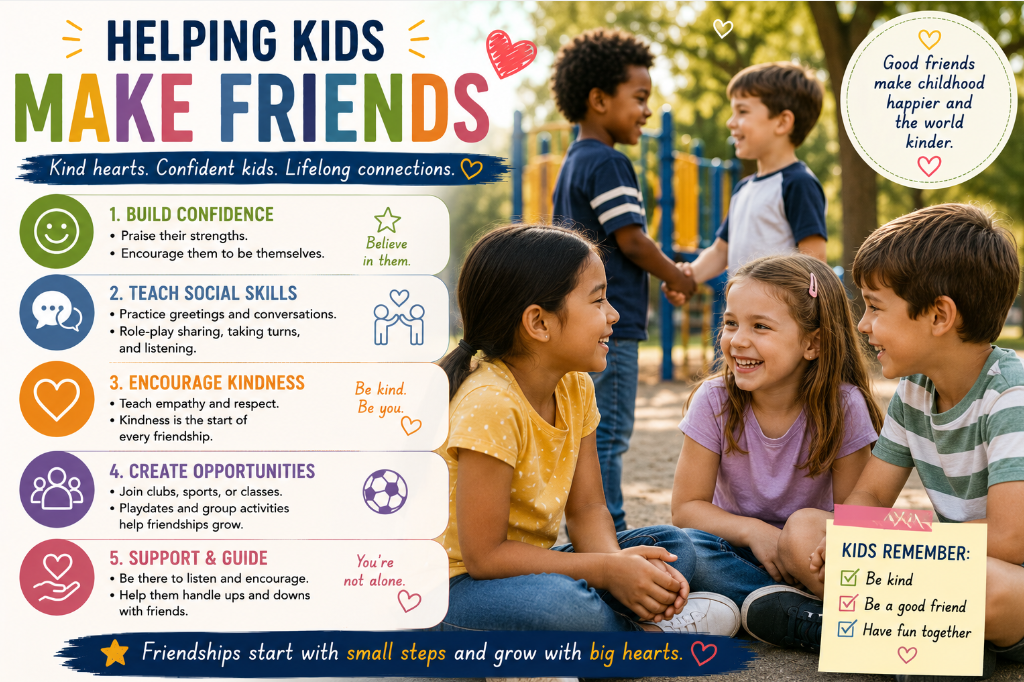
Some kids seem to collect friends without trying. Others hang back at the edge of the playground, want connection badly, and still do not know how to step in. That gap can be painful for children and stressful for parents, especially when you can see your child wants friendship but keeps getting stuck.
The good news is that friendship skills are not something children either magically have or do not have. They are built over time through practice, confidence, emotional awareness, and plenty of small coached moments. If your child struggles to join a game, read social cues, recover after awkward moments, or keep a friendship going, you are not powerless. You can help without forcing, shaming, or turning every playdate into a performance review.
This guide pulls together the big picture: what actually helps kids make friends, what gets in the way, and how parents can support the process in real life.
Why making friends can be hard for kids
Friendship looks simple from the outside, but it asks a lot from children. They need to notice what other kids are doing, read tone and facial expressions, manage their own feelings, start conversations, handle rejection, take turns, and bounce back when things feel awkward. That is a long list.
Some children are naturally more outgoing. Some need time to warm up. Some are still learning how to manage frustration or anxiety in social settings. Some do well one on one but freeze in groups. Others come on too strong because they are excited and not yet skilled at pacing a conversation.
If your child is struggling, it does not mean something is wrong with them. It usually means they need support with the building blocks of connection. A strong place to start is helping them practice the basics in everyday life. The article on building social skills through simple activities and daily practice covers games and routines that make those basics feel more natural.
Start with connection at home
Children learn friendship first in close relationships. Home is where they practice being listened to, waiting for a turn, repairing after conflict, and noticing how their actions affect other people. If family conversations are rushed, correction-heavy, or mostly logistical, children may need more support learning what warm back-and-forth communication feels like.
You do not need to create a perfect home atmosphere. You just need enough steady moments where your child feels seen and heard. That can look like listening without jumping in too fast, reflecting what they are trying to say, and showing curiosity about their social world.
If you want practical ways to strengthen this foundation, effective communication with kids is a useful companion piece. It focuses on active listening, respectful language, and everyday habits that help children feel safer opening up.
Teach the small social moves that lead to friendship
Adults often say, “Go make a friend,” as if children already know what that means. But friendship usually starts with a handful of specific moves:
- saying hello
- watching before joining
- asking, “Can I play too?”
- making one comment about a shared interest
- taking turns in conversation
- handling a no without falling apart
These are learnable skills. Role-play helps. So does practicing scripts before a party, class, camp day, or playground visit. Keep it light. You are not training your child to sound polished. You are helping them feel less blank when a social opening appears.
Useful starter lines include:
- “Can I join this game?”
- “What are you building?”
- “I like your shirt. Do you like that show too?”
- “Want to sit with me?”
Children also need help noticing when to pause, when to listen, and when another child wants space. Those patterns are part of the broader work in building social skills, especially around cooperation, turn-taking, and conversation.
Confidence matters, but confidence grows from competence
Parents sometimes tell children, “Just be confident,” but confidence is not a switch. It grows when children have repeated experiences of doing something hard, surviving discomfort, and seeing that they can handle it. In friendship, that may mean asking one question, joining one game for five minutes, or inviting one child over instead of trying to master every social situation at once.
It helps to give children responsibilities in daily life too. Small responsibilities build a sense of capability, and that confidence often spills into social settings. When a child feels useful and trusted at home, they usually carry a little more steadiness into peer relationships. Building confidence through age-appropriate responsibilities explains how everyday tasks can strengthen independence without overwhelming kids.
Try praising brave effort instead of social success. For example:
- “You said hi even though you felt nervous.”
- “You stayed with the group a little longer today.”
- “You kept trying after that awkward moment.”
That kind of feedback teaches children that progress counts, not just instant popularity.
Help kids understand feelings, not just behavior
Friendship problems are rarely just about behavior. A child who interrupts may be excited or anxious. A child who clings to one friend may be afraid of being left out. A child who gets bossy during play may feel insecure and try to control the situation. If we only correct the behavior, we miss the reason underneath it.
This is where emotional awareness becomes powerful. Children who can name their feelings and notice other people’s feelings have a much easier time repairing conflict, showing empathy, and staying flexible during play. The article on introducing emotional intelligence goes deeper into helping kids recognize, express, and manage feelings in age-appropriate ways.
You can build this skill by asking simple questions after social moments:
- “How did you feel when they said yes?”
- “What do you think your friend felt when the game changed?”
- “What could you do next time if you start feeling left out?”
The goal is not to overanalyze every interaction. It is to help your child connect emotions with choices.
When shyness or anxiety is part of the picture
Some children are not just inexperienced socially. They feel genuinely overwhelmed. New groups, noisy rooms, unfamiliar adults, and fear of embarrassment can shut them down fast. In those cases, pushing harder often backfires. Children may need gradual exposure, rehearsal, and a calmer pace.
If your child hangs back, avoids eye contact, complains of stomachaches before social events, or seems desperate to go but unable to step in, read supporting kids through social anxiety and shyness. It offers a practical framework for helping without adding pressure.
A few rules matter here:
- Do not label your child in front of them as “the shy one.”
- Do not force public performances to prove they are okay.
- Do not answer every social question for them if they can try first.
- Do stay nearby when they need a safe base.
- Do prepare them ahead of time for what to expect.
If anxiety is persistent or interfering with school, sleep, family life, or daily functioning, it is worth talking with a pediatrician or qualified mental health professional.
Choose the right social settings
Not every child thrives in the same kind of environment. A loud birthday party may be too much, while a one-on-one playdate goes beautifully. A child who struggles with unstructured recess may do better in a club, art class, robotics group, library activity, or team with a very clear routine.
Think about where your child is most likely to succeed, not where you wish they would succeed first. Good friendship conditions often include:
- shared interests
- predictable structure
- smaller group size
- repeat exposure to the same kids
- adult support that is present but not intrusive
Repeated contact matters more than one big social opportunity. Seeing the same children weekly gives friendships time to form.
Coach playdates without running them
Playdates can be helpful, but they work best when the setup matches your child’s current skill level. If your child is still learning, start short. Choose one child rather than a crowd. Plan one or two simple shared activities instead of expecting the kids to invent a perfect afternoon.
Before the playdate, review a few basics: greeting, offering choices, taking turns, and what to do if there is a disagreement. During the playdate, stay in the background as much as possible. Step in when needed, but do not narrate every moment or solve every tiny problem.
Afterward, keep the debrief gentle:
- What felt easy?
- What felt hard?
- Was there a moment you felt proud of?
- Is there anything you want to try differently next time?
Children learn more from a calm reflection than from a long critique in the car.
Teach repair, because friendship always includes bumps
Making friends is one skill. Keeping them is another. Even close friends annoy each other, misread each other, and hurt each other’s feelings sometimes. Children need repair skills just as much as they need conversation starters.
Teach your child how to:
- notice when someone looks upset
- pause instead of doubling down
- say, “I didn’t like that” or “I’m sorry” clearly
- offer one simple fix
- accept that not every conflict resolves instantly
This is one reason emotional awareness and communication matter so much. Friendship is not about never getting it wrong. It is about learning how to come back from normal social friction.
A practical plan parents can use this week
If you want a simple starting point, try this plan for the next two weeks:
1. Pick one social goal
Keep it small and specific. Examples: say hello to one child at camp, ask one question during a playdate, or stay at the playground for ten extra minutes.
2. Practice at home
Role-play short scenarios. Keep it playful. Two minutes is enough.
3. Prepare before the moment
On the way to school, camp, or an activity, remind your child of one thing they can try instead of giving a long pep talk.
4. Stay calm afterward
If it goes badly, do not treat it like proof your child is failing. Treat it like information.
5. Notice effort
Point out the brave or skillful part, even if the outcome was mixed.
This kind of steady coaching works better than occasional pressure followed by discouragement.
Common mistakes that make friendship harder
- Talking about your child’s struggles in front of them. Kids hear more than adults think, and labels can become identity.
- Forcing friendships. Encouragement helps. Pressure usually does not.
- Jumping in too fast. Rescue can prevent learning if it happens every time.
- Expecting instant chemistry. Many friendships build slowly.
- Treating every awkward moment like a crisis. Social missteps are normal practice, not permanent damage.
- Focusing only on popularity. One or two genuine connections matter more than being known by everyone.
What success really looks like
Success does not mean your child becomes the loudest kid in the room or suddenly loves every group setting. Real success is quieter than that. It looks like a child who knows how to enter a conversation a little more comfortably, recover after a weird moment, show interest in another person, and trust that friendship can be learned.
Some children make many friends. Some prefer a few close ones. Both can be healthy. Your job is not to manufacture a social personality. It is to help your child build the tools, confidence, and emotional safety that make connection possible.
When you approach friendship as a skill set instead of a popularity contest, things usually get calmer for everyone. Progress may be slow, but it is still progress, and those small social wins add up.
Conclusion
Helping kids make friends is really about helping them feel steady enough to connect: steady in their emotions, steady in conversation, and steady in the face of normal social discomfort. Start small, stay patient, and focus on practice over perfection. If your child needs extra support, there is no shame in reaching out to a pediatrician, school counselor, or child therapist for guidance. Sometimes a little outside help makes the path much easier.
If this helped, read these next:
- Simple social skills activities kids can practice at home
- How to support shy or socially anxious kids without pressure
- Ways to help kids understand feelings and build empathy
Explore more parenting advice here: