
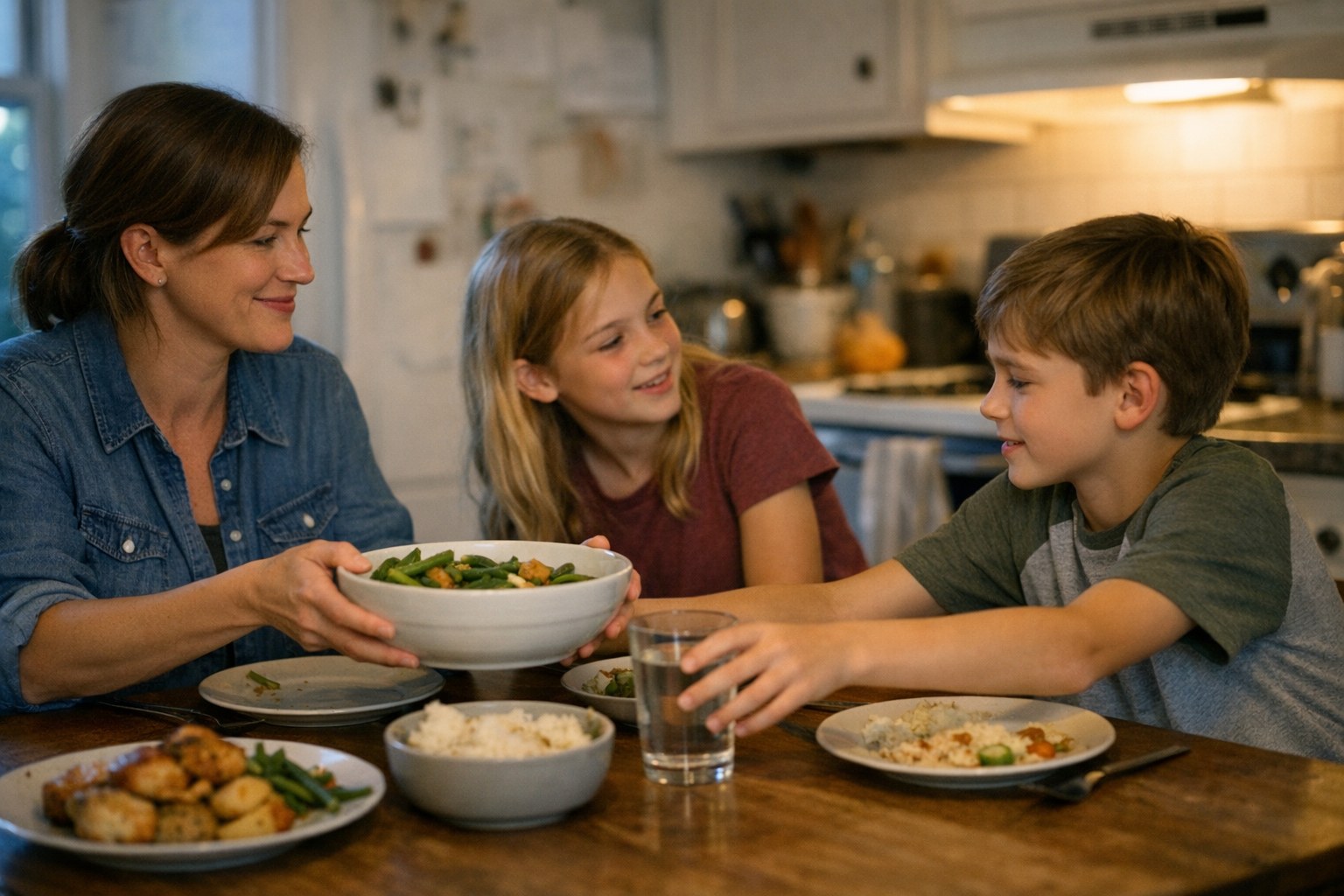
By 6:14 p.m., one child is asking for ketchup, another is sliding off the chair, and you are standing at the counter wondering whether this meal counts if half the family is already distracted. Family meals rarely look like the sweet, peaceful picture people post online. Most nights they look more like spilled water, reheated vegetables, and someone announcing they suddenly hate rice.
That messy reality is exactly why family meals matter. They are not valuable because they are perfect. They matter because they create small, repeatable moments where kids feel connected, seen, and grounded in the middle of ordinary life.
For many families, dinner is one of the only times everyone lands in the same place at the same time. It might last fifteen minutes. It might happen around a kitchen table, a coffee table, or takeout containers on a weeknight that got away from you. But when meals happen together often enough, kids get something bigger than food. They get rhythm, conversation, and a quiet sense that home is a place where people come back to each other.
If your family is trying to create more steadiness overall, articles on creating healthy daily routines and helping kids build healthy habits can support the same goal from a different angle.
Why This Happens
Kids tend to do better when life has predictable anchor points. Meals are one of those anchors. Even when the rest of the day feels rushed, a shared meal tells a child, “This is where we pause. This is where we check in. This is where we belong.”
That matters for a few simple reasons.
Meals slow the day down
Children move through a lot in a single day. School, daycare, activities, transitions, noise, screens, sibling friction, and a thousand little demands can leave them wound tight by evening. Sitting down to eat together creates a natural reset. It gives kids a chance to shift from “doing” into “being with people.”
This is one reason some children seem calmer when there is a steady dinner routine. They are not reacting to the broccoli. They are reacting to the predictability.
Conversation teaches more than we realize
Family meals give kids practice with listening, taking turns, telling stories, asking questions, and noticing how other people feel. A child who says, “Today Jackson wouldn’t share the markers,” is doing more than reporting school news. They are learning how to put their day into words.
Those little conversations also help parents catch things they might otherwise miss. A child who is quiet at bedtime may suddenly talk when their hands are busy with noodles. A teen who shrugs off “How was your day?” in the car might mention something important while passing the salad.
Eating together builds emotional safety
Kids do not need a perfect family atmosphere to feel secure. They need enough regular moments that tell them, “You have a place here.” Shared meals can do that. They remind children that even after rushed mornings, rough moods, and hard school days, the family reconnects.
That kind of steady reconnection can matter even more during stressful seasons. If your child has seemed edgy, clingy, or emotionally worn out lately, regular meals can become one of the few reliable pauses that helps the whole household settle.
What Parents Can Do
You do not need candlelight dinners or a seven-day meal plan to make family meals meaningful. What helps most is keeping them regular enough, simple enough, and calm enough that people can actually show up for them.
Pick consistency over ambition
If every family dinner depends on cooking a full meal from scratch, it may not happen often. A sandwich night, breakfast-for-dinner night, leftovers night, or rotisserie chicken night still counts.
What matters most is the repeatable habit: people gather, people eat, and people share a little space together.
You can even decide on a realistic baseline, such as:
- Three shared dinners a week
- Saturday breakfast together
- A simple after-school snack at the table before activities
Kids benefit from the rhythm, not from your menu being impressive.
Lower the pressure on conversation
Parents sometimes imagine a great family meal means everyone happily discussing their day. In real life, one child says “fine,” another is making fork noises, and someone is offended by peas.
Instead of asking big questions right away, try small ones:
- “What made you laugh today?”
- “What was the weirdest part of your day?”
- “Did anything feel easy today?”
- “Who did you sit with at lunch?”
Small questions are easier for kids to answer, and they often lead to better conversations than “Tell me everything.”
Use meals as a connection point, not a performance test
Some kids eat slowly. Some wiggle. Some talk nonstop. Some barely talk at all. Shared meals work best when the main goal is connection, not flawless table manners.
That does not mean there should be no expectations. It just means the expectations should be realistic. “Sit while we eat.” “Use a calm voice.” “Keep food on your own plate.” Those are clear, manageable goals.
If mealtimes often become battles about behavior, this guide on tips to make mealtimes easier can help reduce the friction.
Protect one simple ritual
Rituals make meals feel special without creating extra work. You might do one rose-and-thorn question, let each person share a high and low from the day, light a candle on Fridays, or have one person choose the music before everyone sits down.
These tiny rituals help meals feel like more than refueling. They make them recognizable in a child’s memory. Years later, kids often remember the repeating details more than the actual food.
Let kids help in small ways
Children are more invested in family meals when they have a role. That role does not have to be big. A preschooler can put napkins on the table. A school-age child can rinse fruit or carry forks. An older kid can choose between two vegetables or help assemble tacos.
Helping gives kids ownership. It also turns meals into a family activity instead of a service adults perform while everyone else waits.
Common Mistakes to Avoid
Expecting every meal to feel meaningful
Some dinners will be lovely. Some will be loud, short, and forgettable. That is normal. The value comes from the pattern over time, not from every meal becoming a magical bonding moment.
Using the table only for correction
If family meals become the place where kids mostly hear criticism — stop slouching, stop talking, eat faster, chew better, do not complain — they may start dreading the experience. Guidance is part of parenting, of course, but children also need warmth and easy conversation at the table.
Turning meals into a food power struggle
The more pressure parents put on bites, finishing, or “just try it,” the more tense mealtimes can become. Encourage exposure to different foods, but try not to make every meal a showdown. Calm, repeated opportunities usually work better than pressure.
If food battles are taking over your evenings, you might also like how to handle picky eating, which takes a gentler approach.
Assuming busy seasons mean giving up
There will be weeks when sports, work, appointments, or pure exhaustion make dinner feel impossible. That does not mean the habit is gone. It means you adapt. Maybe family meals look like bagels before school for a while. Maybe they happen at 5:15 p.m. instead of 7:00. Maybe they happen twice this week, not five times.
Flexible families usually keep routines longer than all-or-nothing families do.
Simple Plan to Try This Week
If family meals have been inconsistent or stressful, do not try to fix everything at once. Try a smaller reset.
Step 1: Choose your easiest shared meal
Pick the meal most likely to succeed this week. For some families that is dinner. For others it is Saturday pancakes or a 15-minute snack after school.
Step 2: Keep the food uncomplicated
Choose familiar food that does not create extra work. This is not the week to test a complicated recipe. Think pasta, tacos, eggs and toast, soup and sandwiches, or leftovers with fruit.
Step 3: Add one conversation prompt
Write down one easy question before the meal starts so you are not trying to invent one in the moment. Ask everyone the same thing. Keep it light.
Step 4: Aim for fifteen calm minutes
You do not need a long meal for it to count. Fifteen connected minutes is enough to build the habit.
Step 5: End before everyone is frayed
It is better to finish a decent meal while things are still going fairly well than to drag it out until everybody is cranky. End on a good enough note and build from there.
FAQ
1. Do family meals still matter if we cannot eat together every night?
Yes. A few regular shared meals each week can still be meaningful. Consistency matters more than perfection.
2. What if my child refuses to talk at the table?
That is okay. Not every child opens up verbally right away. Keep the tone relaxed, avoid pushing, and let them listen until they are ready to join in.
3. Do quick meals count, or does it need to be a full sit-down dinner?
Quick meals absolutely count. A simple breakfast, snack, or easy dinner can still give your family that same sense of connection.
4. What if siblings argue through the whole meal?
Keep expectations short and clear, and shorten the meal if needed. Sometimes younger kids do better with shorter mealtimes and one simple conversation focus instead of too much unstructured talking.
5. Are family meals mostly about nutrition?
Nutrition is part of it, but the bigger benefit is often the routine and connection. Shared meals support communication, predictability, and family belonging too.
Family meals do not have to be fancy to matter. They just have to happen often enough that your child starts to trust the pattern. A regular meal says, in a very ordinary way, “We come back together here.” And for kids, that kind of ordinary can be powerful.
If you want to build more connection into daily life beyond the table, a steadier morning routine can help the whole day feel less rushed and more connected too.