
One child announces they want to learn guitar, save money, and make the soccer team all before dinner, then forgets to put their shoes away ten minutes later. Kids often love big ideas, but they usually need help turning those ideas into steps they can actually follow.
Goal setting sounds like something for planners, whiteboards, and January resolutions, but it shows up in family life all the time. A child wants to finish a chapter book, make a team, remember homework, or stop melting down when a game gets hard. The problem is that many kids think in bursts. They picture the exciting finish line, not the slow middle where habits, patience, and frustration live.
That does not mean they are lazy or unmotivated. It usually means their brains are still learning how to plan ahead, manage time, and stay with something when progress feels boring. If you have already been working on routines that help kids focus better, you have seen this up close. Wanting something is easy. Doing the next small step over and over is the real skill.
The good news is that kids can learn it. They do not need a complicated productivity system. They need goals that make sense, support that feels doable, and a parent who treats the process like practice instead of a character test.
Why This Happens
Children are still building executive function skills. That is the set of brain skills that helps with planning, remembering steps, starting tasks, switching gears, and sticking with a challenge. Adults use these skills without thinking. Kids usually do not.
A seven-year-old may honestly want to read every night but still wander off after brushing teeth. A ten-year-old may swear they are going to keep their room clean and then feel overwhelmed once they see the full mess. A teenager may care deeply about grades and still leave studying until the last minute. The gap between intention and follow-through is normal.
Kids also tend to think in all-or-nothing ways. If they do not become “good at piano” quickly, they may decide the whole goal is pointless. That is why it helps to cultivate a growth mindset while teaching goals. The message is not “pick a target and prove yourself.” The message is “choose something worth working on, then learn how progress actually happens.”
Another piece is visibility. Adults can keep goals in their heads. Kids usually do better when the goal is concrete and visible: one practice chart on the fridge, one sentence on a sticky note, one check-in after dinner. Too much abstraction makes the goal disappear.
What Parents Can Do
Start with one goal, not a full self-improvement project
When kids get excited, they often want to fix everything at once. More reading, cleaner room, kinder sibling behavior, better soccer, less screen time. That sounds ambitious, but it is usually a fast track to discouragement.
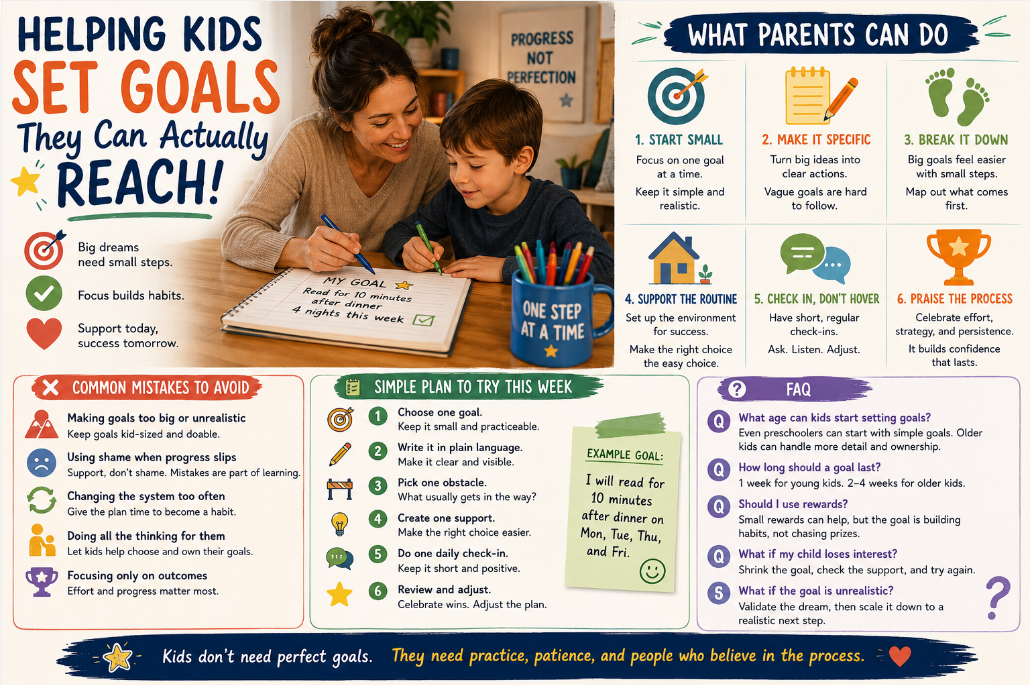
Pick one goal for the week or month. Keep it narrow enough that your child can explain it in one sentence. “Read for ten minutes after school.” “Put dirty clothes in the hamper every night.” “Practice multiplication facts for five minutes before screen time.” Simple wins build momentum.
Help them make the goal specific
Vague goals are hard for kids to follow. “Do better in school” does not tell a child what to do at 4:15 p.m. on a Tuesday.
Try turning fuzzy wishes into visible actions:
- Instead of “get better at reading,” try “read one early chapter book for ten minutes four nights a week.”
- Instead of “be more responsible,” try “pack backpack before bedtime.”
- Instead of “stop giving up so easily,” try “ask for help after trying two ways first.”
If your child is old enough, ask, “What would we actually see if this goal was happening?” That question often makes things clearer fast.
Break the goal into steps your child can picture
Kids handle small steps much better than distant outcomes. If your child says, “I want to get better at math,” you can say, “Okay, what are the repeatable parts?” Maybe that means finishing homework before dinner, checking one missed problem together, and doing two extra practice questions on weekends.
This is closely tied to building problem-solving skills through daily challenges. Instead of handing them the whole plan, invite them into it. Ask, “What usually gets in the way?” or “What should step one be?” Even younger kids can help decide where the chart goes or what time practice fits best.
Make the routine easier than the pep talk
Parents often lean on reminders because reminders feel active. But the better fix is usually the environment. If the goal is homework before devices, set up a basket for the tablet in another room. If the goal is independent reading, keep the current book where your child usually flops after school. If the goal is practicing an instrument, leave the music stand ready instead of packed away.
Small setup changes matter more than long speeches. A home environment that supports focused learning quietly supports follow-through when motivation fades.
Use check-ins, not constant hovering
Kids still need support, but they do not need a manager following them around all day. Pick one check-in point: breakfast, after school, bedtime, or Sunday evening. Ask three short questions:
- What is your goal right now?
- What is your next step?
- Do you need help or just a reminder?
That keeps the goal alive without turning it into background nagging.
Praise effort that connects to the process
Generic praise fades fast. Process praise teaches. Instead of “Good job,” try:
- “You remembered your backpack without me saying anything.”
- “You got frustrated and still finished one more page.”
- “You broke that big job into smaller parts. That helped.”
This kind of feedback teaches kids what worked, which makes it more likely they can repeat it.
Common Mistakes to Avoid
Making the goal too adult-sized. A child goal should fit a child life. If the target requires perfect consistency, it is probably too big.
Using shame when progress slips. Kids learn very little from “You said this mattered to you” or “Why can’t you ever stick with anything?” Slipping is part of learning. The useful question is, “What made this hard?”
Changing the system every two days. If the chart, reward, routine, and expectations all keep moving, kids cannot tell what works. Give a simple plan enough time to become familiar.
Doing all the thinking for them. Support matters, but total parent control does not build ownership. Let your child help choose the wording, timing, and tracking method whenever possible.
Focusing only on outcomes. Some goals take time. If your child is working on reading stamina, a small step like finishing ten minutes without quitting matters before a visible leap does.
Related:
Simple Plan to Try This Week
- Choose one goal. Keep it small enough to practice daily or several times this week.
- Write it in plain language. Example: “I will read for ten minutes after dinner on Monday, Tuesday, Thursday, and Friday.”
- Pick one obstacle. Maybe your child forgets, gets distracted, or starts too late.
- Create one support. Put the book on the couch, set out shoes by the door, or decide homework starts before snack screens.
- Do one daily check-in. Keep it short. “What’s your goal? What’s tonight’s step?”
- Review at the end of the week. Ask what helped, what did not, and whether the goal should stay the same, get smaller, or grow a little.
If the goal involves reading or school confidence, you can pair this with gentle routines that also support early literacy. The more the goal fits naturally into daily life, the less it feels like one more battle.
FAQ
What age can kids start setting goals?
Even preschoolers can start with very simple goals like putting books back on the shelf or getting dressed before breakfast. Older kids can handle more detail and more ownership, but the basic idea can start early.
How long should a child goal last?
For younger kids, one week is often enough to practice a habit and see whether the plan works. Older kids may do well with two to four weeks, especially for school or activity goals. Shorter is usually better than dragging a goal out too long.
Should I use rewards for goal setting?
Sometimes a small reward can help a new habit get started, but it should not do all the work. The long-term aim is helping your child notice progress, capability, and routine, not chase a prize every time.
What if my child picks a goal that is unrealistic?
Do not shut it down immediately. Start by validating the excitement, then help scale it. “Making the travel team is a big dream. What would be a practice goal for this month?” That keeps hope while making the work more concrete.
What if my child loses interest after a few days?
That usually means the goal is too vague, too hard, or not supported well enough by the routine. Go back and shrink it. A smaller goal that sticks teaches more than a big goal that collapses.
Kids do not need to become tiny productivity experts. They just need repeated chances to see that progress is built in small steps, not big speeches. If this week’s goal feels clumsy, that is okay. You are not failing. You are teaching a life skill most adults are still practicing too.