
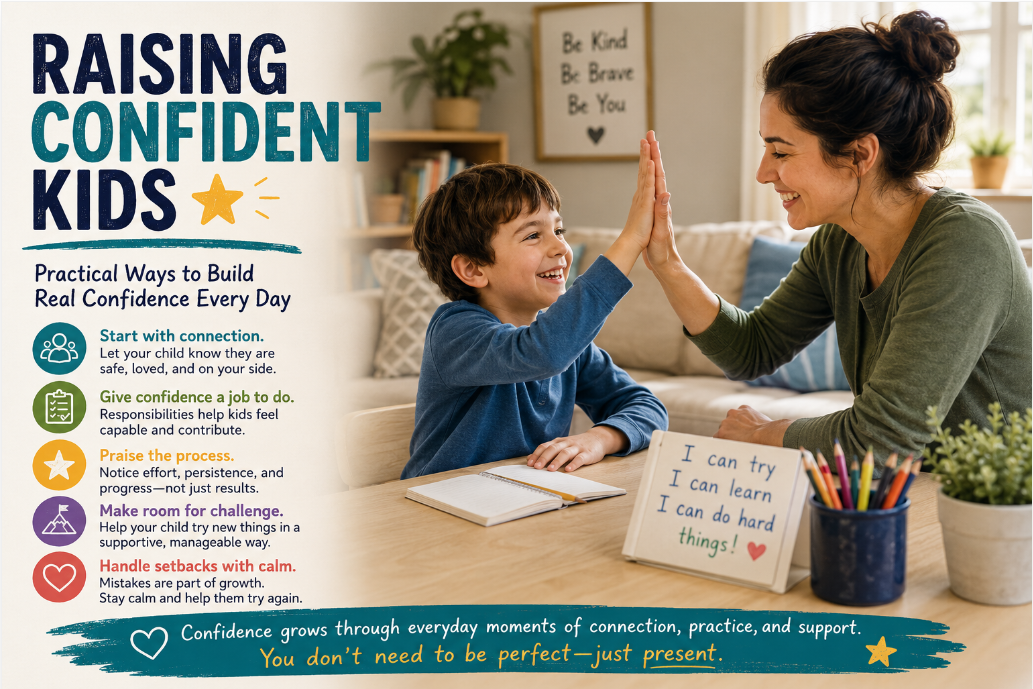
Confidence can look loud from the outside, but in children it is usually much quieter than that. A confident child is not always the one who talks the most, wins the game, or walks into every room without hesitation. More often, confidence looks like trying again after a mistake, speaking up when something feels unfair, asking for help without shame, and believing, little by little, that hard things can be learned.
That matters because many parents worry when a child seems unsure of themselves. Maybe your child gives up quickly, compares themselves to everyone else, refuses to try new things, or melts down when they are not immediately good at something. Maybe they seem capable, but one setback sends them into, “I can’t do it,” or “I’m just bad at this.” Those moments can make parents wonder how to help without pushing too hard.
The good news is that confidence is not something a child either has or does not have. It grows through everyday experiences, relationships, and habits. Children build confidence when they feel safe, capable, and supported. They build it when adults notice effort, create chances for success, and respond calmly when things go wrong.
This guide pulls together the big picture. You will find practical ways to help your child become more secure in who they are, more willing to try, and more resilient when life feels uncomfortable.
Why Confidence Matters More Than Looking Confident
Real confidence is not about performing for other people. It is about having an inner sense of, “I can handle this,” even when something is unfamiliar. That kind of confidence supports learning, friendships, independence, and emotional resilience.
Confident kids are not fearless. They still get nervous, frustrated, embarrassed, and disappointed. The difference is that they begin to trust that those feelings are survivable. They start to believe mistakes are part of growth instead of proof that something is wrong with them.
When confidence is shaky, normal childhood challenges can feel much bigger. A child may avoid group activities, argue before trying something new, cling to adults, or chase constant praise. They may want success but fear the discomfort that comes before it.
That is why confidence works best when parents focus less on building a “confident image” and more on building real competence, emotional safety, and practice with manageable challenges.
Start with Connection Before Correction
Children build confidence best in relationships where they feel accepted, even when they are struggling. If a child feels constantly judged, rushed, or compared, they are more likely to protect themselves than to grow. They may avoid effort, act silly to cover insecurity, or shut down before you can help.
Connection does not mean removing all limits or praising everything. It means your child experiences you as steady, warm, and on their side. A child who feels secure with a parent is more willing to take healthy risks because failure does not feel like a threat to the relationship.
In daily life, that can sound like:
- “This feels hard right now, but we can figure it out.”
- “You do not have to do it perfectly to practice it.”
- “I can see you are frustrated. Let’s slow down and take the next step.”
Connection also helps you spot the real issue. Sometimes a child who seems defiant is actually scared of getting it wrong. Sometimes a child who says, “I do not care,” cares deeply and is protecting themselves from disappointment.
Give Confidence a Job to Do
Children do not become confident just by hearing encouraging words. They become confident through action. When kids are trusted with meaningful responsibilities, they learn that they can contribute, solve problems, and be counted on.
That is why age-appropriate responsibility is such a strong confidence builder. If you want practical examples, building confidence through age-appropriate responsibilities is one of the most direct ways to turn encouragement into real-life practice.
Start small and make the expectation clear. A preschooler can put shoes in the right spot. An early elementary child can feed a pet, clear the table, or pack part of their backpack. An older child can help with laundry, simple meal prep, or keeping track of a weekly task.
The goal is not to create a perfect helper. The goal is to help your child experience, “I can do things that matter.”
If your family likes visual tools, a simple responsibility tracker such as the Melissa & Doug Responsibility Chart can be useful for making expectations visible without constant reminders. It works best as a support for routine, not as a pressure system.
Try to resist overhelping. If you fix every mistake, finish every task, or step in too early, your child misses the chance to feel capable. Support them, but leave room for them to own the work.
Praise the Process, Not the Performance
Parents naturally want to encourage children, but not all praise helps confidence in the same way. Constantly saying “Good job” or focusing only on the outcome can make kids dependent on outside approval. They may start asking, “Was that good?” before deciding how they feel about their own effort.
A healthier approach is process-based praise. Notice strategy, persistence, care, or progress. Instead of “You are amazing at this,” try “You stuck with that when it got frustrating,” or “You kept trying different ways until it worked.”
This is where praise vs rewards for building intrinsic motivation in kids becomes especially important. Confidence grows better when children learn to connect effort with progress, not effort with a prize every time.
That does not mean rewards are always wrong. They can help a new habit get started. But if a child only feels successful when there is a sticker, treat, or big reaction waiting at the end, their motivation stays fragile.
Try these swaps:
- Instead of “You are the best artist,” say “You spent a long time adding detail to that drawing.”
- Instead of “I am so proud because you won,” say “You kept your focus and worked hard.”
- Instead of “Here is a reward for reading,” say “You stayed with that book even when the chapter got tricky.”
Specific praise teaches children what they can repeat. It helps them see themselves as active participants in their own growth.
Teach a Growth Mindset Without Turning It into a Slogan
Children hear a lot of polished messages about believing in themselves, but confidence becomes more real when it is tied to effort, practice, and recovery from mistakes. That is the heart of a growth mindset.
If your child tends to say, “I am just bad at math,” “I cannot do sports,” or “I am not good at making friends,” it helps to reframe ability as something that develops. Cultivating a growth mindset in your child can shift the focus from proving ability to building it.
Growth mindset is not about pretending everything is easy. It is about being honest that learning can feel awkward, slow, and frustrating, and that none of those feelings mean a child should quit.
You can support this by using language like:
- “You cannot do it yet.”
- “What helped a little this time?”
- “What could you try differently next round?”
- “Being new at something is part of learning it.”
Modeling matters too. Let your child hear you talk through your own mistakes without spiraling into self-criticism. When a parent responds to setbacks with flexibility, children learn that imperfection is normal, not dangerous.
Break Big Goals into Small Wins
Confidence often drops when children see only the giant version of a task. They want the end result but cannot picture the steps in between. A child may want to become a stronger reader, more organized student, better athlete, or calmer sibling, but the gap between wanting and doing can feel enormous.
That is why small wins matter. Children need experiences of progress they can actually notice. Helping kids set goals in clear, manageable steps is one of the best ways to build steady confidence instead of short bursts of motivation.
Keep goals concrete and visible. “Practice piano for ten minutes after snack” is more useful than “get better at music.” “Say hi to one classmate” is more useful than “be more social.” “Put homework folder by the door” is more useful than “be responsible.”
When children meet small goals, confidence has something solid to stand on. They are not just being told they can do hard things. They are experiencing it.
One helpful routine is to ask three questions:
- What are you working on right now?
- What is the next small step?
- What kind of help do you want from me?
That keeps the child involved in the process and prevents parents from taking over.
Support Social Confidence Without Pushing Too Hard
For many children, confidence struggles show up most clearly around other people. They may hesitate to join a game, avoid speaking in groups, worry about saying the wrong thing, or stay quiet because they feel behind socially.
Social confidence usually grows through practice, not pressure. Children do better when they have chances to rehearse skills in low-stress situations before being expected to perform in bigger ones.
That is why building social skills through simple activities and practice can be so helpful. Role-playing how to join a game, take turns, introduce themselves, or handle a small disagreement gives children a script to lean on when nerves show up.
If your child seems especially hesitant in social settings, avoid labels like “shy” in front of them. Labels can become identities. Instead, describe what is happening in a more open way: “It takes you a little time to warm up,” or “New groups can feel hard at first.”
Then look for manageable confidence reps:
- one-on-one playdates before large groups
- practicing greetings at home
- activities based on a genuine interest
- celebrating effort to participate, not just perfect social success
If fear becomes intense or starts interfering with school, friendships, or daily life, it is worth speaking with a pediatrician, school counselor, or qualified mental health professional. Support is not a sign of failure. It is another way to help a child feel safe enough to grow.
Let Kids Struggle Without Letting Them Sink
One of the hardest parts of parenting is knowing when to step in. If you rescue too fast, your child misses the chance to build mastery. If you leave them alone with something overwhelming, they may feel defeated. Confidence grows in the middle: supported struggle.
That might mean sitting nearby while your child writes the first sentence instead of writing it for them. It might mean coaching them through what to say to a friend instead of solving the whole conflict yourself. It might mean letting them return to the store with you to politely fix a mistake in their order rather than doing the talking for them.
The message is, “I will not abandon you to hard things, but I also believe you can do part of this.”
This balance is powerful because competence comes from doing. Children need successful experiences, but they also need recovery experiences. They need to learn that frustration can be tolerated, mistakes can be repaired, and embarrassment does not last forever.
Common Mistakes That Accidentally Undercut Confidence
Parents usually hurt confidence by trying to help, not by trying to harm. A few patterns are especially common.
Doing too much for the child
When adults jump in quickly, children may start to assume they cannot manage without help. Support is good. Overfunctioning is not.
Overpraising everything
If every small action gets oversized praise, encouragement can start to feel empty. Children benefit more from calm, specific feedback than nonstop applause.
Comparing siblings or peers
Even casual comparisons can make a child feel they are always being measured. Confidence grows better in an environment of personal progress.
Protecting kids from every failure
Disappointment is uncomfortable, but it teaches flexibility and persistence. Confidence is not built by avoiding failure altogether. It is built by surviving it.
Sending the message that worth depends on achievement
Children need to know they are valued when they struggle, not only when they shine. That emotional safety gives them room to take healthy risks.
A Practical Plan for Raising More Confident Kids
If you want a simple place to start, focus on these habits for the next few weeks:
- Give your child one meaningful daily responsibility.
- Replace generic praise with specific process-based feedback.
- Use “yet” language when your child feels stuck.
- Help them choose one small, visible goal.
- Offer practice for social or emotional challenges before the hard moment arrives.
- Pause before rescuing, and ask what support they actually need.
None of this has to be perfect to work. Confidence grows slowly, often in ways that are easy to miss at first. A child who used to quit after one mistake may now try twice. A child who hid behind you may now whisper hello. A child who needed constant praise may begin to notice their own progress. Those are not small changes. They are the roots of real confidence.
Conclusion
Raising confident kids is less about teaching them to look brave and more about helping them become brave in ordinary, repeatable ways. They need connection, practice, responsibility, realistic goals, and adults who believe growth is possible. They need room to wobble without being shamed for it.
Most of all, they need the steady message that confidence is built, not born. When children learn that effort matters, mistakes are survivable, and progress counts, they begin to trust themselves more deeply. That trust becomes the foundation they carry into school, friendships, challenges, and eventually adult life.
If this helped, read these next:
- Build confidence through age-appropriate responsibilities
- Help your child develop a growth mindset
- Teach kids to set goals they can actually reach
Explore more parenting advice here: