
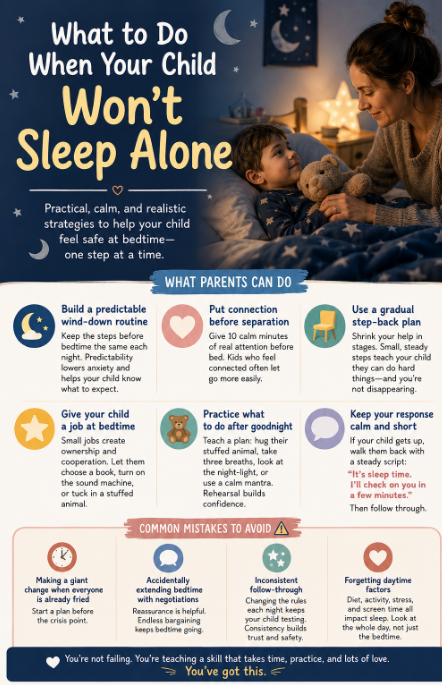
What to Do When Your Child Won’t Sleep Alone
Your child falls asleep the second you lie down next to them, but the moment you try to sneak out, one eye pops open like they have a built-in parent alarm. By the third trip back to their room, everyone is tired, irritated, and wondering how bedtime turned into a nightly hostage negotiation.
When a child will not sleep alone, the problem usually is not just bedtime. It spills into the whole house. Parents lose their evening. Siblings get disrupted. The child starts bedtime already tense because they know separation is coming. And after enough exhausting nights, it is easy to feel trapped between two bad options: stay until they fall asleep every night or listen to a child get more upset than you expected.
You are not failing if this is hard. Sleeping alone is a skill tied to routine, emotional security, habit, and timing. Some children need more support to get there, especially during stressful seasons or after illness or travel. The goal is to help your child feel safe enough to do a little more on their own, one step at a time.
Why This Happens
At bedtime, kids lose the distractions that keep them busy all day. That is when worries, separation anxiety, and “what if” thoughts often get louder. A child who seems confident at noon may feel very different in a dark quiet room at eight-thirty.
Habit plays a big role too. If your child has gotten used to falling asleep with a parent in the room, that pattern becomes part of how their body expects sleep to happen. They are not being manipulative. They are reaching for the sleep conditions that feel familiar. That is one reason sleep changes often work better when they are gradual and predictable instead of sudden and confusing.
Overtired kids can also become less cooperative, not more. A child who misses their best sleep window may get silly, clingy, tearful, or wired. If bedtime has been drifting later and later, it helps to look at the bigger sleep picture. This article on why sleep matters for kids can help you think about routine, rest, and what tiredness really looks like in daily life.
And sometimes the bedtime battle is not only about sleep. It is about connection. If evenings are rushed, bedtime may be the one moment when a child gets your full attention, so they hold onto it with both hands. That does not mean you are doing anything wrong. It just means the fix may involve connection earlier in the routine, not only stricter rules at the very end.
What Parents Can Do
Build a predictable wind-down routine
Children usually handle separation better when the steps before it are boringly familiar. Aim for the same rough order each night: pajamas, bathroom, a short cuddle, one or two books, lights low, then goodnight. Predictability lowers anxiety because your child does not have to wonder what comes next.
Keep the routine warm but not endless. If bedtime stretches into a rotating menu of one more song, one more snack, one more story, your child learns that staying awake keeps the parent there. A clear routine is kinder than a fuzzy one.
Put connection before separation
Some children cling hardest when they feel emotionally hungry. Ten calm minutes of real attention before bed can change the tone of the whole night. Sit on the floor and play one simple game. Chat about the funniest part of the day. Rub lotion on their hands. Let them choose the book. When kids feel filled up, they often let go a little more easily.
If your household has been tense or overstimulated lately, ideas from managing stress together can help you lower the emotional temperature before bedtime instead of trying to fix everything in the dark.
Use a gradual step-back plan
If your child currently needs you lying beside them, going straight to “goodnight, I’m leaving now” may be too big a jump. Instead, shrink your help in stages. Spend a few nights sitting on the bed instead of lying down. Then move to a chair next to the bed. Then move the chair closer to the door. Then do a brief check-in after goodnight instead of staying the whole time.
This kind of fading feels slow when you are tired, but it is often more realistic than a huge sudden change. It teaches your child, “You can do hard things, and I am not disappearing.”
Give your child a job at bedtime
Small jobs can shift a child from passive protest to active participation. They can turn on the sound machine, tuck in their stuffed animal, choose the first book, or press the bedtime light. Kids often cooperate better when they feel part of the routine.
Practice what to do after goodnight
Some kids genuinely do not know what comes after the parent leaves. Tell them exactly what to do: hug the stuffed animal, take three slow breaths, look at the night-light, or whisper, “My body knows how to rest.” If your child responds well to calming exercises, this guide on simple mindfulness for kids offers easy ideas that can fit naturally into bedtime without making it feel like a therapy session.
Keep your response calm and short
If your child gets out of bed, walk them back with as little drama as possible. Long lectures, bargaining, and visible frustration can accidentally turn bedtime into a stimulating event. A steady script works better: “It’s sleep time. I’ll check on you in a few minutes.” Then follow through.
This is where consistency matters most. If the rule changes every night based on everyone’s energy level, children keep testing because sometimes the system really does change.
Common Mistakes to Avoid
Making a giant change when everyone is already fried. Exhausted adults and overtired kids rarely do their best learning at 9:30 p.m. Pick a plan before the crisis point if you can.
Accidentally extending bedtime with negotiations. Reassurance is helpful. A 45-minute debate about monsters, hallway lights, water cups, and blanket angles usually is not. Children can learn that every protest buys more parent time.
Switching strategies every two nights. It is tempting to bounce between lying down, checking every minute, bribing, and starting over. But constant changes make bedtime feel even less predictable. Choose one approach and give it a fair run.
Expecting zero upset. A child can be safe, supported, and still unhappy about a new limit. Some protest does not mean the plan is wrong. It may simply mean the habit is changing.
Ignoring the daytime rhythm. Bedtime often improves when the whole day is steadier. If mornings are chaotic and nights are stretched out, it may help to tighten the family rhythm overall. This piece on building a morning routine that energizes kids and parents sounds unrelated, but calmer starts often support calmer finishes too.
If bedtime has become a full nightly showdown, this guide on overcoming bedtime battles is another useful read because it covers the power-struggle side of the problem while you work on the sleep-alone piece.
Simple Plan to Try This Week
If you want a practical reset, keep it simple for seven days:
- Pick your bedtime and protect it. Do not start the routine after your child is already overtired and unraveling.
- Create a short, repeatable sequence. Use the same 4 to 6 steps every night so your child knows exactly what happens.
- Add ten minutes of connection before lights-out. Fill the attention cup on purpose so bedtime is not the only place your child can get closeness.
- Choose one gradual step-back move. For example, go from lying in bed to sitting on the bed for three nights.
- Use one calm script. Keep repeating the same short line instead of inventing a new speech every time.
- Track small wins. Falling asleep two minutes faster, needing one less check-in, or staying in bed after one return all count as progress.
- Stay with the plan long enough to learn from it. Most families need consistency more than a perfect method.
This is rarely a one-night fix, and that is okay. The real goal for the week is not “my child suddenly sleeps alone with no complaints.” The goal is a bedtime that feels more predictable, less emotional, and a little more independent than it did before.
Related:
Helpful Tools
You do not need to buy anything to help your child sleep more independently, but a couple of optional tools can make bedtime feel calmer and more predictable.
- Hatch Rest — A predictable sound-and-light routine can help some kids understand when the bedtime process starts and what to expect next.
- Weighted Stuffed Animal — For children who like a little extra comfort at bedtime, a cozy weighted stuffed animal can feel reassuring without becoming another long negotiation.
FAQ
Is it normal for a child to suddenly stop wanting to sleep alone?
Yes. Changes like illness, travel, nightmares, a new school phase, family stress, or simply a developmental jump can make a previously independent sleeper feel clingier at night for a while.
Should I stay with my child until they fall asleep?
That depends on your goal. If it is working for your family and you are comfortable with it, that is one thing. If you want your child to fall asleep more independently, staying all the way to sleep every night can make that transition harder. A gradual step-back plan is often easier than stopping all at once.
How long does it take to change a bedtime habit?
Usually longer than tired parents hope. Some children respond within a few nights, while others need a couple of consistent weeks. What matters most is choosing a calm, repeatable plan and not changing it every night.
What if my child says they are scared?
Take the feeling seriously without letting fear run the whole routine. You can validate it, keep the environment comforting, and still hold the bedtime limit. Simple comfort items, a steady routine, and short check-ins often work better than long debates about whether the fear is logical.
When should I get extra help?
If sleep problems are extreme, your child seems unusually distressed, snoring or breathing issues are involved, or bedtime struggles are disrupting family life in a major way for a long stretch, it is reasonable to talk with your pediatrician for guidance.
When a child will not sleep alone, parents often feel like they must choose between being gentle and making progress. Usually you do not. You can be warm, steady, and clear at the same time. Start with a simpler routine, a little more connection, and one small step toward independence. Then repeat it long enough for your child to believe the new pattern is real.