
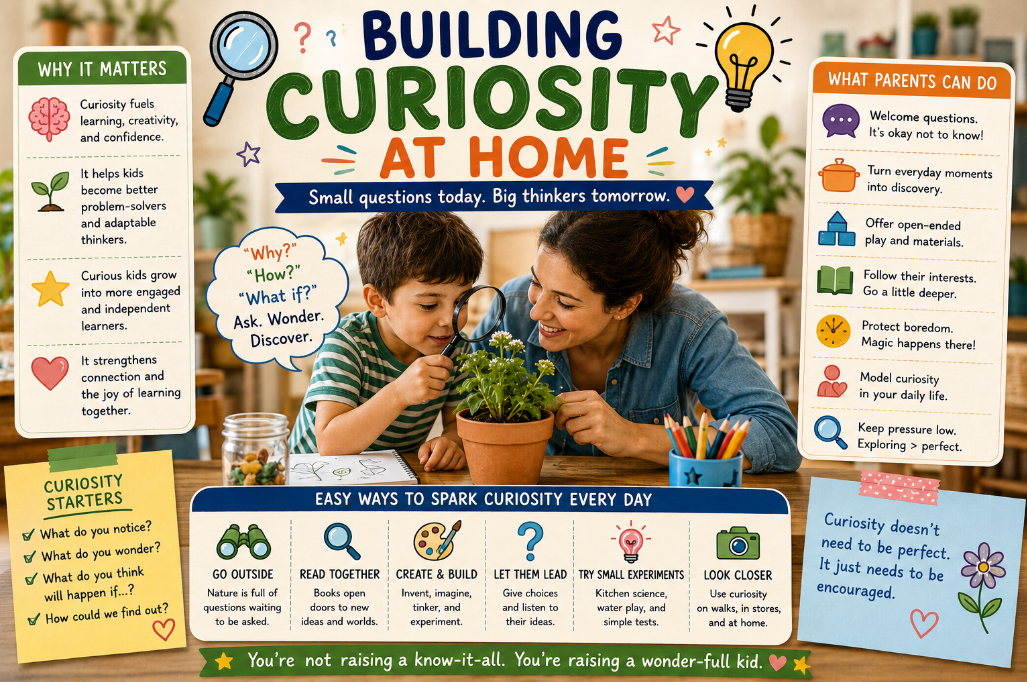
Building Curiosity at Home
Your child has asked why the moon follows the car, whether worms sleep, and how toast gets crunchy — all before breakfast. Then ten minutes later, they shrug at a worksheet and say they are bored. Curiosity is funny like that. Kids often have it in big bursts, but it grows best when everyday life gives it somewhere to go.
Parents usually notice curiosity in flashes. It shows up in the back seat, at bedtime, in the grocery store, or right when you are trying to answer one question and your child has already jumped to three more. The tricky part is that curiosity does not always look tidy or academic. Sometimes it looks like taking apart a crayon wrapper, making a mess with measuring cups, or asking “why” so many times you are tempted to answer, “Because I said so.”
The good news is that you do not need to run your house like a tiny science museum to build curiosity. Most kids become more curious when they have space to notice things, ask questions, try ideas, and hear adults respond with interest instead of shutting the moment down. Small daily habits matter a lot more than fancy projects.
And curiosity is worth protecting. It helps children become better problem-solvers, more flexible thinkers, and more confident learners. If you want a broader look at that connection, this guide to building problem-solving skills through daily challenges pairs well with curiosity because children learn best when they are invited to think, test, and try again.
Why This Happens
Curiosity is part of how kids make sense of the world. Young children are constantly sorting out how things work, what causes what, and where they fit into everything they notice. That is why the same child who seems distracted during a routine task can stay deeply focused on a bug, a puddle, or a cardboard box with wheels drawn on the side.
But curiosity can shrink when life gets too rushed or too managed. If every question gets a quick answer, every activity has a right way to do it, or every free moment gets filled with entertainment, children have fewer chances to wonder for themselves. They start waiting to be told instead of exploring.
Some kids also stop showing curiosity when they are worried about being wrong. If a child thinks the goal is always to give the correct answer fast, they may ask fewer questions and take fewer risks. That is one reason a growth mindset matters here. Kids stay more open to learning when they believe not knowing something is the beginning of the process, not proof that they are behind.
It also helps to remember that curiosity does not look the same in every child. One child talks nonstop. Another quietly studies things. Another wants to build, test, and compare. Your job is not to force one style. It is to notice how your child naturally explores and give that style room.
What Parents Can Do
Make room for questions you do not answer right away
It is fine not to have an instant explanation for everything. In fact, curiosity often grows better when you slow the moment down. Try saying, “That is a good question. What do you think?” or “Let’s figure it out together.” That response tells your child that wondering matters, and that answers can be explored instead of simply delivered.
Let everyday chores become discovery moments
You do not need separate “learning time” to build curiosity. Cooking raises questions about measuring, melting, mixing, and change. Laundry invites sorting and noticing patterns. Walks raise questions about weather, plants, shadows, traffic, and neighborhood life. When children see learning tucked into ordinary routines, it feels natural instead of forced.
Use open-ended play more often
Children ask better questions when the activity itself leaves room to think. Blocks, recycled boxes, water play, pretend play, drawing, and simple building materials all invite experimentation. If your child enjoys figuring things out through doing, everyday activities that boost cognitive development can give you more low-pressure ideas that strengthen thinking without turning the day into school at home.
Follow their interests further than you usually would
If your child is suddenly obsessed with sharks, bridges, mushrooms, trucks, volcanoes, or how keys work, lean into it a little. Borrow books. Watch closely together. Draw one. Compare sizes. Count wheels. Make up a story. Curiosity gets stronger when children feel that their interests are worth staying with for more than five minutes.
Protect boredom a little
Parents often feel pressure to fill every gap, but boredom can be useful. A child who is not instantly entertained may start inventing, building, noticing, or asking. That does not mean you need to enjoy whining about boredom. It just means you do not have to solve it immediately every time. Sometimes the most curious play starts a few minutes after the complaint.
Model curiosity out loud
Children notice how adults learn. If you say things like, “I wonder why that plant grows better in this spot,” or “I have never made this recipe before, so let’s see what happens,” you show that curiosity is not just for kids. It is a normal way to move through life.
Offer materials that invite experimenting
Simple materials often do more than flashy ones: tape, paper, flashlights, measuring cups, magnifying glasses, cardboard, string, old containers, and crayons. And if your child likes hands-on exploring, a few easy experiments from science activities you can do at home can turn curiosity into action without creating a huge production.
Keep pressure low when they do not know the answer
Curious kids still shut down if they feel quizzed all the time. There is a big difference between a conversation and a test. Try asking, “What do you notice?” or “What do you think will happen?” instead of pushing for one correct response. That tone helps children stay engaged instead of performing.
Common Mistakes to Avoid
One common mistake is confusing curiosity with constant productivity. A child does not need to turn every interest into a structured lesson, a workbook page, or a polished project. Sometimes watching ants for ten minutes is enough. Sometimes a question can just be a question.
Another mistake is answering too fast. Of course it is efficient to explain things quickly, but when every wonder gets wrapped up immediately, kids miss the chance to observe, guess, compare, and rethink. You do not need to stall every answer, but it helps to leave room for their own thinking first.
It also helps not to overcorrect mess, noise, and unfinished ideas. Curiosity is often inconvenient. It can involve spilled water, lopsided towers, random collections, and stories that go nowhere. Reasonable limits matter, but if every experiment is shut down because it looks chaotic, children learn to play it safe.
Finally, avoid treating certain interests as more valuable than others. Adults often celebrate reading and science questions but dismiss endless curiosity about bugs, maps, elevators, dolls, or made-up worlds. If your child cares deeply about it, that interest can still become a doorway into learning. And if attention is part of the struggle, this article on helping kids focus better can help you support longer stretches of exploring without turning the moment into a battle.
Simple Plan to Try This Week
If you want to make your home feel a little more curiosity-friendly, try this simple one-week reset.
- Pick one time of day for noticing. It could be breakfast, bath time, a walk, or bedtime. During that time, pause long enough to notice one interesting thing together.
- Answer one question with another question. When your child asks something, try, “What do you think?” before giving the answer.
- Set out one open-ended material. Leave paper and tape on the table, a flashlight by the couch, or a box of recycled containers where your child can reach them.
- Follow one interest deeper. If your child keeps returning to the same topic, spend ten extra minutes on it this week with a book, drawing, or mini experiment.
- Protect one small pocket of boredom. The next time your child says, “I’m bored,” do not rush in right away. Give the moment a chance to turn into an idea.
- Say what you are wondering too. Let your child hear you think aloud about something you do not already know.
This kind of plan works because it is realistic. You are not trying to become a cruise director or a homeschool teacher overnight. You are just making the house a better place for questions to land. Over time, those little moments build a child who notices more, asks more, and trusts themselves to keep learning.
Helpful Tools
You do not need special products to raise a curious child, but sometimes the right book can keep the questions going in a good way.
- National Geographic Kids Books can be a nice fit for kids who ask constant questions about animals, weather, space, or strange facts. It gives them something interesting to explore without turning learning into a lecture.
FAQ
How do I encourage curiosity without making everything educational?
Keep it light. Follow your child’s questions, offer simple materials, and notice interesting things together. Curiosity grows well in ordinary life. It does not need to feel like a lesson plan.
What if my child asks questions all day and I get tired?
That is normal. It is fine to say, “Let’s save that one for later,” or “I’m not sure — let’s look it up after dinner.” The goal is keeping the spirit of wondering alive.
Can screens hurt curiosity?
Sometimes they can, especially if fast entertainment crowds out exploration or boredom completely. But screens are not automatically the problem. What matters most is whether your child still has room for asking, building, imagining, and noticing away from a device too.
My child does not ask many questions. Does that mean they are not curious?
No. Some children show curiosity by watching closely, collecting facts, building things, drawing, or quietly experimenting. Look at how your child explores, not just how often they talk about it.
What is the best age to start building curiosity at home?
Right away, in simple ways. Toddlers, preschoolers, school-age kids, and even older children all benefit from homes where questions are welcome, mistakes are okay, and adults stay interested too.
Building curiosity at home is less about planning the perfect activity and more about how you respond to everyday wonder. Slow down for the question. Leave room for messier thinking. Let interests stretch a little longer than usual. Children do not need parents who know everything. They need parents who are willing to notice, wonder, and explore alongside them.