How to Support Early Literacy can feel surprisingly tricky when your child would rather talk, wiggle, or wander off than sit with a book. Here are practical ways to build reading confidence without turning it into a daily battle.
Some kids will happily memorize the dinosaur names in a picture book but suddenly need a snack, a bathroom break, and a dramatic floor collapse the moment you suggest sounding out three little words.
Early literacy often looks less like a magical reading moment and more like ten ordinary minutes squeezed between breakfast crumbs, missing shoes, and a child who would rather talk about trucks than letters. If that is your house, you are not behind. Most young children learn best when reading and writing feel woven into real life instead of turning into a miniature school day at the kitchen table.
Supporting early literacy does not mean pushing academics too soon. It means helping your child notice sounds, connect words to meaning, enjoy books, and feel capable around letters. Those small experiences add up. If your child is still wiggly, inconsistent, or only interested when the topic is sharks or princesses, that is normal.
The goal is not to raise the earliest reader in the neighborhood. The goal is to build a child who thinks, “Books are for me, words make sense, and I can figure this out.” If you are also trying to build a calm routine, this guide on creating a home environment that supports focused learning can help.
Why This Happens
Early literacy grows in layers. Before kids read independently, they usually need a lot of practice with listening, speaking, memory, attention, and sound awareness. That is why a child can tell you every detail of a favorite story and still struggle to recognize simple sight words.
Young kids are also uneven learners. One child may love being read to but resist writing. Another may know many letter names but freeze when asked what sound those letters make. Some children can focus beautifully on a book about animals and tune out completely if the material feels boring or too hard. Motivation matters.
It also helps to remember that literacy is not just about decoding words. It includes vocabulary, comprehension, storytelling, and confidence. A child who retells a funny family story in great detail is already building skills that support later reading and writing.
If your child is easily distracted, it can help to pair literacy work with strategies from this article on helping kids focus better. Attention and literacy often grow side by side.
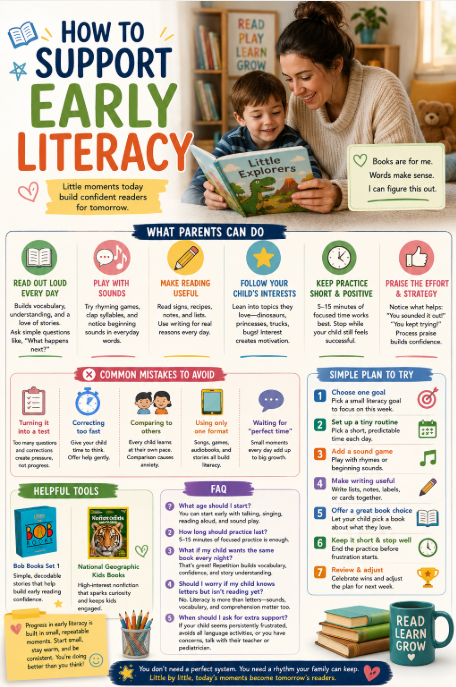
What Parents Can Do
Read out loud even after your child knows some words
Reading aloud is still one of the most useful things you can do. It builds vocabulary, listening stamina, and a sense that books are enjoyable rather than just work. Picture books, silly rhymes, beginner readers, comics, and nonfiction all count.
Pause sometimes and say things like, “What do you think happens next?” or “Why do you think she did that?” Keep it conversational. You are building understanding, not giving a quiz.
Play with sounds, not just letters
Phonics matters, but many young kids need sound play before formal reading clicks. Try rhyming games in the car, clap out syllables at lunch, or ask, “What sound do you hear at the start of sun?” These tiny moments build phonological awareness, which is a big piece of early reading.
You can do this casually: “I’m thinking of something in this room that starts with /b/.” Your child guesses “book,” “bag,” or “blanket,” and suddenly you have done literacy practice without anyone calling it practice.
Let your child see reading and writing used for real reasons
Kids are more interested when literacy solves an actual problem. Write a grocery list together. Label a drawing. Leave a note in their lunch box. Ask them to help read a recipe step, a street sign, or a birthday card. Real-life reading feels more meaningful than random worksheets.
When kids see that words help people remember, organize, laugh, and connect, literacy stops feeling abstract.
Follow your child’s interests shamelessly
If your child only wants books about bulldozers, bugs, or ballerinas, lean in. Interest creates stamina. A child who resists “practice reading” may suddenly work hard to decode a page about volcanoes. That is not cheating. That is smart parenting.
If reading has become a battle, you may also like this article on what to do when your child hates reading. Sometimes the fix is not more pressure. It is a better entry point.
Keep practice short enough to end well
For early readers, ten calm minutes often works better than thirty miserable ones. Stop while your child still feels capable. That helps protect confidence and makes it more likely they will try again tomorrow.
You can say, “Let’s read two pages together and then you pick the next book,” or “We’ll practice three words and then we’re done.” A clear finish line lowers resistance.
Praise effort, strategy, and noticing
Instead of only saying “Good job,” try being specific: “You looked at the first sound,” “You noticed that word came back again,” or “You kept trying even when that page felt tricky.” This kind of feedback teaches kids what helps them succeed.
That approach connects well with building a growth mindset, because it frames reading as a skill that grows with practice rather than a talent kids either have or do not have.
Common Mistakes to Avoid
Turning every reading moment into a test. If every page comes with a question, correction, or performance check, kids can start to associate books with pressure. Some reading time should just feel good.
Correcting too fast. Give your child a second to think. If they get stuck, offer help gently: “Want to try the first sound together?” Jumping in immediately can make kids feel watched rather than supported.
Comparing siblings or classmates. Early reading timelines vary a lot. One child may read sooner while another builds stronger language or comprehension first. Comparison usually creates anxiety, not progress.
Using only one format. Some kids warm up through songs, magnetic letters, audiobooks, or storytelling before they engage with beginner readers. Literacy can start in many places.
Waiting for long stretches of free time. Most families do not have ideal, quiet afternoons every day. Five minutes here and there still count.
Simple Plan to Try This Week
Day 1: Set up a tiny reading routine
Pick one predictable time: after breakfast, before bath, or right before bed. Keep it short enough that you can actually repeat it.
Day 2: Add one sound game
On a walk or in the car, play a quick game with beginning sounds or rhymes. No supplies needed.
Day 3: Make writing useful
Ask your child to help write part of a shopping list, a card for a grandparent, or labels for toy bins.
Day 4: Offer a high-interest book choice
Let your child choose something that matches their obsession of the week. Interest is the point.
Day 5: Practice without pressure
Read together for a few minutes, then stop before frustration spikes. Say, “We’re done for today. You worked hard.”
Day 6: Retell a story
After reading, ask your child to tell the story back in their own words. This strengthens comprehension and sequencing.
Day 7: Notice what worked
Ask yourself: Was my child more engaged with silly books, factual books, sound games, or writing notes? Use that information next week instead of starting from scratch.
Helpful Tools
Optional tools can make early literacy practice feel lighter, especially when your child is still building confidence.
- Bob Books Set 1 – A simple beginner-reader set can be useful when your child is ready to practice short, decodable words without a lot of overwhelm.
- National Geographic Kids Books – High-interest nonfiction books can pull in kids who are more motivated by animals, space, or facts than traditional early readers.
Related:
Related:
Related:
FAQ
What age should I start supporting early literacy?
It can start very early through talking, singing, reading aloud, and playing with sounds. It does not need to look like formal lessons.
How long should early literacy practice last?
For many young children, 5 to 15 minutes of focused practice is enough. Consistency matters more than long sessions.
What if my child wants the same book every night?
That is usually helpful, not harmful. Repetition builds vocabulary, confidence, and story awareness. Kids often learn a lot from familiar books.
Should I worry if my child knows letters but is not reading yet?
Not necessarily. Letter knowledge is just one part of literacy. Sound awareness, vocabulary, comprehension, and confidence all matter too.
When should I ask for extra support?
If your child seems persistently frustrated, avoids all language activities, or you have concerns about speech, hearing, or learning progress, it is reasonable to talk with their teacher or pediatrician for guidance.
Conclusion
Early literacy is usually built in small, repeatable moments: one bedtime story, one silly rhyme in the car, one note taped to the fridge, one page your child manages to read with a little help. You do not need a perfect system. You need a rhythm your family can actually keep.
Start small, stay warm, and let progress look ordinary. Those ordinary moments are often where confidence grows. If you want more ideas for making reading feel inviting, take a look at Learning to Read.