
School readiness can make even calm parents feel strangely tense. One minute your child is building block towers on the floor, and the next you are wondering whether they should already know letters, sit still longer, follow directions the first time, or walk into preschool or kindergarten without melting down at the door.
That pressure is understandable, but it can also send families in the wrong direction. School readiness is not about turning home into a classroom or trying to force a young child to act older than they are. It is about helping your child build a set of practical skills that make the school day feel more manageable: listening, communicating, handling transitions, playing with others, staying with a task for a short stretch, and feeling comfortable around books, language, and simple routines.
In other words, readiness is bigger than academics. A child who knows every letter but cannot separate easily, follow a simple direction, or recover after a small frustration may still have a hard start. A child who is still learning letters but can listen, ask for help, join a group, and try again after mistakes may be more ready than worried adults assume.
This guide pulls the big picture together. If you are trying to prepare a child for preschool, pre-K, or kindergarten, the goal is not perfection. The goal is steady progress in the skills that help children feel capable, connected, and ready to learn.
What school readiness really means
School readiness usually gets reduced to a checklist: recognize some letters, count a little, write part of a name, know some shapes and colors. Those skills can help, but they are only part of the picture.
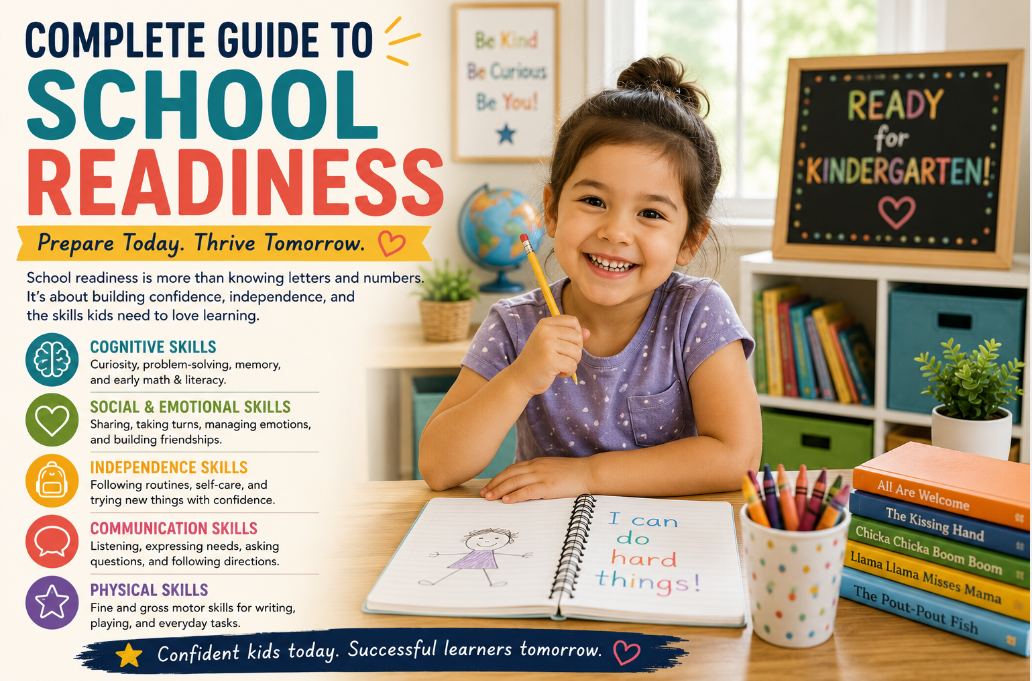
Most children do better at school when they are growing in several areas at once:
- language skills, like listening, speaking, and understanding directions
- early literacy, like noticing print, enjoying books, and hearing sounds in words
- early thinking skills, like sorting, remembering, comparing, and problem-solving
- social skills, like taking turns, joining play, and handling small conflicts
- emotional skills, like coping with frustration, separating from caregivers, and asking for help
- everyday independence, like using the bathroom, washing hands, putting things away, and managing simple routines
That is why school readiness looks different from child to child. Some children walk in eager to talk but need more help with focus. Some are cautious socially but love books and routines. Some are active and bright but struggle with transitions. Readiness is not one trait. It is a mix of skills that grow over time.
Why parents often feel behind
A lot of school readiness stress comes from mixed messages. Parents hear that they should not push too hard, but they also hear warnings about being behind. They are told play matters, but then they see social media posts featuring color-coded learning plans and four-year-olds doing worksheets at the table.
The result is that many families overfocus on visible academic skills and underfocus on the skills that make those academics usable in a classroom. A child who can identify letters but rarely listens to a full instruction may still struggle. A child who can count to twenty but falls apart every time the plan changes may need more support with transitions than with numbers.
This is one reason Learning Through Play matters so much. Young children often build readiness best through hands-on, playful repetition. They learn by moving, pretending, sorting, building, asking questions, and trying things again, not just by sitting still and performing on cue.
If your child is wiggly, inconsistent, or much more capable some days than others, that does not automatically mean something is wrong. Young children are still developing stamina, self-control, and confidence. Your job is to support those skills in realistic ways, not panic every time development looks uneven.
The core skills that matter most before school starts
If you want to focus your energy well, these are usually the most useful readiness targets.
Listening and following simple directions
School asks children to hear a direction, hold it in mind, and act on it. Start small at home. Practice one-step and two-step directions in normal life: put your shoes by the door, then bring me your backpack. Keep your tone calm and your expectations clear.
You are not trying to create instant obedience. You are helping your child build the habit of noticing instructions and moving through them without constant rescue.
Comfort with books, stories, and language
A child does not need to be reading independently to be school-ready, but it helps if books feel familiar and language-rich experiences are part of daily life. Talking, singing, storytelling, and read-alouds all count.
For a practical breakdown of what this looks like in everyday family life, How to Support Early Literacy is a strong place to start. It shows how simple reading habits, sound play, and conversation build the foundation for later success.
Social confidence
Group settings require children to share space, wait briefly, join activities, and recover from awkward moments. That does not mean your child has to be outgoing. Quiet children can be ready too. What matters more is whether they are starting to practice the skills that help them connect and participate.
If this is an area your child finds tricky, Building Social Skills offers useful ways to practice turn-taking, communication, empathy, and simple friendship skills before school begins.
Focus in short bursts
No young child needs hour-long attention. What helps is the ability to stay with a simple task for a few minutes, especially with support. Puzzles, drawing, looking at books, sorting games, and simple building tasks all strengthen that skill.
It also helps when the environment is not fighting your child every step of the way. Creating a Home Environment That Supports Focused Learning explains how a calmer setup, fewer distractions, and easier access to materials can make practice feel more doable.
Everyday independence
Teachers spend a lot of time helping children with practical tasks, so small self-help skills really matter. Practice taking shoes on and off, washing hands, opening containers, tidying up, using the bathroom, and carrying out a simple routine. Independence does not need to be perfect. It just needs to be growing.
How to build readiness without pushing too hard
The best school-readiness plan is usually simple enough to survive real life. Long lessons tend to create resistance. Short, repeatable habits are more effective.
Try thinking in terms of daily exposure rather than academic performance. A useful week might include:
- reading together most days, even for ten minutes
- talking through routines and transitions out loud
- one playful fine motor or thinking activity a day
- practice with simple independence tasks
- time with other children when possible
- lots of chances to ask questions, solve small problems, and keep trying
That is enough to build momentum without making home feel tense.
One practical way to do this is to lean into ordinary tasks that already contain learning. 10 Everyday Activities That Boost Cognitive Development in Young Kids is especially helpful here because it shows how sorting, cooking, storytelling, and simple routines can support memory, sequencing, attention, and problem-solving without becoming formal lessons.
If your child enjoys structured practice and you want one optional extra tool, the LeapFrog LeapStart can be a useful supplement for school-readiness skills like following directions, early literacy, and simple independent practice. It works best as a small add-on, not the center of the plan.
A realistic home plan for the months before preschool or kindergarten
You do not need to do everything every day. But if you want a simple rhythm, this one works well for many families.
1. Read aloud every day
Books build vocabulary, listening, comprehension, and comfort with print. Keep it warm and interactive. Ask what your child notices. Let them turn pages. Reread favorites. Do not worry if they move around while listening.
If your child is already showing interest in letters, sounds, or simple words, Learning to Read can help you understand the typical progression from letter recognition to early decoding without rushing the process.
2. Practice school-like routines in gentle ways
Morning routines, cleanup routines, snack routines, and bedtime routines all help children learn what it feels like to move from one part of the day to the next. Narrate what comes next. Use simple language. Keep the sequence consistent enough that your child starts to anticipate it.
3. Build fine motor skills through play
Children use small hand muscles for drawing, using scissors, managing clothing, and handling classroom materials. Good practice includes playdough, coloring, painting, stickers, tearing paper, stringing beads, using tongs, and helping in the kitchen.
4. Make room for pretend play and problem-solving
Pretend play is not extra credit. It supports language, social thinking, planning, and self-regulation. When children invent games, negotiate roles, or work through how to build something that keeps falling over, they are practicing school-readiness skills in a very real way.
5. Help your child tolerate small frustrations
School brings waiting, mistakes, correction, and unexpected changes. Resist the urge to fix every small struggle immediately. Stay nearby, coach briefly, and let your child try. Learning to pause, breathe, and try again is part of readiness too.
Common readiness gaps and what to do about them
Most children do not arrive equally strong in every area. Here are a few common concerns and what usually helps.
“My child knows a lot, but cannot sit still.”
Young children often need movement in order to learn. Instead of trying to force long seated work, use short activities with clear endpoints. Alternate movement and quieter tasks. Practice listening during play, not only at a table.
“My child is shy around other kids.”
Shyness does not mean a child is not ready. What helps is gradual practice: playground visits, short playdates, role-playing greetings, and talking through what to say when joining a game. Focus on confidence and familiarity, not personality change.
“My child resists books or letters.”
Back up and reduce pressure. Choose books tied to strong interests. Read shorter pieces. Let your child listen while moving or cuddling. Keep literacy playful and frequent rather than intense and corrective.
“My child melts down with transitions.”
Predictability helps. Give warnings, keep routines visible, and practice moving from one activity to another when the stakes are low. Some children need extra support with transitions long before they need more academics.
“My child still needs help with every little task.”
Pick one or two independence goals at a time. Practice when nobody is rushed. Break the task into parts. Expect it to be slower before it gets easier.
Common mistakes that make school readiness harder
Parents usually mean well here, but a few habits can backfire.
- Over-focusing on worksheets. Some children enjoy them, but worksheets alone do not build the broader readiness skills kids need.
- Turning reading into a test. Constant correction can make books feel stressful instead of inviting.
- Doing too much for your child. Speeding things up in the moment can slow independence in the long run.
- Comparing your child to other children. Readiness is uneven. Comparison tends to create anxiety, not progress.
- Ignoring emotional readiness. Separation, frustration tolerance, and asking for help matter just as much as early academics.
- Trying to fix everything at once. Children make better progress when adults focus on a few high-value skills and repeat them consistently.
If you are worried that your child is struggling beyond the normal range, it is reasonable to talk with their preschool teacher, pediatrician, or another qualified professional. Support is most useful when it is specific and early, not when it starts from panic.
What school readiness looks like in real life
A school-ready child is not a child who never cries, never gets distracted, and always knows the right answer. It is a child who is beginning to function in a group, beginning to manage simple expectations, and beginning to feel that learning is something they can do.
That child might still be shy. They might still need reminders. They might still forget to put the cap back on the marker or need help opening a lunch container. But if they can listen, participate, communicate, recover from small problems, and stay engaged often enough to keep learning, they are on solid ground.
That is the frame worth keeping. School readiness is less about proving your child already behaves like a seasoned student and more about helping them enter school with the tools to grow there.
Conclusion
If you are preparing a child for preschool or kindergarten, you do not need to create a perfect learner before day one. You need to help your child build confidence with books, language, routines, social interaction, independence, and simple problem-solving. Those are the foundations that make the classroom feel less overwhelming and more approachable.
Start with what your child needs most. Read together. Practice small routines. Make space for play. Let them struggle a little without rescuing instantly. Support communication, curiosity, and confidence. Those ordinary moments are often the real work of school readiness.
And if progress feels slow, remember that readiness is not a single moment you either hit or miss. It is a process. Small skills, repeated often, turn into a child who walks into school a little more prepared, a little more independent, and a lot more ready to learn.
If this helped, read these next:
- How to support early literacy at home
- Building social skills before school starts
- Why learning through play prepares kids for school
Explore more parenting advice here: