Early literacy can feel oddly high stakes for something that often starts with a child sitting upside down on the couch, half-listening to a story while asking twelve unrelated questions. Parents hear a lot about reading milestones, kindergarten readiness, and building strong skills early, so it is easy to worry that every skipped page or distracted read-aloud means your child is falling behind.
Most of the time, it is not that dramatic.
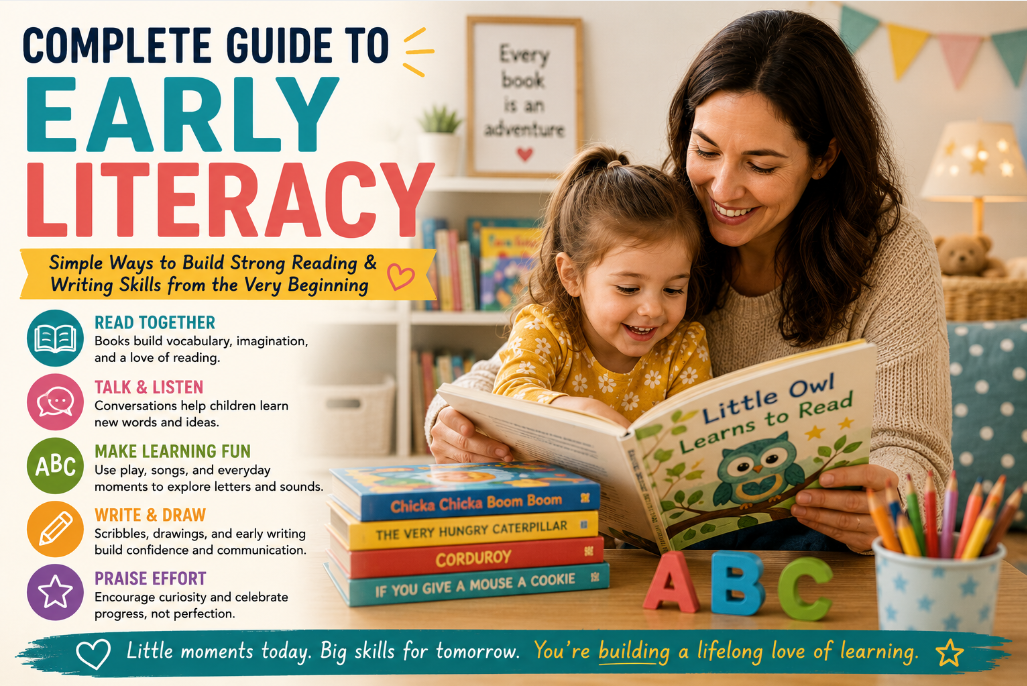
Early literacy is not about pushing academics earlier and earlier. It is about helping children build the small, connected skills that make reading possible later: noticing sounds, enjoying books, understanding stories, recognizing print, connecting letters and sounds, and feeling that words are something they can learn. Those skills grow best through steady, ordinary practice, not pressure.
If your child loves books but cannot yet read them, resists books entirely, or seems interested one day and impossible the next, that does not mean you are doing it wrong. Early literacy development is rarely neat. It tends to move in bursts, with plenty of repetition, detours, and personality mixed in.
This guide is the big-picture hub for parents who want practical ways to support reading from the earliest years through the first real stages of independent reading. You do not need a perfect routine or a mini classroom at home. You need a helpful plan, realistic expectations, and a way to keep reading from turning into a power struggle.
What early literacy really means
When parents hear “literacy,” they often picture a child sounding out words from a beginner book. That matters, but early literacy starts sooner and includes more than decoding.
It includes:
- listening to stories and understanding what happened
- noticing rhyme and beginning sounds
- recognizing that print carries meaning
- learning letter names and letter sounds
- building vocabulary through conversation and books
- retelling events in order
- growing the confidence to try, guess, and keep going
That is why a child who cannot read independently may still be making real progress. A preschooler who loves rhymes, a kindergartener who points out letters on cereal boxes, and a first grader who retells a story with detail are all building literacy in meaningful ways.
If you want a stage-by-stage breakdown of how these skills build over time, Learning to Read is a useful companion. It walks through the progression from letter recognition to phonics, sight words, and early fluency.
Why reading support goes sideways at home
Parents usually do not struggle because they do not care. They struggle because home reading can become emotionally loaded fast.
A child may feel tired, distracted, or embarrassed that reading is harder than it looks. A parent may be trying to help but end up correcting every line. Ten minutes later, everyone is tense and nobody remembers the story.
Some children resist because the material is too hard. Some resist because it is too boring. Some love being read to but hate reading aloud themselves. Some children are capable readers in short bursts but shut down when they think they are being evaluated.
That is one reason What to Do When Your Child Hates Reading matters so much in this topic area. Reading refusal is often less about laziness and more about frustration, pressure, or the feeling of failing in front of someone important.
The fix is usually not “try harder.” It is making the experience feel more manageable while still giving your child real practice.
The foundations that matter most
Read aloud more than you think you need to
Reading aloud still counts even after your child knows some letters, some sounds, or even some simple words. It builds vocabulary, attention, comprehension, and the sense that books are enjoyable. It also lets your child experience stories that are far beyond what they can decode on their own.
Read picture books, beginner readers, funny nonfiction, comics, poetry, folktales, and books tied to your child’s current obsession. The content matters less than the habit and the connection.
Pause now and then to wonder aloud: “Why do you think he did that?” or “What do you think happens next?” Keep it conversational. A read-aloud should feel like shared attention, not a quiz.
Let spoken language do some of the heavy lifting
Children build literacy long before they write full sentences. Conversation matters. Storytelling matters. Singing matters. Rhyming matters. So do jokes, pretend play, and hearing interesting words in daily life.
Ask your child to retell what happened at the park. Play a rhyming game in the car. Clap syllables in names. Notice the first sound in familiar words. These tiny moments strengthen the sound and language awareness that supports later reading.
Make print part of normal life
Children learn that words matter when they see them everywhere. Point out labels, signs, menus, grocery lists, recipes, and birthday cards. Let your child watch you write a note. Keep books where they can actually reach them.
Early literacy grows faster when print feels useful, familiar, and ordinary instead of appearing only when it is “time to practice.”
How to support early literacy without turning home into school
Many families get stuck because they think literacy support has to look formal. It does not. Young children usually learn better from short, repeatable routines than from long lessons.
A stronger approach looks like this:
- ten minutes of reading together most days
- brief sound or letter play
- easy access to books your child likes
- writing opportunities that feel useful or fun
- lots of normal conversation
If your child is in the earliest stage, How to Support Early Literacy goes deeper on keeping these habits simple and realistic for everyday family life.
Try a loose rhythm instead of a rigid schedule. For example:
- after breakfast: notice one letter or sound
- afternoon: read one short book or a few pages
- evening: retell part of the day or listen to a story
That is enough to create consistency without making reading feel like a constant assignment.
What to do at different stages
Before your child is reading words
Focus on enjoyment, language, and print awareness. Choose books with rhythm, repetition, strong pictures, and topics your child genuinely likes. Let them turn pages, point to pictures, repeat favorite lines, and “read” familiar books from memory.
Useful goals at this stage include:
- recognizing some letters
- hearing rhyme and beginning sounds
- understanding that books move left to right and front to back
- connecting stories with pleasure and closeness
When your child is starting phonics and simple words
Keep practice short and concrete. Work on a few sounds at a time. Use magnetic letters, easy word families, and silly examples. Let your child blend sounds without rushing them.
This is where a beginner set such as Bob Books Set 1 can be genuinely useful for some families because the text is simple enough to let new readers experience success instead of constant overwhelm. It is not necessary for every child, but for a child who freezes when books feel too busy, simpler pages can lower the emotional barrier.
Do not assume longer practice means better practice. Five calm minutes with real success beats twenty minutes of visible frustration.
When your child can read a little but avoids it
This stage surprises a lot of parents. A child may technically know enough to read, but still resist because the effort is high. Decoding, remembering, tracking, and understanding all at once is tiring.
That is why motivation matters as much as mechanics. How to Encourage a Love of Reading is especially helpful here. Interest-led reading often unlocks more practice than “good for you” books ever will.
If your child loves sharks, jokes, soccer, weather, space, or strange facts, lean hard into that. High-interest books are not a shortcut around reading. They are often the doorway into it.
For interest-led reading at home, a series such as National Geographic Kids Books can be a good fit when a child is more motivated by facts, animals, science, or vivid nonfiction than by traditional storybooks. Use it as an option, not a requirement.
When reading feels hard, not just unappealing
Some children are not merely reluctant. They are discouraged. That changes the approach.
If reading practice often ends in tears, guesses, stalling, or total shutdown, it helps to shift from “How do I make my child do this?” to “How do I make this feel safer and more doable?”
How to Help Struggling Readers covers this in more detail, but the short version is:
- shorten sessions
- take turns reading
- use easier books some of the time
- praise effort and strategy, not just accuracy
- end before everyone is fried
You can say things like, “That was a tricky word. I like how you went back and tried again,” or “Let me read this part and you take the next line.” Those small shifts reduce shame and keep the child in the work.
If your child is consistently struggling despite steady support, it is worth talking with their teacher, reading specialist, or school support team. Home support matters, but it should not replace professional help when a child needs more targeted instruction.
A practical home plan parents can actually keep up with
You do not need an elaborate literacy system. You need a plan that can survive normal family life.
Try this:
1. Build a daily reading anchor
Choose one dependable moment: after lunch, before bed, right after school, or during breakfast. Keep it predictable.
2. Keep a small rotation of appealing books visible
Too many choices can be oddly unhelpful. Put out a small basket with a mix of easy favorites, newer finds, and high-interest topics.
3. Pair reading with closeness, not correction
Sit together. Keep your tone calm. If a book is going badly, switch roles or stop early instead of turning it into a fight.
4. Use writing in light ways
Ask your child to help write a grocery item, label a drawing, sign a card, or sound out one short word. Writing reinforces reading, but it does not need to become a worksheet.
5. Re-read favorites without guilt
Repetition is not wasted time. Familiar books build vocabulary, confidence, and fluency.
6. Watch for patterns
Is your child more willing in the morning? More open to nonfiction? Better with shorter books? Less resistant when you read first? Those patterns matter more than generic advice.
Common mistakes that make early literacy harder
Mistake 1: treating every reading session like a test.
Children learn more when they feel supported than when they feel examined.
Mistake 2: pushing books that do not match the child’s interest or level.
The “right” book on paper is the wrong book if it causes immediate resistance.
Mistake 3: correcting too much.
Some correction is helpful. Constant interruption kills momentum and confidence.
Mistake 4: assuming resistance means laziness.
Avoidance often signals frustration, fatigue, or fear of failure.
Mistake 5: waiting for long, perfect reading sessions.
Short, steady practice is usually what moves the needle.
Mistake 6: comparing siblings or classmates.
Nothing good happens when a child feels like the slow one in the family.
What progress really looks like
Progress in early literacy often looks smaller than parents expect and more meaningful than it seems in the moment.
It can look like:
- a child asking for the same book again
- spotting a familiar word on a sign
- trying to sound out a word without being forced
- retelling a story in better detail
- lasting five calm minutes longer than last month
- choosing a fact book independently
Those things count. They are signs that literacy is becoming more familiar, more confident, and less emotionally heavy.
Conclusion
The best early literacy support is not flashy. It is warm, steady, and realistic. It helps children connect books with meaning, confidence, and connection instead of pressure. It gives them room to build sound awareness, vocabulary, print knowledge, and reading stamina at a human pace.
If your child already loves books, keep feeding that spark. If reading has become tense, step back and make it easier to succeed. If progress feels slow, remember that literacy grows in layers, and home support works best when it is consistent rather than intense.
You are not trying to create a perfect reader overnight. You are helping your child build the foundation for a lifetime of reading, learning, and curiosity.
If this helped, read these next:
- simple ways to support early literacy at home
- what the learning-to-read stages look like
- how to encourage a genuine love of reading
Explore more parenting advice here: