
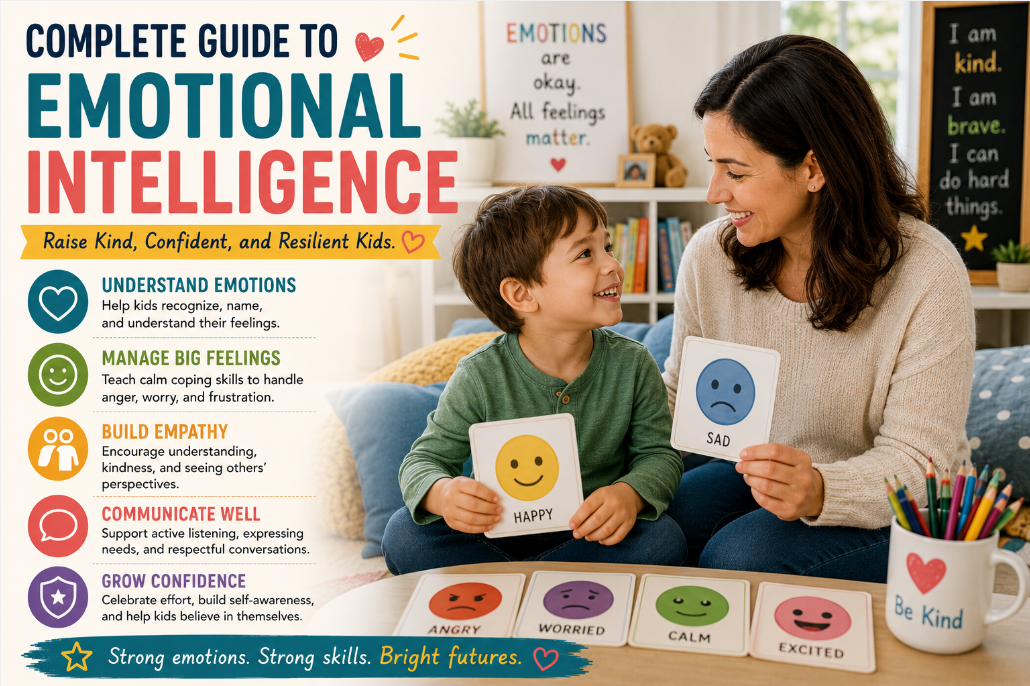
Parents hear a lot about emotional intelligence, but the phrase can feel vague when your child is crying over the wrong cup, snapping at a sibling, or shutting down after a hard school day. In real life, emotional intelligence is not about raising a child who is calm all the time or endlessly good at talking about feelings. It is about helping a child notice what is happening inside them, put some language around it, and gradually learn what to do next.
That matters more than many parents realize. Children who can recognize feelings, recover from frustration, and understand how their actions affect other people usually have an easier time with friendships, learning, family routines, and problem solving. They still have hard moments, of course. The difference is that those hard moments become chances to practice a skill instead of proof that something is wrong.
For many families, emotional development gets treated like an extra. We focus on behavior, homework, sleep, and schedules first. But emotional intelligence sits underneath all of those things. A child who can name disappointment is easier to coach through a setback. A child who can notice rising frustration is more likely to pause before hitting, yelling, or giving up. A child who can read another person’s feelings is better prepared for friendship, teamwork, and repair after conflict.
This guide pulls the bigger picture together. You will find practical ways to teach emotional awareness, support big feelings, build empathy, strengthen self-regulation, and make daily communication more useful. The goal is not perfection. The goal is helping your child become more emotionally steady, more understood, and more capable over time.
What Emotional Intelligence Really Looks Like in Kids
Emotional intelligence in children usually shows up in ordinary moments. It looks like a child saying, “I am mad,” instead of only screaming. It looks like noticing when a friend is left out, asking for a break before melting down, or accepting help after a disappointment. These are small moments, but they matter because they show a child is building awareness, language, and control.
A useful starting point is introducing emotional intelligence in ways kids can actually understand. That foundation helps parents see emotional intelligence as a group of skills: recognizing emotions, expressing them safely, managing reactions, showing empathy, and handling social situations with growing maturity.
Children do not build those skills in a straight line. A child may use great feeling words at bedtime and still fall apart over a broken cracker the next afternoon. That does not mean the teaching is not working. It means the child is still practicing, especially when tired, hungry, overwhelmed, or moving too fast.
It also helps to remember that development, temperament, and stress all play a part. Some children are naturally more intense. Some are slow to warm up. Some feel everything loudly and need more support learning how to recover. Emotional intelligence is not about making every child look the same. It is about helping each child become more aware and more skillful with what they feel.
Start with Naming Feelings Instead of Arguing with Them
When a child is overwhelmed, parents often jump straight to fixing, correcting, or explaining. The problem is that children usually learn best once they feel understood. If your child is crying because they lost a game, embarrassed about a mistake, or furious that a sibling touched their toy, your first job is not to debate whether the feeling makes sense. Your first job is to name what is happening.
That can sound very simple:
- “You are really frustrated right now.”
- “That was disappointing.”
- “You wanted it to go differently.”
- “I can see you feel nervous about this.”
Naming the feeling does not reward bad behavior. It gives the child a map. Once children hear language for what they are experiencing, they are less likely to feel trapped inside it. They begin to separate the feeling from the action. That is a huge step forward.
This is also where many parents notice the overlap with behavior. A child who seems rude, dramatic, or defiant may actually be confused by a rush of feelings they cannot sort out yet. When you slow down enough to label the emotion, you often make the next step possible.
Teach Regulation as a Practice, Not a Demand
It is easy to tell kids to calm down. It is much harder to teach them how. Self-regulation is one of the central parts of emotional intelligence because it helps children move from impulse to choice. That skill grows through repetition, modeling, and realistic expectations, not through lectures in the middle of a meltdown.
If you want the deeper toolkit, teaching self-regulation with simple calming and awareness strategies gives parents concrete ways to build this skill over time. The most useful approaches are usually boring in the best way: breathing practice, noticing body signals, rehearsing coping tools when calm, and creating a predictable plan for hard moments.
Children need to learn what early stress feels like in their body. Maybe their fists get tight. Maybe their face gets hot. Maybe they talk louder, move faster, or want to hide. When parents help kids spot those signals early, they can use a support tool sooner instead of waiting until the feeling is already driving the whole moment.
Good regulation tools are simple enough to use under pressure. That might include:
- taking five slow breaths with you
- pushing against a wall for heavy input
- counting to ten while squeezing a pillow
- getting a drink of water and starting over
- taking a short break in a calm corner
Not every strategy works for every child. Some children need movement. Some need quiet. Some need connection first and space later. The key is to practice tools before the crisis, keep them consistent, and avoid turning regulation into another performance test.
Support Big Emotions Without Making Them Bigger
Children cannot build emotional intelligence if home only makes room for pleasant feelings. They need to know anger, sadness, fear, jealousy, embarrassment, and disappointment can all be handled safely. That does not mean every reaction is acceptable. It means every feeling can be approached with steadiness.
For parents in the thick of meltdowns, shutdowns, or emotional storms, supporting your child through big emotions in practical ways is one of the most important companion pieces to this guide. The big idea is that children borrow our calm before they can create much of their own.
In the moment, try to think in this order:
- safety first
- connection second
- problem solving later
If your child is too flooded to listen, that is not the time for a long lesson. A quieter voice, fewer words, and a grounded presence usually work better than a perfect explanation. Once your child is settled, then you can talk about what happened, what they felt, and what they can try next time.
Parents sometimes worry that validation will make emotions stronger. In practice, the opposite is often true. Feeling understood lowers defensiveness. Children who do not have to fight to prove they are upset can move toward recovery faster.
Build Empathy So Feelings Are Not Only About the Self
Emotional intelligence is not just inward. Children also need to notice and care about the feelings of other people. That is where empathy comes in. Empathy helps kids repair after conflict, cooperate with peers, and understand that other people have inner experiences just like they do.
One of the strongest ways to build that skill is teaching empathy through stories, role-play, and everyday kindness practice. Empathy grows when parents ask questions that move children beyond their own first reaction. What do you think your brother felt when that happened? What might your friend have needed in that moment? What could you do now to make it a little better?
Children often need help slowing down enough to consider another point of view. That is normal. Perspective-taking is hard when a child feels wronged, jealous, embarrassed, or defensive. Keep your expectations age-appropriate. A preschooler may only manage a simple repair. An older child may be able to talk through both sides of a conflict more fully.
Empathy also grows when children experience it from adults. If parents respond with mockery, dismissal, or constant harshness, children learn to protect themselves instead of opening toward others. Warm, firm parenting gives children a model for how care and limits can live together.
Use Everyday Communication to Teach Emotional Skills
A lot of emotional coaching happens in the small conversations around school pickup, bedtime, conflict, and ordinary mistakes. Children become more emotionally intelligent when adults give them room to talk, listen without rushing, and respond in ways that lower shame.
That is why effective communication with kids matters so much for emotional growth. When parents practice active listening, reflect feelings, and ask open questions, children learn that emotions are not dangerous topics. They learn that hard feelings can be spoken about, not just acted out.
Useful questions include:
- “What felt hardest about that?”
- “What were you hoping would happen?”
- “What did your body feel like when you got upset?”
- “What would help next time?”
These questions are better than interrogation or quick judgment because they invite reflection. They help a child build self-awareness, which is one of the strongest predictors of better emotional control later on.
It also helps to watch your own tone. Children hear emotional messages through volume, pace, and facial expression long before they absorb a carefully chosen sentence. Calm communication does not mean being fake or endlessly patient. It means trying not to add extra fuel when a child is already struggling.
Look for the Stress Under the Behavior
Some children seem to lose emotional skills at the exact moment they need them most. That is often because stress narrows what they can access. A child who can usually talk about feelings may become snappy, clingy, forgetful, silly, or explosive when the nervous system is overloaded.
That is where helping kids manage stress before it spills into behavior becomes an important part of emotional intelligence work. Stress does not always look dramatic. It can build from poor sleep, overscheduling, friendship issues, school pressure, family tension, sensory overload, hunger, or too little downtime.
When behavior suddenly gets harder, ask yourself a few simple questions:
- Has my child had enough sleep?
- Has the schedule been too full or unpredictable?
- Is there a social or school stressor in the background?
- Have we been correcting more than connecting?
- Does my child need a skill, a break, or both?
Seeing the role of stress does not excuse everything. It just gives parents better information. If you only address the behavior on the surface, you may miss the reason the child is running out of emotional bandwidth so quickly.
Create Family Routines That Support Emotional Growth
Emotional intelligence is easier to build in a home that feels predictable enough for children to practice. Kids do better when they know when important transitions happen, what support is available, and how the family handles hard moments. You do not need a perfect schedule. You need enough structure that emotions are not being managed in constant chaos.
A few routines help a lot:
- a regular time to reconnect after school
- a calm bedtime rhythm with fewer rushed interactions
- a repeatable plan for breaks, repairs, and apologies
- a family habit of talking about feelings without mocking them
Some families like a daily check-in question at dinner. Others do best with one-on-one time at bedtime or on the drive home. The format matters less than the consistency. Emotional intelligence grows when children get repeated chances to notice, name, and process what happened in their day.
It is also useful to make repairs normal. Children do not need parents who never get frustrated. They need parents who can say, “I was too sharp just then. Let me try again.” That teaches accountability without shame and shows children that emotional mistakes can be repaired instead of hidden.
Common Mistakes That Can Slow Emotional Development
Parents usually do not undermine emotional intelligence on purpose. It tends to happen when stress is high and everyone is trying to get through the day. A few patterns are especially common.
Expecting skills only in the hardest moments
If the first time a child uses a calming tool is during a meltdown, it will probably not go well. Emotional skills need calm practice first.
Talking too much during distress
Children who are flooded cannot absorb long explanations. Short, steady support works better than a speech.
Shaming feelings while trying to control behavior
Comments like “stop being so dramatic” or “there is nothing to cry about” usually teach children to hide feelings, not manage them.
Confusing validation with permissiveness
You can fully validate a feeling while still setting a firm limit on hitting, yelling, or cruel words.
Ignoring the parent’s role as a model
Children learn emotional habits from what adults do under pressure. They watch how we recover, apologize, pause, and speak when frustrated.
A Practical Plan for Building Emotional Intelligence at Home
If you want a realistic starting point, keep it simple for the next two weeks:
- Name your child’s feeling before you correct the behavior.
- Practice one calming tool when everyone is already calm.
- Ask one reflection question after a hard moment.
- Help your child repair one conflict instead of only punishing it.
- Notice one stress pattern that makes emotions harder to manage.
- Model one honest repair when you get it wrong.
These are small moves, but they stack up. Emotional intelligence rarely grows through one big breakthrough. It grows through hundreds of ordinary moments where a child feels understood, guided, and gradually more capable.
Conclusion
Helping kids build emotional intelligence is really about helping them become more human in a steady, supported way. They need words for their feelings, tools for their bodies, empathy for other people, and adults who can stay close without taking over every emotion for them. They need practice, repetition, and a lot of patience.
The payoff is not just fewer meltdowns, though that can happen. The bigger payoff is a child who knows feelings can be noticed, handled, talked about, and repaired. That kind of emotional confidence supports family life now and gives children a skill set they will carry into school, friendships, work, and adulthood.
If this helped, read these next:
- Start with emotional intelligence basics for kids
- Teach self-regulation for big feelings
- Help kids grow empathy and kindness
Explore more parenting advice here: