
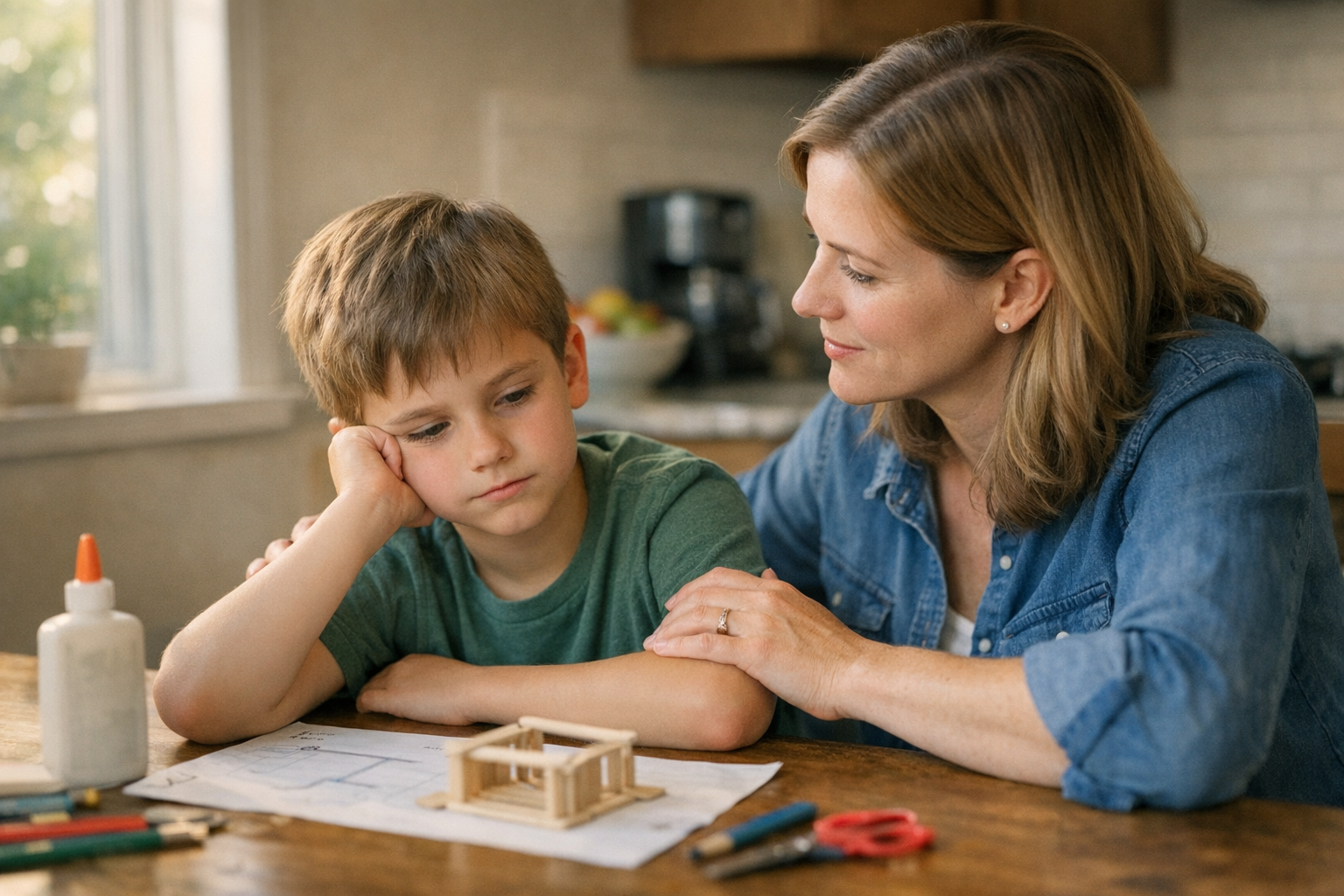
Your child misses the goal, forgets the lines, spills the milk, and suddenly the whole day seems ruined. Maybe they crumple into tears over a small mistake. Maybe they stomp off and say they will never try again. Maybe they act tough for ten minutes and then melt down over something completely unrelated. Those moments are when a lot of parents quietly wonder, “How do I help my child handle life without falling apart?”
Resilience is not about raising a child who never cries, never gets upset, or shrugs off every hard thing. Most parents do not want a kid who feels less. They want a kid who can feel disappointed, frustrated, embarrassed, or nervous and still find their way back.
That is the practical version of resilience. It is the ability to recover after a hard moment, try again after a setback, and keep a mistake from turning into a whole identity. And the good news is that resilience usually grows in very ordinary family moments. It is built when a parent stays steady after a bad day, helps a child name what happened, and shows them what comes next.
Why This Happens
Children are still learning how to handle discomfort. Adults have years of practice with frustration, failure, delay, and embarrassment. Kids do not have that backlog yet. A spelling mistake, a lost game, or a friend saying no can feel huge because their brains and bodies are still learning how to sort intensity from catastrophe.
Some children also feel setbacks more strongly than others. A child who is sensitive, perfectionistic, or easily overwhelmed may react hard to things that look small from the outside. That does not mean they are weak. It often means they need more repetition, more recovery practice, and more support building a path back to calm.
It also helps to remember that resilience is not the same as independence. A resilient child is not a child who handles every hard thing alone. Resilience grows when children experience stress in manageable doses and have enough support to move through it instead of getting stuck in it. If your child is already carrying a lot emotionally, Helping Kids Through Family Stress can help you see how outside pressure affects everyday coping.
What Parents Can Do
Stay calm enough to lend your child your steadiness
When a child is unraveling, parents often feel pulled toward fixing, lecturing, or rushing the emotion away. But the first job is usually simpler: be the calmest nervous system in the room. That does not mean sounding robotic. It means resisting the urge to match the panic.
You might say, “That was really disappointing,” or “You are having a hard moment. I’m here.” Those lines do not solve the problem, but they keep the child from feeling alone inside it.
Name the moment without making it dramatic
Some children get stuck because every setback starts to feel like proof that they are bad at something. A helpful middle ground is to name what happened clearly but keep it in proportion.
Try language like:
- “You made a mistake, but mistakes are fixable.”
- “You are disappointed because you worked hard and it did not go the way you hoped.”
- “That felt embarrassing. Embarrassing is not the same as dangerous.”
- “You can be upset and still keep going later.”
This kind of language helps children separate the event from their identity. It teaches, “Something hard happened” instead of “I am a failure.”
Teach recovery before you teach the lesson
Parents naturally want to talk about what the child should do differently next time. But if a child is still flooded, the lesson will not land. Recovery comes first. That might mean water, movement, a few quiet minutes, a hug, deep breaths, or sitting beside you while they settle.
Once the intensity drops, then you can shift into problem-solving. If your child often struggles to bounce back after frustration, Supporting Your Child Through Big Emotions can help with that first stage of emotional recovery.
Use “what now?” more than “why did you do that?”
Resilience grows when children learn that hard moments still have a next step. After the crying, the anger, or the disappointment, help your child move toward action.
That might sound like:
- “What would help your body calm down right now?”
- “Do you want to try again today or tomorrow?”
- “What is one small thing we can do next?”
- “What would make this feel a little more manageable?”
Those questions show children that being upset is allowed, but it is not the end of the story.
Let kids do hard things in doable doses
Parents sometimes accidentally weaken resilience by over-rescuing. If we step in too fast every time a child feels frustrated, nervous, or disappointed, the child gets relief but loses practice. The goal is not to throw them in the deep end. The goal is to give them a challenge small enough to survive and meaningful enough to learn from.
That could mean encouraging them to ask the teacher for help instead of doing it for them, letting them finish a tricky puzzle without constant correction, or helping them return to a game after losing once. Resilience builds when children discover, “I can feel uncomfortable and still function.”
Praise recovery, not just success
Many kids hear a lot about outcomes: good grade, scored goal, finished project, won game. But resilience lives in the middle part. Notice the getting-back-up moments.
Say things like:
- “You were upset, and you still came back to finish.”
- “I noticed you took a break instead of quitting.”
- “That was frustrating, but you kept working.”
- “You did not like the result, and you handled it better the second time.”
If your child struggles especially with losses or unmet expectations, Helping Kids Handle Disappointment pairs well with this recovery-focused approach.
Share your own repair process
Children learn resilience partly by watching adults recover. You do not need to model perfection. In fact, it is often more useful to let your child hear something like, “I was really frustrated, so I took a minute and tried again,” or “That meeting did not go the way I wanted, but I am going to reset and keep going.”
This helps children understand that resilience is not a personality trait some people get for free. It is something people practice, including grown-ups.
Common Mistakes to Avoid
Trying to shut down the feeling too fast. “It’s not a big deal” may be true from an adult perspective, but it rarely helps a child recover faster. Children calm down better when they feel understood first.
Turning every setback into a pep talk. Kids do not always need a speech about grit. Sometimes they need quiet company, a glass of water, and one simple next step.
Rescuing too early. If you always step in before frustration peaks, your child misses the chance to learn what getting through frustration feels like.
Confusing toughness with resilience. A child who hides feelings is not automatically coping well. Real resilience includes feeling, recovering, and re-engaging.
Focusing only on performance. Children who believe love and approval depend on winning, achieving, or being “naturally good” often have a harder time recovering from setbacks. If hard seasons are already wearing your child down, Parenting Through Difficult Phases can help you keep your expectations steady without becoming harsh.
Simple Plan to Try This Week
If you want to build resilience without turning it into a whole parenting project, try this for the next seven days:
Step 1: Pick one recurring hard moment
Choose one place where your child reliably struggles: losing games, homework mistakes, sibling conflict, sports frustration, bedtime fears, or social disappointment.
Step 2: Decide on one calming phrase
Use the same line each time so your child starts to recognize it. Something like, “This is hard, and you can handle hard things,” or “You do not have to like this to get through it.”
Step 3: Build one short recovery routine
Keep it simple: breathe, drink water, sit together, then pick a next step. Repetition matters more than creativity here.
Step 4: Practice one tiny do-over
After a setback, help your child re-enter in a small way. One more problem. One more serve. One more sentence. One more try saying it calmly. The goal is not a perfect comeback. The goal is returning at all.
Step 5: Name the bounce-back
At the end of the day, mention one recovery moment you noticed. “You were really upset after soccer, but you came back and joined dinner.” That helps children see themselves as someone who can recover.
Step 6: Keep expectations realistic
Resilience grows slowly. The win is not “my child never melts down.” The win is “my child is starting to need less time and less rescue to get moving again.” If fear is a big part of the pattern, Helping Kids Overcome Fear can be useful alongside resilience work.
Helpful Tools
You do not need products to raise a resilient child, but a couple of optional tools can support the conversations and routines that help kids recover.
- The Whole-Brain Child can be a useful parent read if you want a better feel for why kids fall apart so quickly and how to help them reconnect before teaching.
- Feelings and Emotions Cards can help younger children identify what they are feeling after a setback, which often makes recovery easier and less explosive.
FAQ
What is resilience in children, really?
In everyday life, resilience is the ability to recover after stress, disappointment, mistakes, or change. It is less about “being tough” and more about learning how to come back.
Can a sensitive child still become resilient?
Absolutely. Sensitive children may feel things more intensely, but they can become deeply resilient when they learn good recovery skills and get steady support.
Should I let my child fail on purpose?
No. You do not need to create failure. Real life provides plenty of frustration on its own. The goal is to help your child move through normal setbacks instead of shielding them from all discomfort.
What if my child cries over every small mistake?
Start with regulation, not correction. Help them calm down, name what happened, and practice one tiny re-entry step. Over time, the pattern often softens as they learn that mistakes are survivable.
How long does it take to build resilience?
It is an ongoing skill, not a one-time lesson. You are looking for gradual change: faster recovery, more willingness to try again, and less need for rescue in the same kinds of situations.
Resilience is built in small moments when your child falls apart a little, then learns how to come back together. Stay steady, keep the next step small, and notice the recoveries. That is usually how stronger coping grows.