
One day your child is talking about what snack to bring to the park, and the next they are asking whether Grandma can still see them from heaven, or why the dog is not coming home. Loss can land in the middle of Tuesday, and that is part of what makes it so hard for kids and parents.
When a child loses a grandparent, a pet, a friend, or another person who mattered to them, the feelings rarely show up in a neat, tearful moment. Sometimes it looks like clinginess at bedtime. Sometimes it looks like silly behavior at the funeral. Sometimes it is a child asking the same question 14 times in two days. Sometimes it is anger because their cereal broke in half.
If you are in that stage right now, you are not doing anything wrong. Children grieve in pieces. They dip into the pain, then come back out and ask for a sandwich or run off to play. That back-and-forth can feel confusing to adults, but it is often how kids handle what feels too big to process all at once.
As you support them, it can help to remember that children often need steady routines and simple emotional language at the same time. If your child is already struggling with bigger transitions, this guide on helping kids through big changes can support the day-to-day side too.
Why This Happens
Adults usually understand loss as one event with long emotional ripples. Kids often experience it in bursts.
A young child may not fully understand what death means. They may ask when someone is coming back. They may seem fine for hours, then melt down when they cannot find their favorite socks. An older child may understand the loss is permanent but still have trouble expressing what they feel. They might go quiet, become irritable, or worry about other people dying too.
Children also watch the adults around them for clues. If the room feels tense, if routines disappear, or if nobody is naming what happened, kids often fill in the blanks themselves. Those guesses can be more upsetting than the truth.
Loss also takes away predictability. Kids feel safer when life makes sense. When someone important dies, or even when a beloved pet is gone, the world can start to feel less steady. That is why grief can show up as sleep issues, extra questions, trouble concentrating, or a stronger need for reassurance.
Some children respond with behavior that looks unrelated. They may become more sensitive to disappointment, more reactive with siblings, or more anxious at drop-off. If that sounds familiar, ideas from helping kids through family stress can be useful alongside grief support.
What Parents Can Do
Tell the truth in simple words
Children do better with clear, gentle language than with vague phrases. Saying someone “went to sleep” or was “lost” can create fear and confusion, especially for younger kids.
Simple is better: “Grandpa died yesterday. His body stopped working, and he cannot come back. We are very sad because we love him.”
You do not need a perfect speech. You just need honest words your child can return to.
Expect repeated questions
Kids often ask the same question again and again, not because they were not listening, but because they are slowly trying to understand something huge.
You might hear:
“When is the dog coming back?”
“Who will take me to soccer now?”
“Are you going to die too?”
Answer calmly, even if it feels repetitive. Repetition is part of how children make sense of loss.
Name feelings without forcing them
Some kids cry openly. Others do not. Some want to talk in the car. Others want to build with blocks while they talk sideways.
Try simple observations instead of pressure:
“You seem quieter today.”
“It makes sense if you miss her.”
“You do not have to talk right now. I’m here when you want to.”
This kind of calm language can matter more than a big emotional talk. If your child has a hard time putting feelings into words in everyday life, this post on effective communication with kids has ideas that fit here too.
Keep routines as steady as you can
Grief changes a lot. Bedtime, meals, school, and familiar rituals help children feel like the ground is still there.
This does not mean pretending nothing happened. It means letting life hold them while they process it. Keep the basics moving when possible: breakfast, bath, reading time, lights out. Predictability is comforting.
Make room for memory
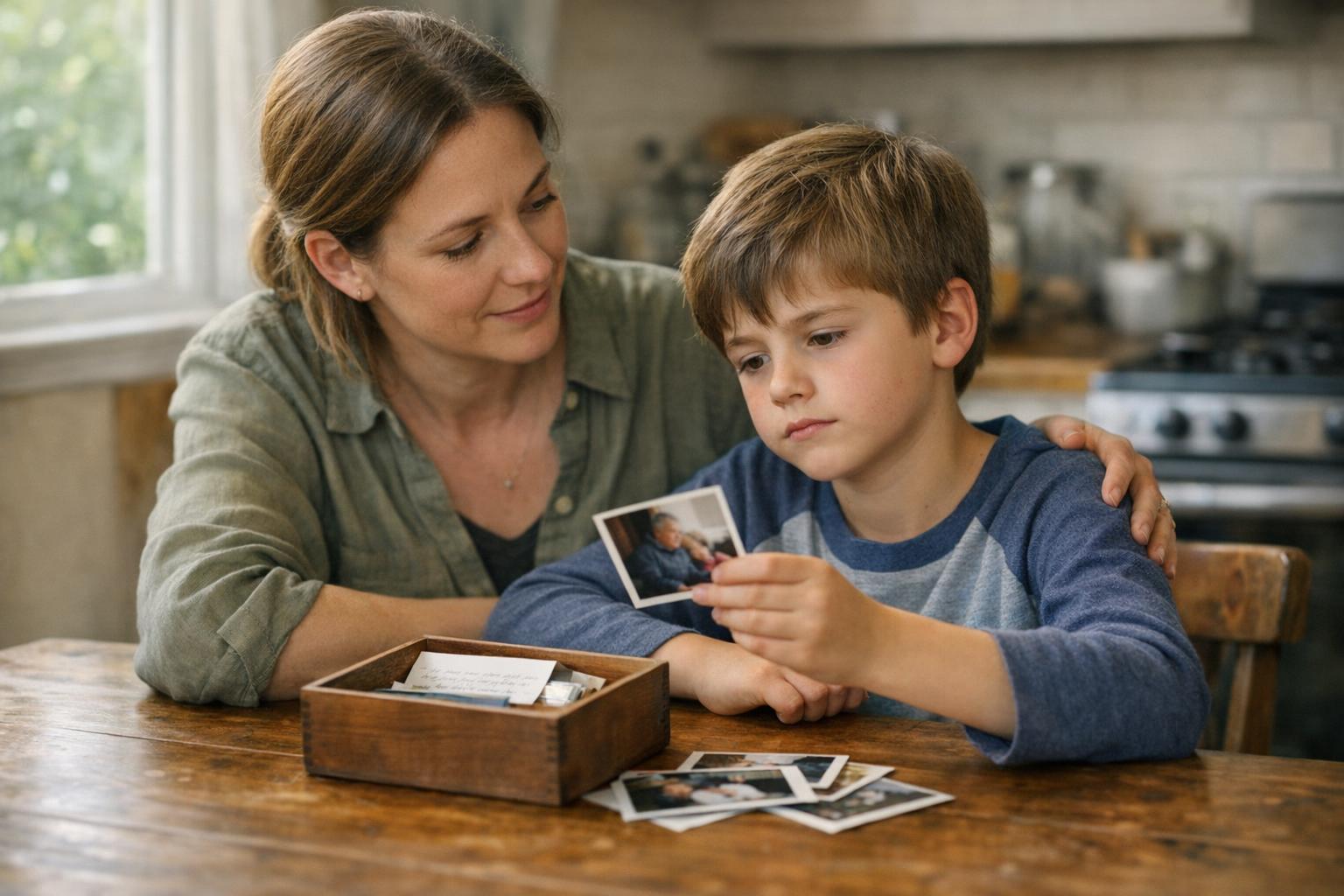
Children often need a concrete way to stay connected. That might be looking at photos, drawing a picture, lighting a candle with an adult, planting flowers, or making a small memory box with notes and favorite objects.
For a child who lost a pet, you might print one favorite photo and let them choose where it goes. For a grandparent, maybe they help bake that person’s favorite cookies once a month. Small rituals can be powerful because they give grief somewhere to go.
Watch for behavior that is really grief
A child who suddenly refuses school, argues more, or falls apart over tiny things may not be “acting out” in the usual sense. They may be overloaded.
That does not mean there are no boundaries. It does mean the response should be steady and compassionate. Think: “You may not hit. You are having a hard time, and I’m staying with you.” That balance helps.
Use books and tools as conversation starters
Some children talk more easily when the conversation is not face-to-face. A simple prompt, card, or parent guide can make those moments feel less intense.
Common Mistakes to Avoid
Trying to fix the sadness too fast
When your child hurts, the instinct is to make it better immediately. But grief is not a problem you solve in one talk. If you rush to silver linings, your child may feel like the sad feelings are too much for you.
Instead of “Don’t be sad,” try “I know. You really miss him.”
Talking only once
Many parents have one hard conversation, then hope it is covered. Most children need dozens of smaller conversations over time. Keep the door open.
Reading behavior as disrespect
A grieving child may be more scattered, irritated, or needy. That does not excuse hurtful behavior, but it does change how you interpret it. Respond to the need underneath the behavior whenever you can.
Hiding all your own feelings
Children do not need adults to be emotionless. They need adults to be steady. It is okay for your child to see you cry and hear you say, “I’m sad too, and I’m okay.” That teaches them feelings can be big without being dangerous.
Forcing participation in rituals
Some children want to attend a memorial or say goodbye in a formal way. Some do not. Offer choices when possible. A child might prefer drawing a picture for the casket, visiting later, or having a private family ritual at home.
Simple Plan to Try This Week
Day 1: Use one clear sentence
Say what happened in plain language. Keep it short. Let your child respond in whatever way they respond.
Day 2: Create one steady routine
Choose one anchor point your child can count on this week, like bedtime stories, a walk after dinner, or pancakes on Saturday morning.
Day 3: Invite, do not force, conversation
Try a low-pressure opener during a side-by-side moment: “I’ve been thinking about Uncle Mike today. Have you?” If they say no, let that be okay.
Day 4: Make a memory ritual
Pick something tiny and repeatable: a candle on Sunday, a photo by the bed, a shared story at dinner, or writing one memory on a slip of paper.
Day 5: Prepare for questions at odd times
Kids often bring up loss at bedtime, in the grocery store, or two minutes before school. You do not need a perfect setting. Answer simply, then come back to it later if needed.
Day 6: Notice behavior without overreacting
If your child is extra clingy, tearful, or irritable, say what you see before correcting. “You seem worn out today.” That small pause can lower the temperature fast.
Day 7: Check what support you need too
Children do better when the adults around them are supported. Ask yourself what would help this week: another family member handling school pickup, a friend bringing dinner, or one quiet hour to reset.
If your child is also dealing with fear around separation, this article on handling separation anxiety may help with the clingy moments that sometimes follow a loss.
Helpful Tools
Optional tools can make emotional conversations feel a little easier, especially for kids who do not open up quickly.
A set of feelings and emotions cards can help younger children point to what they feel when words are hard.
For parents who want more support around hard conversations, How to Talk So Kids Will Listen is a useful, practical guide to keeping communication open without pushing.
FAQ
Should I tell my child right away when someone dies?
Usually yes. It is better for your child to hear it from a trusted adult in simple, honest language than to piece it together from overheard conversations.
What if my child does not seem sad?
That can be normal. Some children process grief through play, questions, or delayed reactions. A lack of tears does not mean the loss did not matter.
Is it okay for my child to go to a funeral or memorial?
Often yes, if they are prepared for what to expect and have a supportive adult with them. When possible, give them a choice and explain the event in simple terms first.
What if my child keeps asking whether I will die too?
Stay calm and answer briefly. You might say, “Most people live until they are very old. I plan to be here taking care of you for a long time.” Reassurance matters, but avoid making impossible promises.
When should I look for extra support?
If your child seems stuck in intense distress for a long time, or grief is making daily life much harder at home or school, getting support from a pediatrician, school counselor, or child therapist can be a helpful next step.
Loss does not move in a straight line, and kids do not grieve in tidy ways. They ask odd questions, laugh at strange times, and revisit the same feelings long after adults expect them to be “past it.” What helps most is not having perfect words. It is being the steady person who tells the truth, makes room for sadness, and keeps showing up.
And if your child is carrying several hard feelings at once, our guide to supporting emotional growth during change is another good place to start.