
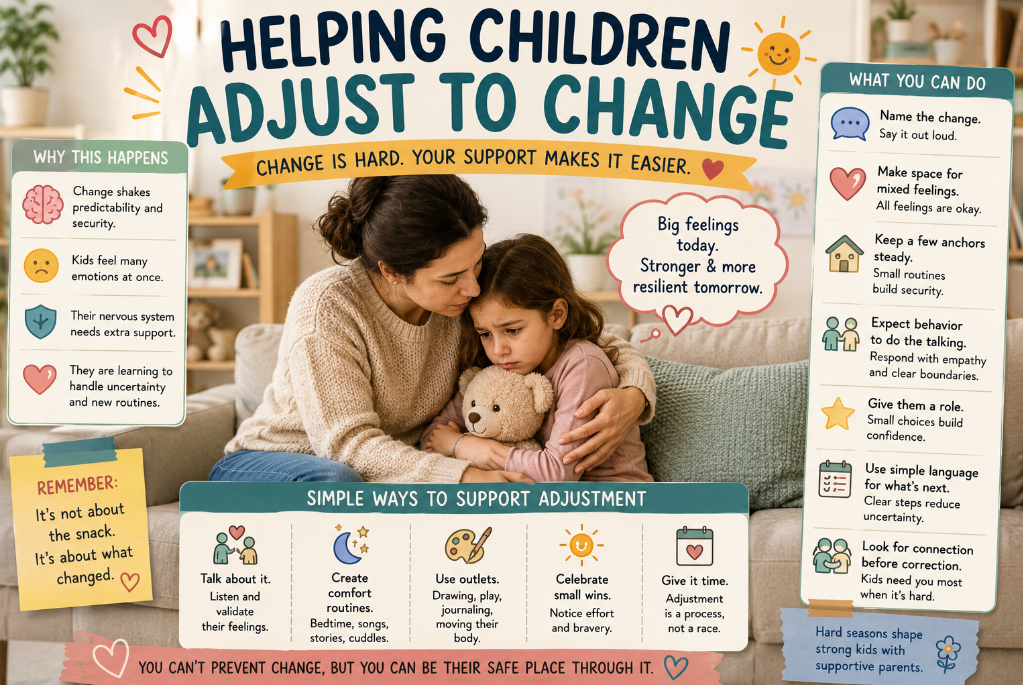
One day your child is fine, and the next they are crying because their blue cup is in the dishwasher, clinging at drop-off, or snapping at everyone over socks. Sometimes that behavior shows up right after a move, a new baby, a school change, a long vacation, or even a change in the family schedule. What looks like “overreacting” is often a child trying to make sense of life feeling different.
Change can shake even easygoing kids. A child who usually rolls with things may suddenly get louder, needier, more sensitive, or withdrawn. That can be confusing for parents, especially when the change was supposed to be a good one. But emotional growth often happens right in the middle of those messy transition weeks.
The goal is not to talk children out of their feelings or make every transition smooth. It is to help them feel safe enough to name what is changing, handle the feelings that come with it, and slowly build confidence that they can adjust. If your child is having a hard time lately, this season may be doing more emotional work than you can see.
Why This Happens
Children depend on predictability. They may not say, “I feel unsettled because my world has shifted,” but their behavior often says it for them. Routines help kids know what comes next, who is available, and where they fit. When that structure changes, their nervous system can go on high alert.
Some children respond by becoming clingy. Some become controlling. Some fall apart over tiny disappointments because they are already working hard to cope with the bigger change underneath. If you have ever thought, “This cannot really be about the snack,” you were probably right.
Another piece is that kids do not always have the language to describe mixed feelings. They can feel excited about a new school and still grieve the old one. They can love a new sibling and still miss having you to themselves. They can look forward to a trip and still struggle when they get home. That emotional overlap is normal.
It also helps to remember that change asks children to do several difficult things at once:
- let go of something familiar
- tolerate uncertainty
- manage stronger feelings than usual
- learn new expectations or routines
That is a lot for a child brain. If your child is also sensitive, tired, hungry, or already stressed, the transition can hit even harder. Articles like this guide to parenting through difficult phases can help parents zoom out and remember that hard stretches do not always mean something is going terribly wrong.
What Parents Can Do
Name the change out loud
Many kids calm down when a parent simply says what is true. Try plain language: “You have been extra upset since school ended,” or “A lot has changed since we moved.” That tells your child you see the bigger picture. It also helps them connect feelings to events instead of assuming they are just “bad” or “too much.”
You do not need a long speech. What matters is that you make the invisible visible.
Make space for mixed feelings
Children do better when they learn that two feelings can exist at the same time. You can say, “You can be excited about camp and still nervous,” or “You can love the baby and still wish things felt quieter.” That kind of language reduces shame and makes emotional flexibility easier over time.
If your child tends to melt down fast, this is also where supporting children through big emotions becomes part of the work. Before problem-solving, kids usually need help feeling understood.
Keep a few anchors steady
When life changes, do not try to keep everything the same. Just protect a few reliable anchors. Bedtime rhythm, a silly goodbye ritual, Friday pancakes, reading on the couch, a short walk after dinner, or ten minutes of one-on-one time can all send the message: not everything is moving.
These small routines matter because they lower the background stress. A child does not need a perfect schedule. They need a few dependable touchpoints.
Expect behavior to do some of the talking
Kids often communicate stress sideways. That may mean more whining, more tears, more power struggles, or a sudden need to control little things. Instead of asking only, “How do I stop this behavior?” ask, “What is this behavior telling me right now?”
That does not mean every outburst gets a free pass. Boundaries still matter. But the response usually works better when it combines limits with empathy: “I will not let you hit. You seem really wound up since your routine changed. Let’s get your body calm first.”
Give your child a job in the transition
Change feels less scary when children have some role in it. Let them pack the “first night” box after a move, pick the song for the new morning routine, choose a photo for a memory board, or help create the after-school plan. Small choices can rebuild a sense of control without putting adult decisions on their shoulders.
This works especially well for kids who get anxious when things feel done to them instead of with them.
Use simple language for what comes next
Uncertainty is hard on children. They usually do better with short previews than vague reassurance. Instead of saying, “Don’t worry, you’ll be fine,” try: “Tomorrow I’ll walk you to the classroom, we’ll do two hugs, and your teacher will help you hang up your backpack.”
Specific steps give the brain something to hold onto. This can be especially helpful if your child is dealing with clinginess around separation, and resources like handling separation anxiety in young children can help you build a calmer handoff routine.
Look for connection before correction
During change, children often need more connection than usual, even if they act like they deserve less. Sit next to them while they color. Rub their back at bedtime. Invite them to help with ordinary tasks. Keep conversations low-pressure. Emotional growth rarely comes from one perfect talk. It usually grows through repeated moments of safety.
Common Mistakes to Avoid
Talking kids out of their feelings too quickly
Parents naturally want to reassure. But “It’s not a big deal” or “You’ll get used to it” can land as dismissal, even when meant kindly. Reassurance works better after validation, not before it.
Expecting the child to “be grateful” for positive changes
A bigger bedroom, a fun camp, a new school, or a family trip can still stir up grief, worry, and exhaustion. Children are allowed to struggle with good changes too.
Changing every routine at once
When families are under pressure, it is tempting to overhaul everything. But a child adjusting to one big change does not also need a brand-new bedtime system, new rules, and a packed calendar if those things can wait.
Taking the behavior personally
Transition stress can make kids more oppositional, more emotional, or less cooperative. That does not automatically mean they are becoming disrespectful or manipulative. Sometimes it means they are overloaded. Staying curious helps more than taking the bait.
Waiting for a calm child before offering support
Children often need help getting regulated before they can use words, listen, or reflect. If you wait for perfect calm before offering connection, you may miss the moment when they need you most.
Simple Plan to Try This Week
If your child is in the middle of a transition, keep the plan small and realistic.
Day 1: Name what has changed
Use one sentence at a calm moment: “There has been a lot to adjust to lately.” Do not force a deep conversation.
Day 2: Add one steady anchor
Pick one ritual you can keep this week no matter what. A predictable bedtime check-in works well.
Day 3: Preview tomorrow
At bedtime, walk through the next day in three or four simple steps. Keep it concrete.
Day 4: Offer one choice inside the change
Let your child choose between two lunch options, two goodbye rituals, or two after-school wind-down activities.
Day 5: Watch for the pattern
Notice when the hardest moments happen. Is it right before drop-off, after school, or at bedtime? Patterns help you support the real stress point instead of reacting to every flare-up.
Day 6: Build a feeling habit
Try a simple check-in: “What felt easy today? What felt hard?” If your child resists talking, let them point, draw, or answer while playing.
Day 7: Celebrate coping, not perfection
Say what you noticed: “You were nervous, but you still walked in,” or “You were upset, and you told me with words.” Emotional growth is not the absence of hard feelings. It is learning what to do with them.
Helpful Tools
Some families like a few concrete tools during transition-heavy seasons. These can support calmer conversations and better emotional language.
- Feelings and Emotions Cards can help younger kids point to what they feel when words are hard to find.
- How to Talk So Kids Will Listen is a useful parent resource if you want more practical ways to respond during tense or emotional moments.
FAQ
How long does it take a child to adjust to change?
It depends on the child and the size of the change. Some bounce back in days. Others need weeks or longer. Look for gradual signs of adjustment rather than instant comfort.
Is clinginess normal during transitions?
Yes. Extra closeness can be a child’s way of checking that their safe base is still there. It usually eases as the new situation becomes more familiar.
What if my child seems angry instead of sad?
That is common. Kids often show stress through irritability, control battles, or quick frustration. Anger may be covering worry, grief, or uncertainty.
Should I bring up the change if my child is not talking about it?
Usually yes, but gently. You are not forcing a conversation. You are opening the door by noticing what is true and making it safe to talk if they want to.
When should I worry that it is more than normal adjustment?
If distress is intense, lasts a long time, affects sleep or daily functioning in a major way, or your child seems stuck rather than slowly adapting, it may help to check in with your pediatrician or a licensed child mental health professional.
Children do not grow emotionally by avoiding change. They grow when a trusted adult helps them move through it without feeling alone. If this season has been rocky, it may simply mean your child is doing the hard work of adjusting. Keep showing up, keep naming what is real, and keep the steady pieces steady. If your family is juggling a lot, this piece on helping kids manage stress may give you a few more ways to lighten the load at home.