
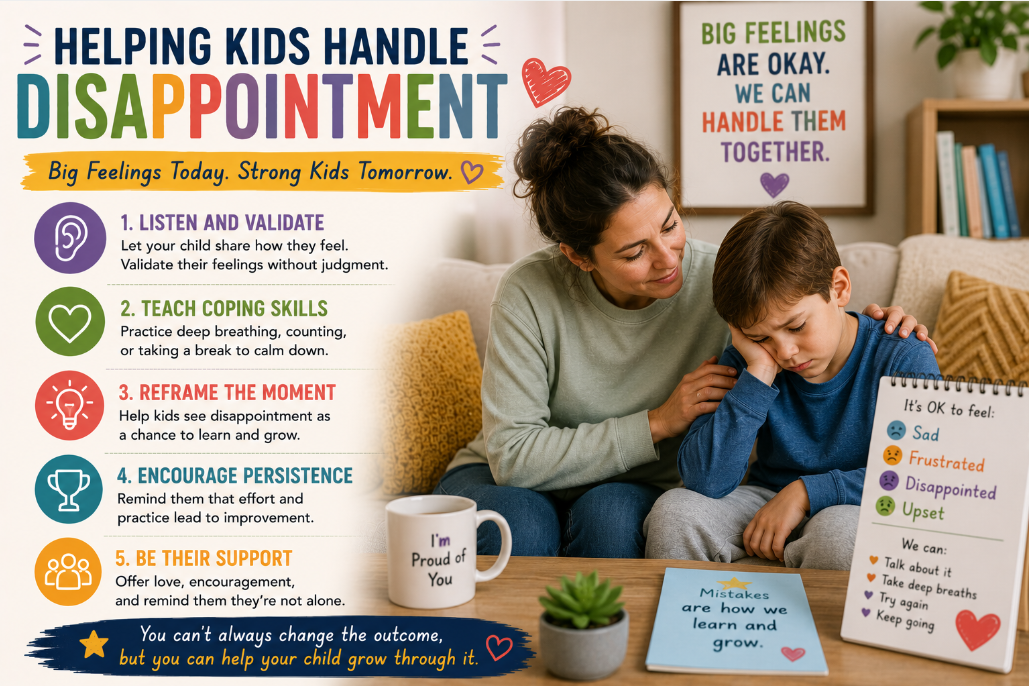
Your child was sure they would get invited, picked, chosen, or allowed to go — and then the answer was no. Now they are on the floor in tears, furious at their brother, or suddenly insisting they never cared in the first place. Disappointment can hit kids hard because it is not just about the moment they lost. It is also about the picture they had in their head of how things were supposed to go.
Maybe it was the team they did not make. Maybe it was the playdate that got canceled, the cupcake they wanted that someone else grabbed first, or the birthday party they were not invited to. However it shows up, disappointment can make ordinary family life feel long very quickly.
Parents often feel pulled in two directions here. One part of you wants to comfort your child right away. Another part wants to say, “This is life. You cannot fall apart every time things do not go your way.” Both reactions make sense. The trick is helping your child feel the feeling and learn how to carry it without letting it run the whole house.
The good news is that disappointment is a skill-building moment. Kids can learn to recover, adjust, and try again. If your family is also working on supporting your child through big emotions, this is one of the places that work really matters.
Why This Happens
Kids do not just react to what happened. They react to the story they were already telling themselves. If your child spent all day expecting to sit next to a best friend, win the game, or hear “yes,” the crash feels bigger when reality goes the other way.
Children also tend to have less perspective than adults. A grown-up can think, “This stings, but there will be another chance.” A child often thinks, “This is terrible, unfair, and maybe always going to be this way.” That is why a small event can create a huge reaction.
Temperament matters too. Some kids are naturally more intense. Some are more sensitive to fairness. Some hold themselves to high standards and take every setback personally. Others seem fine until later, when disappointment leaks out as whining, picking fights, or shutting down.
Disappointment also tends to pile onto other stress. A tired child, a hungry child, or a child already stretched by school or social stuff will usually have less room for a letdown. If that sounds familiar, you may also see overlap with things like what to do when your child feels left out or social worries that look bigger after one hard moment.
What Parents Can Do
Start by naming what happened
You do not need a long speech. A simple sentence helps your child feel seen and lowers the pressure to prove they are upset.
Try:
- “You really wanted that to happen, and it did not.”
- “That felt like a big letdown.”
- “You are disappointed, and I get why.”
This is not the same as agreeing that life is unfair forever. It is just telling the truth about the moment.
Do not rush too fast into fixing
When kids are upset, adults often go straight to solutions. “There will be another game.” “You can do it next time.” “It is not a big deal.” Those lines are not terrible, but if they come too early, kids usually hear them as, “Stop feeling this.”
Instead, stay with the feeling for a minute before pivoting. A child who feels understood settles faster than a child who feels talked out of their reaction.
Keep the boundary while allowing the feeling
It is okay for your child to cry, pout, or need space. It is not okay to slam doors, insult a sibling, or throw a shoe across the kitchen. This is where calm clarity matters.
You can say:
- “You can be upset. You cannot hit.”
- “You can cry on the couch. You cannot scream in your sister’s face.”
- “I will stay with you, but I will not let you break things.”
This teaches a powerful lesson: feelings are real, but behavior still matters.
Help your child tell the fuller story
Once the first wave passes, gently widen the frame. You are not trying to erase the disappointment. You are helping your child hold more than one truth at once.
For example:
- “You are disappointed you were not chosen, and you still worked hard.”
- “You wanted that playdate, and it is okay to be sad that plans changed.”
- “You did not get what you hoped for today, and that does not mean you will never get a turn.”
This is especially helpful for kids who slide into all-or-nothing thinking.
Coach recovery, not just endurance
After disappointment, some kids need help figuring out what to do next. Recovery might mean taking a walk, drawing, jumping on the trampoline, sitting quietly, or making a new plan for the rest of the day.
You can ask:
- “Do you want comfort, space, or help making a new plan?”
- “What would help your body calm down right now?”
- “What is one small thing we can do next?”
That is how kids learn they can move through hard feelings instead of staying stuck inside them.
Use everyday disappointments as practice
Not every lesson has to come from a giant heartbreak. The wrong color cup, the sold-out snack, the rained-out park trip, or the game that ended badly all count as practice reps. When parents stay steady during small letdowns, kids build the skills they need for bigger ones later.
If your child tends to spiral when plans change, routines and previews can help. That is one reason articles like handling separation anxiety and helping kids overcome fear often overlap with disappointment work more than parents expect.
Common Mistakes to Avoid
Making it smaller than it feels. Saying “It is not a big deal” may be factually true to you, but it usually makes kids push harder to be understood.
Turning the whole moment into a lecture. Right after a letdown is rarely the best time for a long lesson about resilience, gratitude, or perspective.
Trying to erase every disappointment. If parents constantly rescue, replace, or rearrange life so kids never hear no, children miss the chance to build tolerance for frustration.
Getting pulled into the drama. If your child is melting down and you escalate too, the disappointment becomes a second problem. Calm does not mean cold. It means steady.
Expecting one good conversation to solve it forever. This skill grows slowly. Some kids need the same coaching fifty times before it starts sounding like their own inner voice.
Simple Plan to Try This Week
If disappointment has been a repeating issue at your house, try this simple plan for the next seven days.
1. Pick one calm phrase ahead of time
Choose a line you can actually remember when emotions are high, like: “You are disappointed, and I am here.” The more often you use the same calm language, the safer it starts to feel.
2. Decide on one recovery option
Make a short list with your child when they are calm: water, quiet corner, walk outside, music, stuffed animal, drawing, or five minutes alone. Then use the list in the moment instead of inventing a solution under pressure.
3. Practice with small letdowns
When a small disappointment happens, resist the urge to fix it instantly. Name it, hold the boundary, and help your child recover. That is the real practice.
4. Debrief later, not during the peak
Once your child is calm, ask two short questions: “What felt hardest?” and “What helped you get through it?” Keep it simple. You are helping them notice their own patterns.
5. Praise recovery, not pretending
Notice progress like, “You were really upset, and you calmed your body,” or “You were disappointed, but you still used kind words.” That teaches kids the goal is not to feel nothing. The goal is to handle the feeling well.
Helpful Tools
Some families like having a few concrete tools nearby for hard moments. These are optional, but they can make emotional coaching easier.
- How to Talk So Kids Will Listen — A parent-friendly communication book can help when you want better language for tough moments.
- Feelings and Emotions Cards — Emotion cards can give younger kids a simple way to name what they feel after a hard letdown.
FAQ
Is it okay to let my child cry when they are disappointed?
Yes. Crying is a normal response to a letdown. The goal is not to stop the feeling instantly. The goal is to help your child move through it without hurting people or getting stuck there for hours.
Should I try to toughen my child up?
Kids usually become more resilient by feeling supported while they handle hard things, not by being shamed for reacting. Support and strength are not opposites.
What if my child gets angry instead of sad?
That is common. Anger can be the top-layer feeling that shows up over hurt, embarrassment, or frustration. Name the disappointment underneath while still holding limits around behavior.
How do I handle repeated disappointment about friends?
Listen first, then look for patterns. If your child often feels excluded or confused socially, gentle coaching, role-play, and resources like how to respond to bullying concerns can help you respond more clearly.
When should I worry more?
If disappointment regularly leads to extreme aggression, intense shutdown, or distress that does not match the situation over and over, it may help to talk with your child’s pediatrician or a qualified mental health professional for added support.
Kids do not learn to handle disappointment because life suddenly gets easier. They learn because someone calm stays nearby long enough to show them what recovery looks like. That work is slow, repetitive, and sometimes exhausting. It is also worth it. And if you are helping your child carry a lot of big feelings lately, this guide on supporting your child through big emotions may be a good next read.