
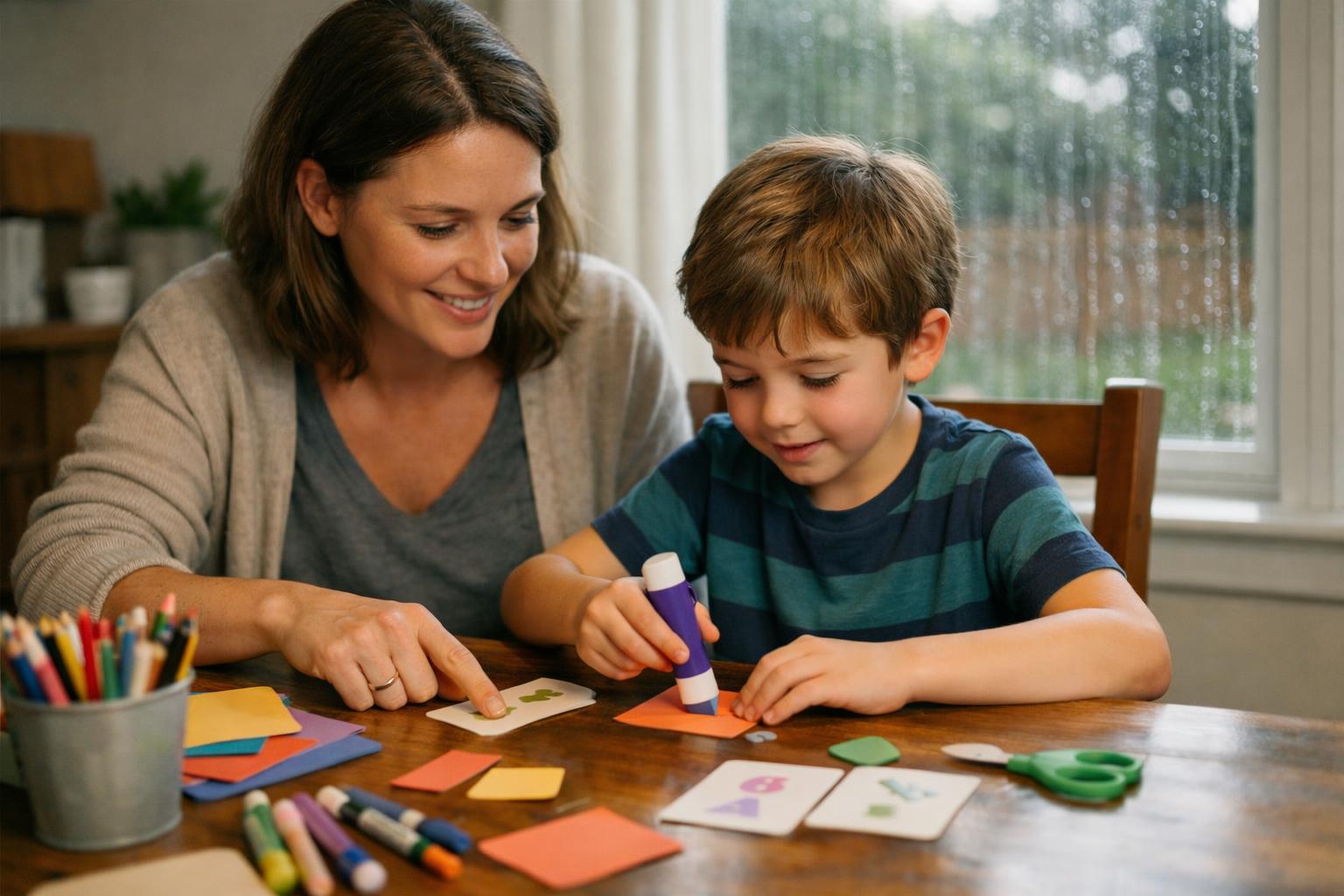
The rain has been tapping the windows since breakfast, the couch cushions are already on the floor, and your child has somehow gone from bored to feral in under twelve minutes. This is usually the moment parents start scrolling for “easy rainy day ideas” while also trying to stop someone from turning the hallway into a sock-slide racetrack.
Rainy days can feel long, especially when kids have energy to burn and school-style work is the last thing they want to do. The good news is that learning at home does not need to look like worksheets at the kitchen table. Some of the best rainy day learning happens when a child is building, sorting, pretending, guessing, noticing, and telling you what they think will happen next.
If you need fresh ideas that feel a little more purposeful than just “stay busy,” a few screen-free learning activities can turn a gray afternoon into something calmer and more productive. And if your child tends to bounce between activities, this guide on how to help kids focus better can make these moments easier to stretch.
Why This Happens
Rainy days throw off more than plans. They also change the rhythm kids rely on. There is less outdoor movement, fewer natural transitions, and often more togetherness than everyone really wants. When children cannot run, explore, or switch environments as easily, they often start looking for stimulation any way they can.
That does not mean they need formal lessons. It usually means they need meaningful activity. Kids learn best when they can do something with their hands, make choices, and get quick feedback. A child who groans at handwriting practice may happily label a homemade “museum.” A child who resists math facts may suddenly care deeply about counting marshmallows for a building challenge.
Rainy days can also work in your favor. When the pace slows down, children often have more room for observation, storytelling, experimenting, and problem-solving. That is why activities tied to curiosity tend to work especially well. If your child loves asking why everything works the way it does, building curiosity at home is a strong place to borrow ideas from too.
What Parents Can Do
Start with one simple invitation
Instead of announcing a big plan, offer one clear starting point. Kids often do better when the activity begins before they have time to reject it.
You might say:
- “Want to make a treasure map of the living room?”
- “Help me test which paper airplane flies farthest.”
- “Let’s build the tallest tower we can from what is in this basket.”
The goal is not to oversell it. It is to create enough interest for your child to begin.
Use ordinary materials
You do not need to pull off a teacher-level setup. Painter’s tape, paper, cups, books, dice, cardboard, socks, measuring spoons, toy animals, and crayons can cover a lot of ground. Children are usually more engaged by what they can manipulate than by how “Pinterest-worthy” an activity looks.
That is one reason learning through play works so well on stuck-inside days. The materials are ordinary. The thinking is not.
Build learning into movement
Rainy day learning goes better when kids are not expected to sit still too long. Hide letter cards around the room and send them on a hunt. Put numbers on sticky notes and have them jump to the answer. Ask them to carry objects, sort objects, match objects, and race the timer while they do it.
A five-year-old who will not write the alphabet might happily run to find the letter that makes the /b/ sound. A seven-year-old who hates review work may enjoy solving clues taped around the hallway.
Pick activities with a real purpose
Kids are more willing to practice a skill when it leads to something concrete. Instead of “do some writing,” try making menus for a pretend café. Instead of “practice reading,” let them read clues for a scavenger hunt. Instead of “do math,” ask them to measure ingredients, keep score, or compare distances in a flying-paper contest.
This is also a good place to borrow from educational games kids enjoy. Light structure often works better than a full lesson when the mood in the house is already getting wobbly.
Follow the activity that gets traction
If one idea clearly clicks, stay there longer than you planned. Parents sometimes feel pressure to rotate through lots of activities, but depth is usually better than variety. If your child spends forty minutes building a cardboard zoo, that is not “just killing time.” That can include design, classification, storytelling, spelling, labeling, and problem-solving all in one go.
Keep the tone light
Rainy day learning falls apart when children feel tricked into surprise school. The moment the activity feels like a test, many kids shut down. Stay curious instead of evaluative.
Try phrases like:
- “Show me how you figured that out.”
- “What do you think will happen if we change this part?”
- “Do you want to try another way?”
- “That was clever. I would not have thought of that.”
Simple Rainy Day Learning Ideas to Try
1. Living room scavenger hunt
Write clues or picture prompts that send your child searching for objects by color, shape, beginning sound, texture, or category. Younger kids can match pictures. Older kids can decode clues or write their own for a sibling.
2. Paper airplane lab
Fold different airplane styles, predict which will fly farthest, test them, and track results. This gives you easy practice with comparison words, measurement, observation, and cause-and-effect thinking.
3. Pretend store or café
Use pantry items, play food, or books as inventory. Kids can make signs, write menus, count money, total simple purchases, and practice taking turns in conversation.
4. Build-and-explain challenge
Give your child cups, blocks, pillows, or cardboard and ask them to build something that solves a problem: a bridge for toy animals, a bed for a stuffed bear, or a ramp for a marble. Then ask them to explain why they made certain choices. That kind of thinking pairs well with building problem-solving skills.
5. Indoor weather station
Let your child observe the rain, draw the clouds, measure rainfall in a cup outside if possible, or keep a tiny chart of what changes during the day. It sounds simple, but kids often love recording what they notice when the world outside looks different.
6. Story basket
Fill a basket with random objects like a spoon, toy car, sock, flashlight, and paper leaf. Ask your child to build a story using all of them. This helps with sequencing, vocabulary, and flexible thinking without feeling like language work.
Common Mistakes to Avoid
Doing too much setup. If it takes thirty minutes to prepare, you may be too tired to enjoy it by the time your child starts. Simple is more sustainable.
Expecting school behavior at home. Home has different energy. Kids may learn best standing up, sprawled on the rug, or halfway inside a blanket fort. That is fine.
Overcorrecting every mistake. If you jump in each time your child misspells a word or counts wrong, the activity can start feeling heavy. Let the flow continue unless the child wants help.
Switching too fast. Boredom in the first two minutes does not always mean the idea is a flop. Some kids need a little time to enter the activity.
Using screens as the automatic backup. Screens are not evil, but when they become the immediate rescue plan, kids miss the chance to practice creating their own fun and following through on a challenge.
Simple Plan to Try This Week
If rainy afternoons tend to go sideways in your house, try this low-pressure plan:
Step 1: Make one “rainy day basket”
Fill a bin with paper, tape, crayons, dice, index cards, measuring spoons, a deck of cards, sticky notes, and a few random small toys. Keep it somewhere easy to grab.
Step 2: Choose three repeatable activities
Pick one literacy idea, one math or logic idea, and one build-or-create idea. For example:
- Story basket
- Store game
- Build-and-explain challenge
Step 3: Use a short rhythm
Try 10 to 20 minutes of one activity, then a snack or movement break, then one more activity if the mood is still good. You do not need to fill the whole day with structured ideas.
Step 4: Let your child help choose the next round
Children are more cooperative when they feel some ownership. Give two options instead of asking a wide-open question.
For example: “Do you want to make clues or build something?” works better than “What do you want to do?”
Step 5: Notice what actually worked
At the end of the day, ask yourself what kept your child engaged the longest. Was it pretending, moving, building, sorting, drawing, or competing against a timer? That tells you far more than a generic list of rainy day ideas ever will.
Helpful Tools
You do not need special products for rainy day learning, but a couple of optional tools can make these activities easier to repeat:
- Educational Flash Cards can be useful if your child likes quick games with matching, sorting, memory, or speed challenges.
- National Geographic Kids Books are a good fit for children who get more engaged when learning starts with real animals, weather, space, or science facts.
FAQ
What if my child says every activity is boring?
Start smaller and earlier. Offer one activity before boredom turns into a full-house mood. Also make sure the first task is easy enough to enter quickly.
Do rainy day learning activities need to be educational in an obvious way?
No. If your child is planning, sorting, comparing, imagining, building, retelling, or explaining, learning is already happening.
How long should a rainy day activity last?
For many kids, 10 to 20 minutes is plenty unless they are deeply engaged. Stop while things are still going well instead of squeezing every drop out of it.
What if I have kids with different ages?
Choose activities with open-ended roles. A younger child can sort or collect while an older child writes clues, keeps score, or explains the rules.
Is it okay to use screens later if we already tried a learning activity?
Absolutely. This is not about banning screens. It is about having better options before the day turns into endless scrolling and arguments.
Rainy days do not have to be magical to be worthwhile. If you can turn one restless afternoon into a little more curiosity, a little less chaos, and one activity your child wants to repeat, that counts. And if you want even more low-pressure ideas that blend play with real skill-building, learning through play is a natural next read.