
Screen-Free Learning Activities
Your child says they are bored five minutes after the tablet goes away, but somehow they can spend half an hour sorting buttons, building a paper city, or turning measuring cups into a science lab. That is the sweet spot screen-free learning activities can tap into.
When parents hear “learning activity,” it can sound like one more thing to prep, supervise, and clean up. Most of us are not trying to recreate a classroom at home. We just want a few solid ideas that keep kids engaged, curious, and using their brains without defaulting to a screen every time there is a gap in the day.
The good news is that screen-free learning does not have to be fancy. It usually works best when it feels practical, hands-on, and slightly playful. A child measuring rice for a pretend store, matching socks by size, or making a map of the living room is learning just as surely as a child tapping an app. The difference is that screen-free activities tend to build attention, problem-solving, and conversation at the same time.
They also help parents see how their child learns in real life. You notice which tasks hold their attention, where they get frustrated, and what kinds of materials pull them in. If your child tends to drift quickly, pairing these ideas with a few simple strategies from creating a home environment that supports focused learning can make a big difference.
Why This Happens
Screens are efficient. They are bright, responsive, and built to keep attention. Real-world learning asks children to do more of the work themselves. They have to imagine, test, adjust, and stick with a problem when there is no instant animation rewarding them every three seconds.
That does not mean screens are bad. It just means screen-free learning uses a different set of muscles. Kids are practicing patience, sensory awareness, flexible thinking, and persistence. When a tower falls, they rebuild it. When a clue in a scavenger hunt does not make sense, they rethink it. When a recipe needs one more cup of water, they measure again.
These activities also work because they feel real. Children are more likely to stay engaged when a task has a visible purpose: making something, finding something, solving something, organizing something. That is why ordinary hands-on experiences often teach more than a worksheet ever could.
And if your child seems to “focus better” on screens than anything else, that does not necessarily mean they cannot learn without one. It often means they need shorter, clearer tasks with stronger entry points. This is where helping kids focus better and using engaging, low-pressure activities can work together.
What Parents Can Do
Start with what is already in your house
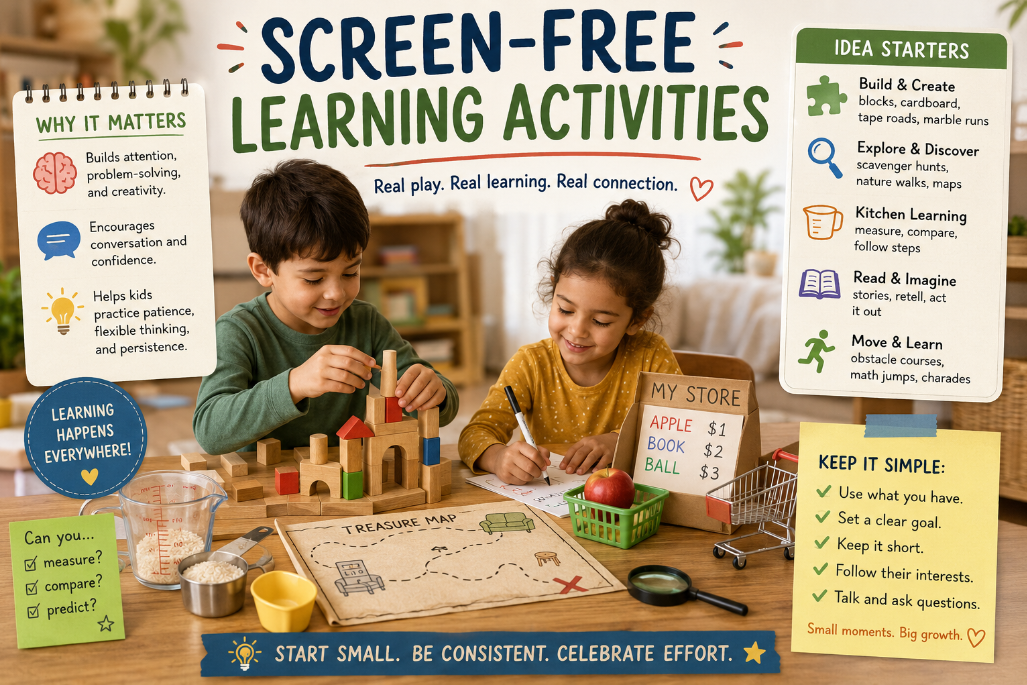
You do not need a closet full of educational supplies. Cups, tape, paper, crayons, toy animals, index cards, blocks, and laundry baskets can do a lot. The more approachable the setup feels, the more likely you are to use it on a random Tuesday.
Try simple invitations like: “Can you sort these buttons by color?” “Can you build a bridge for the toy car?” or “Can you make a store and price three things?” Those tasks build math, language, and reasoning without making the child feel like they are being assigned extra work.
Use activities with a clear goal
Open-ended play matters, but some kids do better when the activity has a finish line. Instead of saying, “Go do something educational,” try, “Can you make the tallest tower that stays up for ten seconds?” or “Can you draw a treasure map from the couch to the kitchen?” A clear challenge gives the brain somewhere to land.
This is one reason activities that involve planning and trial-and-error are so useful. They naturally strengthen the same mental muscles used in school tasks. If your child enjoys that kind of thinking, these ideas pair nicely with daily problem-solving challenges for kids.
Rotate by energy, not just subject
One mistake parents make is choosing every activity based on academic goals alone. A tired kid after school may not want to write, but they might happily do a movement-based scavenger hunt, count jumping jacks in groups of five, or act out a story with stuffed animals. Learning still counts when the body is involved.
It helps to keep a loose mix on hand:
- Quiet activities: drawing, pattern cards, sticker scenes, beginner puzzles, read-alouds
- Hands-on builders: blocks, cardboard creations, tape roads, marble runs
- Movement activities: obstacle courses, clue hunts, hopscotch math, acting out vocabulary words
- Kitchen learning: measuring, pouring, comparing sizes, following steps
When the activity fits your child’s energy level, it usually lasts longer and feels easier for everyone.
Let interests lead the lesson
A child obsessed with dinosaurs can measure toy dinosaurs, sort them by size, write fact cards, and create a habitat box. A child who loves pretend cooking can practice counting, sequencing, describing textures, and following directions. Interest is not a distraction from learning. Interest is often the doorway into it.
If you are trying to build curiosity more broadly, it can help to borrow from ways to build curiosity at home so your activities feel less like forced enrichment and more like a natural extension of what your child already wants to explore.
Keep it short enough to succeed
Parents sometimes abandon screen-free learning because the first attempt goes badly. Usually the problem is not the idea. It is the length. A ten-minute activity that ends well is far more useful than a forty-minute project that ends with everyone irritated and glue on the dog.
You can always stop while things are going well and return later. That helps protect motivation. Kids remember whether an activity felt satisfying much more than whether it lasted a long time.
Talk with your child while they work
The language around the activity matters. Ask things like, “What do you notice?” “What do you think will happen if…?” or “How did you decide that?” Those kinds of questions build reflection and vocabulary without feeling like a quiz.
They also support flexible thinking and confidence. If you want to reinforce that mindset, this article on cultivating a growth mindset in your child fits naturally with screen-free learning because both depend on trying, revising, and trying again.
Common Mistakes to Avoid
Making every activity too complicated. Children do not need an Instagram-worthy setup. In fact, simpler activities often get better follow-through because parents actually repeat them.
Switching to a screen too fast. A little boredom is not a crisis. Sometimes kids need a minute to fuss, wander, and reset before they settle into a hands-on activity.
Overexplaining. If you give a five-minute lecture before the child touches the materials, you may lose them. Start with one clear instruction and let the activity teach the rest.
Expecting independent play immediately. Some kids need a few minutes of joint setup before they take over. That is normal, not a failure.
Turning the activity into a performance review. If every moment becomes correction, children stop experimenting. Let messy attempts count as learning too.
Related:
Simple Plan to Try This Week
If you want a realistic reset, try this plan instead of buying new supplies or making a giant schedule:
- Pick one daily screen transition. Choose the time when your child usually reaches for a device: after school, while dinner is cooking, or early Saturday morning.
- Prepare three low-effort options. For example: a sorting tray, a scavenger hunt card, and a building challenge.
- Keep each option visible. When kids can see the materials, they are more likely to begin.
- Use a short invitation. Say, “Want to build, sort, or hunt?” A simple choice works better than a speech.
- Start with 10 to 15 minutes. If it goes well, great. If not, you still practiced the shift away from screens.
- Notice what held attention. Was it movement, structure, pretend play, or making something useful?
- Repeat the winner. Familiarity often beats novelty. A good activity can be reused with small tweaks.
If you need a few more ideas once you find your rhythm, this list of everyday activities that boost cognitive development can give you more low-pressure ways to keep learning woven into normal life.
FAQ
Do screen-free learning activities have to look academic?
No. Building, sorting, pretending, measuring, retelling stories, and solving little problems all count as learning. Children often learn best when it does not feel overly formal.
What if my child says screen-free activities are boring?
That is common at first, especially if screens have been the default. Keep the activity short, hands-on, and tied to something your child already likes. A little initial resistance does not mean the idea is wrong.
How long should these activities last?
For many kids, 10 to 20 minutes is plenty. Stop while the activity is still going reasonably well instead of stretching it until everyone is done.
Do I need to buy educational kits?
Not usually. Household materials can cover a lot of ground. If you eventually buy something, it should be because it truly fits your child’s interests and gets used often.
Are screens always bad for learning?
No. Screens can be useful tools. The goal is balance. Screen-free activities matter because they strengthen attention, conversation, creativity, and real-world problem-solving in ways that passive screen time often does not.
Screen-free learning works best when it feels ordinary enough to repeat. You do not need a perfect homeschool setup or a color-coded rotation chart. You need a few good ideas, a realistic entry point, and the patience to let your child warm up. Start small, keep it practical, and if you also want to be more intentional about digital habits, Screen Time With Purpose is a helpful next read.