
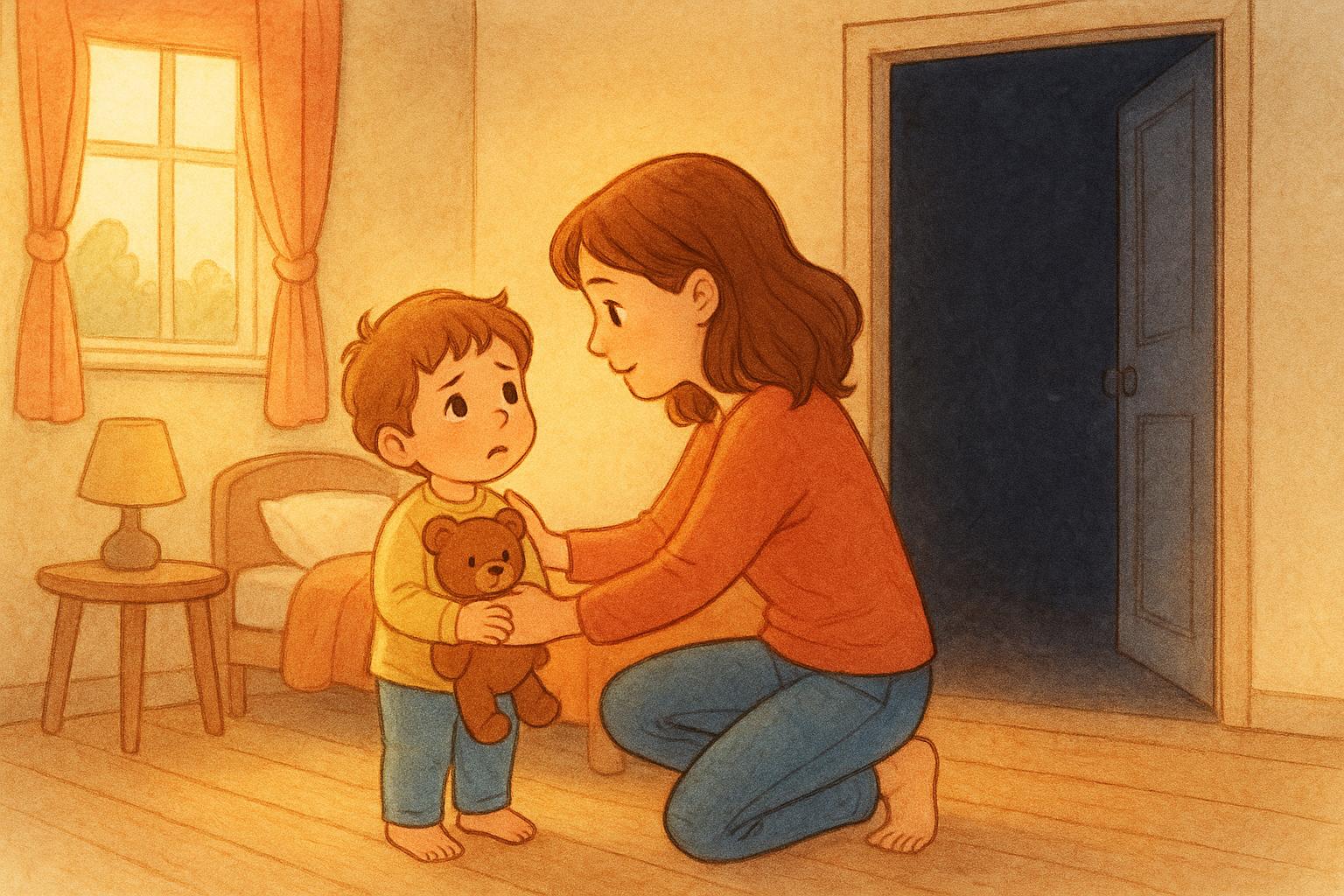
A child who was perfectly happy five minutes ago can suddenly freeze at the bedroom door, cling to your leg at swim class, or insist there is definitely something living in the hallway after dark. Fear can show up fast, and when it does, it can throw off the whole day.
Most parents have had that moment where what seems small to us feels huge to our child. The dog next door barks. The room gets dark. A birthday party feels too loud. School drop-off suddenly becomes tearful after weeks of going smoothly. It can be tempting to say, “You’re fine,” because we want to help our kids move on. But fear usually settles faster when children feel understood first and pushed second.
Helping kids overcome fear is not about talking them out of every worry. It is about giving them enough safety, language, and practice to handle the scary thing a little better over time. If your child gets overwhelmed easily, it may also help to look at ways to support big emotions without escalating the moment.
Why This Happens
Fear is a normal part of child development. Kids are constantly noticing new things, but they do not yet have a mature sense of what is dangerous, what is unfamiliar, and what is simply uncomfortable. Their imagination is often stronger than their logic, especially when they are tired, rushed, or already stressed.
A preschooler may fear hand dryers, toilets flushing, or shadows on the wall because the sounds and sensations feel intense. A school-age child may worry about being laughed at, sleeping away from home, getting called on in class, or trying something new in front of other kids. Older children may hide fear behind avoidance, irritation, or a sudden stomachache.
Sometimes fear also grows when kids accidentally get the message that avoidance is the only safe option. If every worry leads to immediate rescue, the child feels relief in the short term, but they do not get the chance to learn, “I can do hard things, and the feeling passes.”
That does not mean parents should force children into distress. It means the goal is steady, supported practice. Think less “sink or swim” and more “small steps with a calm grown-up nearby.” If your child also struggles in social settings, this article on supporting kids through social anxiety and shyness can give you another layer of ideas.
What Parents Can Do
1. Name the fear without feeding it
Children calm down faster when they feel seen. Start by naming what you notice in a simple, steady way.
You might say:
- “That dog barked loudly, and it startled you.”
- “You seem nervous about going into the dark room.”
- “It looks like you’re worried about being at the party without me.”
This is different from agreeing that the fear is true. You are not confirming that there is a monster in the closet. You are confirming that the feeling is real.
2. Avoid arguing with fear
When kids are activated, logic usually does not land well. “There is nothing to be scared of” often makes children feel misunderstood, not reassured. Instead of debating, stay calm and move toward grounding.
Try:
- “I’m with you.”
- “Let’s take one slow breath together.”
- “We don’t have to do the whole thing at once. Let’s just do the first step.”
If your child regularly gets stuck in back-and-forth battles, some of the same tools used for reducing power struggles can help here too, especially keeping your voice low and your instructions simple.
3. Break the scary thing into tiny steps
This is often the most helpful part. Fear shrinks when kids can approach it in manageable pieces.
For example, if your child is afraid of sleeping alone, the steps might look like this:
- Play in the bedroom together during the day.
- Spend a few quiet minutes there before bedtime.
- Stay in the room while your child falls asleep.
- Move your chair closer to the door over several nights.
- Check in at planned intervals instead of staying the whole time.
If your child fears dogs, the steps might be watching dogs from far away, then standing across the street, then walking closer with a trusted adult, then meeting one calm dog on a leash.
The key is to make the steps small enough that your child feels stretched, not flooded.
4. Practice when your child is calm
The middle of a meltdown is not the best time to teach coping skills. Practice earlier in the day when your child is regulated.
You can rehearse:
- Taking three slow breaths
- Squeezing hands together and relaxing them
- Using a simple phrase like “I can be brave and scared at the same time”
- Role-playing what to do at drop-off, bedtime, or a new activity
Kids love repetition when it feels predictable. That is one reason routines work so well. If home life feels generally chaotic right now, it may help to revisit the power of routine so your child has more stability around stressful moments.
5. Praise effort, not fearlessness
Many children do not need to be told to “be brave” in a big, dramatic way. They need parents to notice the tiny wins.
Try praising:
- “You walked into class even though your body felt nervous.”
- “You told me what scared you instead of shutting down.”
- “You stayed with the new group for five minutes today. That’s progress.”
This teaches kids that courage is not the absence of fear. Courage is doing the next right step while fear is still there.
6. Watch your own signals
Children read our faces, tone, and pace. If we rush in looking alarmed, they often feel more unsafe. If we stay matter-of-fact, they borrow our calm.
That does not mean becoming robotic. It means being the steady person in the room. Even a simple, “I know this feels hard. I’m staying with you,” can change the tone.
Common Mistakes to Avoid
Moving too fast
Pushing children before they are ready can backfire. If the step is too big, fear gets reinforced instead of reduced.
Rescuing too quickly every time
If a child never gets the chance to stay with discomfort for a few supported seconds, they miss the experience of coping successfully. Comfort your child, yes, but look for small moments where they can practice.
Teasing or minimizing
Saying “Don’t be a baby” or laughing off a fear can create shame on top of anxiety. Even when the fear seems irrational, the feeling is still real.
Turning reassurance into a long ritual
Some children ask the same worried question over and over because each answer gives them a quick hit of relief. Keep reassurance warm but brief, then shift toward action: “You’re safe, and let’s do our plan.”
Expecting instant results
Fear usually improves through repetition, not one perfect conversation. A child who manages 10 percent more than last week is moving in the right direction.
Simple Plan to Try This Week
If you want a realistic way to start, pick one fear to work on this week instead of tackling everything at once.
Day 1: Choose the fear and describe it clearly
Be specific. Not “my child is anxious,” but “my child cries at bedtime when the lights go off” or “my child refuses to join group activities.”
Day 2: Make a tiny step ladder
Write down 4 to 6 steps from easiest to hardest. Keep the first step so easy it feels almost too easy.
Day 3: Teach one coping tool
Pick one simple tool only: slow breathing, a phrase, holding your hand, or counting to five. Practice during a calm moment.
Day 4: Try the first step
Keep it short. End while your child is still successful, not after they are completely overwhelmed.
Day 5: Repeat the same step
Repetition builds confidence. Kids often need to succeed at one level more than once before moving on.
Day 6: Move up slightly
If step one went reasonably well, try step two. If not, stay where you are. Slower is fine.
Day 7: Notice progress out loud
Say something concrete: “Last week you would not go near the pool gate. Today you stood beside me and watched for two minutes.” That kind of feedback helps children see growth.
Helpful Tools
Some families like having a simple tool to make emotional conversations easier. These are optional, not magic fixes.
- Feelings and Emotions Cards can help younger kids name what they feel when “scared” comes out as crying, anger, or refusal.
- How to Talk So Kids Will Listen is a useful parent resource if you want more calm, practical language for tense moments.
FAQ
Is it normal for kids to go through fearful phases?
Yes. Many fears are age-related and temporary. Kids often cycle through worries as their imagination, awareness, and independence grow.
Should I make my child face the fear?
It is usually better to encourage gradual exposure rather than forcing a child into a situation all at once. Small supported steps work better than overwhelming pressure.
What if my child keeps asking for reassurance?
Give a short calm answer, then return to the plan. Too much repeated reassurance can accidentally keep the fear cycle going.
How do I know if a fear is becoming a bigger problem?
If fear is regularly interfering with sleep, school, friendships, daily routines, or family life for an extended period, it may be worth discussing with your child’s pediatrician or a qualified mental health professional.
What should I say in the moment when my child is scared?
Keep it simple: “You feel scared. I’m here. Let’s do one small step together.” Kids need calm presence more than a long speech.
Fear does not mean your child is weak, and it does not mean you are handling things badly. It means your child is still learning how to feel safe in a world that can sometimes feel big, loud, and unpredictable. With patience, steady support, and lots of tiny practice moments, most kids grow stronger right through the fears that once seemed enormous. And if your child needs extra support learning to connect with others too, this guide on building social skills is a helpful next read.