
One child will proudly feed the dog every morning and remind you if you forget. Another will stare at a pair of socks on the floor like they appeared by magic and have nothing to do with them. Helping kids take on age-appropriate responsibilities is rarely about finding the perfect chore chart. It is about teaching them, step by step, that they are capable, needed, and trusted.
Many parents want their kids to be more helpful, but the daily reality gets messy fast. A four-year-old “helps” put away groceries by stacking yogurt in the crisper drawer. A seven-year-old promises to clear the table, then wanders off halfway through. A ten-year-old says, “Why do I have to do everything?” after being asked to empty one trash can. It can feel easier to just do it yourself.
But responsibility is not only about getting jobs done around the house. It is also part of learning. When kids remember a routine, follow through on a task, notice what needs doing, and recover from a mistake, they are building executive function, confidence, and independence. Those same skills show up in school, friendships, and everyday problem-solving.
That is why small responsibilities matter so much. They teach kids that they can contribute to family life, not just be managed by it.
Why This Happens
Parents sometimes assume a child is being lazy when they do not follow through. Sometimes that is not the full story. Responsibility depends on several skills that are still developing.
Young kids often need many repetitions before a task becomes routine. They may understand what you want one day and forget it the next. Older kids may resist because they want control, feel overwhelmed, or truly do not know how to break a bigger job into smaller steps.
Responsibility also grows unevenly. A child can memorize dinosaur facts, build a complicated block city, and still forget to put their lunchbox on the counter. That does not mean they are impossible. It means responsibility is a skill set, not a personality trait.
Kids do better when responsibilities match their age, are clearly taught, and feel meaningful. When expectations are vague or too advanced, parents end up nagging and kids end up tuning out.
If your child also struggles with self-starting in other areas, this article on helping kids become independent learners can support the same bigger goal.
What Parents Can Do
Start with jobs your child can actually finish
The fastest way to create battles is to assign a task that is too big, too vague, or too boring for your child’s current stage. “Clean your room” is huge. “Put your books on the shelf and dirty clothes in the hamper” is clearer and more doable.
Try thinking in layers:
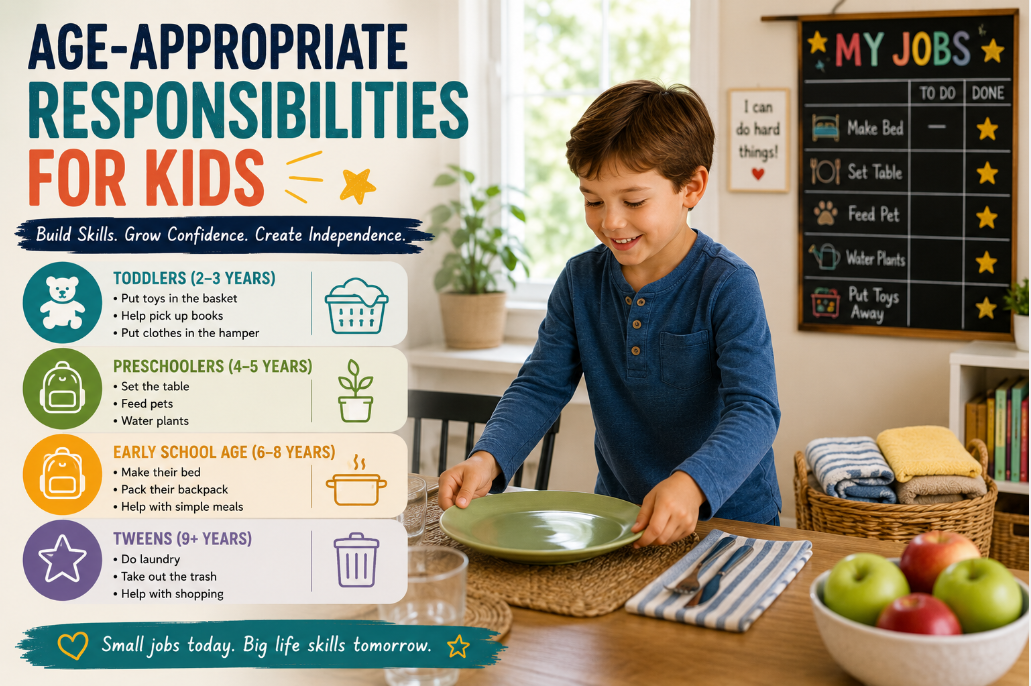
- Ages 2-4: put toys in a bin, carry napkins to the table, place shoes by the door, put dirty clothes in the hamper, help wipe small spills
- Ages 5-7: make the bed loosely, clear their plate, feed a pet with help, match socks, refill water bottles, pack part of a school bag
- Ages 8-10: empty the dishwasher section by section, fold simple laundry, help make lunches, take out bathroom trash, reset shared spaces
- Ages 11+: do a full load of laundry, cook simple meals, manage homework materials, babysit briefly with adult backup nearby, keep track of recurring home tasks
These are not rigid rules. A capable six-year-old may do more than a distractible nine-year-old. The better question is, “Can my child do this with a little support and regular practice?”
Teach the task before expecting the task
Kids often get labeled unhelpful when no one has actually taught them what “done” looks like. If you want your child to reset the table after dinner, show them exactly where cups go, what happens to crumbs, and where napkins belong.
A simple teaching pattern works well:
- You do it while they watch.
- You do it together.
- They do it while you stay nearby.
- They do it on their own, then you check in briefly.
This feels slower at first, but it saves a lot of correcting later. The same idea helps with school habits too. If you are working on routines at home, this guide on creating a home environment that supports focused learning has useful ways to reduce friction.
Use routines instead of repeated reminders
Most kids respond better to predictable sequences than to constant verbal prompting. Instead of saying “Don’t forget your lunchbox” every morning, build a short launch routine: shoes, backpack, water bottle, lunchbox. Same order. Same place.
Responsibility grows when kids can lean on structure instead of your memory.
You can say:
“Before we leave, check your four things.”
“After snack, your job is cup in the sink and chair pushed in.”
“When pajamas are on, dirty clothes go straight into the hamper.”
Those tiny repeatable patterns matter more than long lectures.
Let contribution feel real
Kids are more motivated when they believe their effort matters. “Help because I said so” usually has a short shelf life. “The dog depends on you for breakfast” lands differently.
Point out the real value of what they do:
- “When you refill the water bottles, everyone is ready for tomorrow.”
- “When you put your art supplies away, it is easier to find them next time.”
- “When you bring your library books back to the basket, we don’t lose reading time.”
That kind of feedback builds ownership better than vague praise.
Give choices inside the expectation
Children often resist less when they have some say. The responsibility stays the same, but they get a little control over how it happens.
For example:
- “Do you want to feed the dog before breakfast or right after?”
- “Do you want to put away laundry first or clear your desk first?”
- “Would you rather be in charge of napkins or water cups tonight?”
This keeps you out of unnecessary power struggles while still holding the line.
Connect responsibility to confidence
Many parents worry that expecting too much will create pressure. That can happen if tasks are unrealistic or constant. But healthy responsibility usually has the opposite effect. Kids feel steadier when they know they can do useful things.
That is one reason responsibility pairs well with family goal setting. If you want to build follow-through over time, this post on helping kids set goals can help you turn “be more responsible” into something visible and manageable.
Common Mistakes to Avoid
Giving a huge task all at once
Kids shut down when a job feels endless. Break large tasks into parts. “Pick up everything in here” is less helpful than “Start with books, then clothes, then toys.”
Correcting every detail
If your child loads forks in the wrong slot or folds towels crookedly, ask yourself whether the goal is perfection or participation. Overcorrecting can make kids stop trying.
Only asking when you are already annoyed
When responsibility only comes up in a tense moment, kids start to associate it with criticism. Practice responsibilities when no one is melting down.
Doing too much for capable kids
It is easy to keep tying shoes, packing backpacks, and hunting for homework because it feels faster. But when parents do every step, kids miss the chance to build memory, planning, and self-trust.
Using shame as motivation
Statements like “Why are you so lazy?” or “Your sister can do it” may get a reaction, but not the one you want. They tend to create defensiveness, not growth. A better approach is calm, direct, and specific.
If your child gives up quickly after small mistakes, the ideas in how to cultivate a growth mindset in your child fit nicely with responsibility work at home.
Simple Plan to Try This Week
If you want a reset, keep it small. One week is enough to start a new pattern.
Day 1: Pick two responsibilities
Choose one personal task and one family contribution. Example: put dirty clothes in the hamper and feed the dog.
Day 2: Teach both tasks clearly
Show what the task looks like from start to finish. Do not assume your child knows the steps.
Day 3: Build the tasks into the day
Attach each job to an existing routine. After getting dressed, clothes go in the hamper. Before your own breakfast, feed the dog.
Day 4: Reduce extra talking
Use short prompts instead of speeches. “What comes after pajamas?” works better than a frustrated reminder loop.
Day 5: Notice effort and follow-through
Be specific: “You remembered the dog without me asking.” “You came back and finished the second step.” That reinforces progress without overdoing praise.
Day 6: Adjust what is not working
If the task keeps failing, make it smaller, clearer, or better timed. Struggle does not always mean refusal. Sometimes it means the setup is wrong.
Day 7: Add one tiny next step
Once two responsibilities feel stable, add another small one. Slow growth usually sticks better than a dramatic family “new system” that lasts three days.
FAQ
At what age should kids start having responsibilities?
Very young children can start with simple jobs like putting toys in a basket or carrying napkins to the table. The goal is not efficiency at first. It is participation and habit-building.
What if my child refuses every responsibility?
Pull back and look at the setup. The task may be too hard, too vague, or introduced during conflict. Start with one small responsibility, teach it clearly, and tie it to a routine.
Should kids get paid for chores?
That depends on your family. Many parents separate basic family contributions from optional extra jobs. Everyday tasks can simply be part of living together, while larger extra jobs may earn money.
How many responsibilities should my child have?
Fewer than you think. A couple of consistent responsibilities done well is more useful than a long list everyone forgets by Wednesday.
What if the job is not done perfectly?
Focus first on consistency and effort. You can coach quality over time. If kids feel every attempt gets criticized, they often stop taking initiative.
Responsibility grows slowly, then suddenly. One day you are repeating yourself about socks and water bottles. Later you notice your child packed their folder, fed the cat, and wiped the counter without making it a whole event. That progress usually comes from small expectations, repeated calmly, over time.
Keep the tasks realistic. Teach before expecting. Let your child feel that what they do matters. And if you want to build that same sense of capable independence in other parts of life, learning through play is another surprisingly effective way kids practice initiative, persistence, and problem-solving.