
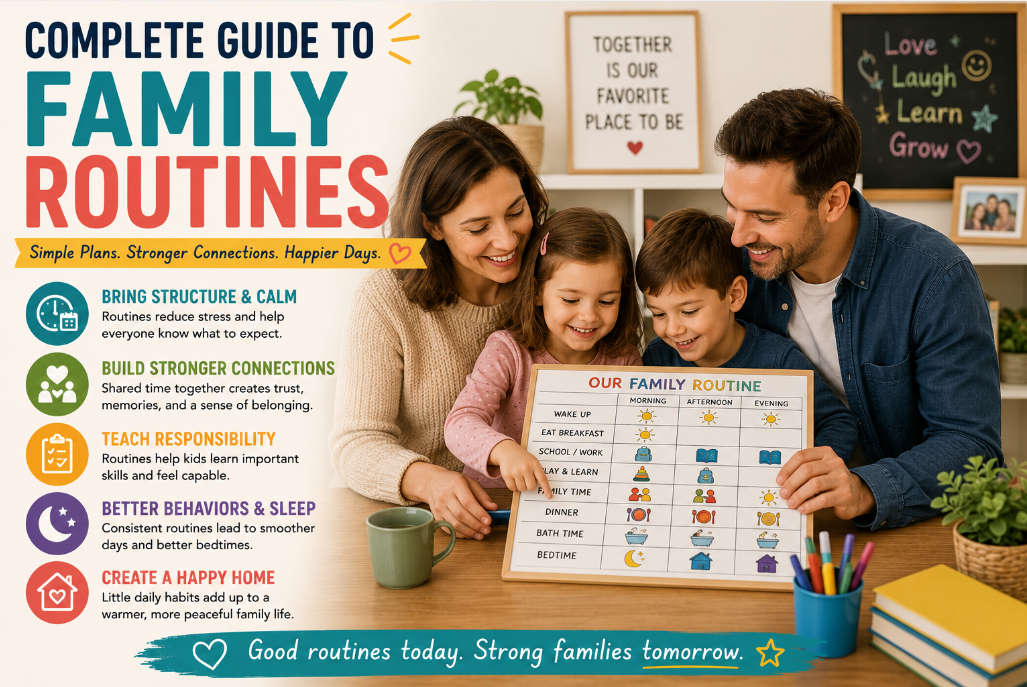
Some of the hardest parts of parenting are not the big one-time decisions. They are the moments that happen every single day: getting everyone out the door, handling the after-school crash, turning off screens without an argument, and getting kids into bed without the whole evening falling apart.
That is where family routines can help. A good routine does not make family life perfect, and it does not remove every meltdown, delay, or rough day. What it does is make daily life more predictable. When children know what usually happens next, they often feel safer, cooperate more easily, and need fewer reminders. Parents benefit too because routine reduces decision fatigue and lowers the stress of constantly starting from scratch.
If your days feel choppy, rushed, or full of repeated battles, building a few reliable routines can change the tone of your home. This guide brings the big picture together. It will help you understand why routines matter, where families usually get stuck, and how to create routines that are realistic enough to actually last.
Why Family Routines Matter More Than Parents Think
Children do not naturally manage time, transitions, or expectations the way adults do. They are still learning how to shift from play to cleanup, from school to home, from energy to rest. When every transition feels unpredictable, they often respond with stalling, arguing, or emotional overload.
Routines reduce that friction. Instead of hearing a fresh set of instructions every day, children begin to internalize a familiar pattern. That pattern becomes a kind of shortcut. They know what morning usually looks like. They know what happens after dinner. They know what bedtime involves. That predictability can lower anxiety, improve cooperation, and make the household feel calmer.
There is also a practical side to routine. Parents are carrying a lot at once: work, meals, appointments, school demands, laundry, emotions, and all the invisible planning that keeps a home moving. A routine turns some of that constant decision-making into repeatable habits. You are not reinventing the evening every night. You are following a sequence your family already knows.
If you want a closer look at how predictability affects behavior, The Power of Routine explains why consistency helps kids feel secure and behave more calmly.
What Gets in the Way of Good Routines
Many families assume their routine is failing because they are not disciplined enough. Usually, that is not the real issue. Most routines fail because they ask too much, change too often, or do not match real family life.
One common problem is making routines too detailed. Adults may create a long list that sounds reasonable on paper but feels overwhelming to a child. Another problem is inconsistency. If bedtime starts at a different time every night, or if expectations depend on how tired the parent is, children have to figure the system out all over again.
Timing matters too. Kids who are hungry, overtired, overstimulated, or coming off a long school day often struggle more with even simple tasks. That does not mean the routine is useless. It means the routine needs to fit the child’s actual capacity in that moment.
Some routines also break down because they focus only on control. A child who feels constantly directed may resist even helpful structure. The goal is not to run your home like a boot camp. The goal is to create enough structure that family life feels easier, while still leaving room for warmth, flexibility, and choice.
For a practical breakdown of how realistic routines hold together during ordinary messy weekdays, Creating Healthy Daily Routines is especially useful.
The Core Parts of a Strong Family Routine
You do not need to schedule every hour of the day. Most families do better when they create a few dependable anchor points. These anchors give the day shape without making it rigid.
1. Morning
Mornings tend to set the emotional tone for the rest of the day. If everyone starts in panic mode, the stress can linger for hours. A simple morning routine usually works better than an ambitious one. Wake up, get dressed, eat breakfast, brush teeth, gather what you need, and leave. That may sound basic, but consistency matters more than complexity.
Preparing the night before can make a huge difference. Laying out clothes, packing backpacks, and deciding on breakfast ahead of time can remove several common points of conflict. If mornings are a regular struggle in your house, How to Build a Morning Routine That Energizes Kids and Parents offers helpful ways to make the start of the day calmer and more manageable.
2. After-school reset
Many kids come home tired, hungry, and emotionally spent. Parents sometimes expect them to jump straight into homework, chores, or family plans, then feel confused when the child melts down. A short reset routine can help a lot. That might look like shoes away, snack, quiet time, connection, then homework or play. The exact order matters less than the fact that it becomes familiar.
3. Meals and transitions
Regular mealtimes and predictable transitions can reduce a surprising amount of stress. When children know there is a routine around dinner, cleanup, bath, or evening downtime, they are less likely to feel every shift as a fresh disruption. Transitional cues can help too. A five-minute warning, a short song, dimming the lights, or a repeated phrase can signal that one part of the day is ending and another is beginning.
4. Bedtime
Bedtime routines are often where parents most clearly feel the difference between structure and chaos. Children usually settle better when bedtime follows the same order each night: maybe bath, pajamas, brushing teeth, books, cuddle, lights out. If bedtime has turned into a nightly fight, Overcoming Bedtime Battles can help you rebuild the evening with less conflict.
How to Build a Routine That Your Family Will Actually Use
The best routine is not the most impressive one. It is the one your family can repeat on an ordinary Tuesday when everyone is tired.
Start by choosing one trouble spot instead of trying to fix the whole day at once. Many parents get farther by focusing on mornings, after school, or bedtime first. Once one part of the day feels steadier, you can build from there.
Next, simplify the steps. Children follow routines more easily when there are just a few clear actions. Think in short sequences, not long speeches. Instead of constantly saying, “Go get ready for bed,” make the routine concrete: pajamas, teeth, two books, lights out.
Visual reminders can help, especially for young children. A picture chart, simple checklist, or written list on the fridge makes the routine visible instead of relying on repeated verbal reminders. This can also reduce power struggles because the routine becomes something you and your child are following together, not just something you are enforcing from above.
Choice matters too. Structure works better when children have some small sense of ownership. You can keep the routine firm while offering limited choices inside it. Do you want the red pajamas or the blue ones? Do you want to brush teeth before or after the story? Would you like your snack at the table or on the porch? Small choices help children feel respected without changing the main plan.
It also helps to think of routines as rehearsed patterns, not rules your child should immediately master. Learning a routine takes repetition. You are teaching, prompting, and adjusting until the pattern becomes familiar.
Screen Time and Routines: Why This Link Matters
One reason routines collapse so easily is that screens can interrupt the natural flow of the day. When a child moves from a highly stimulating game or show straight into dinner, homework, or bedtime, the transition often feels abrupt and upsetting. This does not mean screens are automatically the problem. It means they need a clear place in the routine.
For many families, it helps to decide in advance when screens happen, where they happen, and when they end. You might choose screens only after homework, only in shared spaces, or never during the last hour before bed. Predictable limits usually work better than last-minute decisions made in the middle of a conflict.
If screen use has become one of the main pressure points in your home, Managing Screen Time offers practical ideas for setting healthy boundaries without turning every device into a power struggle.
Sleep, Routine, and Behavior Are Closely Connected
Sometimes a routine problem is really a sleep problem in disguise. An overtired child often has a much harder time with transitions, patience, emotional control, and cooperation. A child who looks defiant at 7:30 p.m. may simply be worn out and running on fumes.
That is why family routines work best when they support sleep instead of fighting against it. A consistent bedtime, a calm wind-down, and a predictable sleep environment all make it easier for children to settle. If you need help connecting your evening routine to better rest, Sleep Matters explains how bedtime habits influence sleep quality and how to build a more restful nighttime rhythm.
When sleep issues are persistent, intense, or affecting daytime functioning, it is a good idea to speak with your pediatrician. Routine can help a lot, but it is not the right tool for every sleep concern.
A Practical Plan for Creating Family Routines
If you want to make real progress without overwhelming yourself, try this step-by-step approach.
Step 1: Notice where the day goes off track
Pick one routine challenge that creates the most stress right now. It might be school mornings, post-dinner chaos, or bedtime resistance. Be specific. “Our evenings feel hard” is a starting point, but “everything falls apart between dinner and bed” gives you something clearer to work with.
Step 2: Build a short sequence
Create three to five steps that happen in the same order. Keep them simple enough for your child to remember. Most families do not need a perfect clock-based schedule. They need a predictable pattern.
Step 3: Teach it when no one is in crisis
Do not introduce a new routine in the middle of a meltdown if you can avoid it. Walk through it during a calm moment. Practice it. Talk about what comes first, next, and last. Younger kids often benefit from a playful run-through.
Step 4: Expect reminders at first
A routine does not become independent just because you explained it once. Repetition is the process. Your child is learning the pattern over time. Calm consistency matters more than perfect compliance.
Step 5: Review what is not working
If the routine keeps breaking down, ask why. Is it too long? Too rushed? Too late in the day? Is your child hungry, tired, or unclear on the steps? Adjust the routine rather than assuming your child is simply refusing.
Common Mistakes Parents Make With Routines
One common mistake is trying to fix too much at once. A giant family reset often feels motivating for a day or two, then collapses. Small changes are more durable.
Another mistake is making the routine too verbal. If the whole system depends on constant reminders, it can quickly become exhausting for everyone. Short cues, charts, and repeated patterns usually work better than long explanations.
Parents also sometimes confuse consistency with rigidity. A strong routine does not mean every day must look exactly the same. Life includes sick days, visitors, late practices, travel, and plain old bad moods. Flexibility is part of a healthy routine. The point is to return to the pattern, not to maintain perfection.
It is also easy to assume that if a child resists a routine, the routine is not working. In reality, children often push back when something is new or when a limit is being reinforced. That does not automatically mean you should abandon it. Give it time, watch for patterns, and adjust thoughtfully instead of reacting to one rough evening.
What Family Routines Can and Cannot Do
Family routines can create more calm, lower daily stress, and help children know what to expect. They can support cooperation, sleep, emotional regulation, and a smoother household rhythm. They can also help parents feel less like they are firefighting all day.
What routines cannot do is erase every challenge. They will not stop a child from ever getting upset. They will not solve deeper emotional, developmental, or medical concerns on their own. If your child is having persistent difficulty with behavior, anxiety, sleep, or daily functioning, a pediatrician, school professional, or qualified specialist may be able to help you look at the bigger picture.
Still, routines are one of the most practical tools many families have. They are not flashy, but they work. A calmer morning, a smoother after-school transition, or a less chaotic bedtime may not seem dramatic from the outside, but inside a family those changes can make everyday life feel much more manageable.
Conclusion
Good family routines are not about controlling every minute. They are about creating enough predictability that children can settle into the day instead of fighting every transition. When routines are simple, repeated, and realistic, they often reduce stress for both kids and parents.
If your home feels scattered right now, start small. Choose one part of the day, build a short repeatable pattern, and give it time. You do not need a perfect schedule. You need a rhythm your family can trust. Over time, those ordinary repeated moments can become the structure that makes family life feel steadier, kinder, and a lot less exhausting.
If this helped, read these next:
- Why consistent routines help kids feel secure and cooperate better
- How to build healthy daily routines that survive real family life
- Ways to make bedtime routines calmer and less stressful
Explore more parenting advice here: