
Your three-year-old throws the crayons after being told coloring time is over, and suddenly you are standing there trying to decide whether to lecture, ignore it, or take every art supply out of the house. That small moment is where positive discipline either starts to work or falls apart. Younger children do not need harsher reactions in those moments. They need calm, clear guidance that teaches what to do next.
Positive discipline can sound a little vague until you are using it with a child who is tired, loud, stubborn, or halfway under the kitchen table. In real life, it is not about being endlessly patient or never saying no. It is about holding the limit while still treating your child like a learner instead of a problem.
That matters especially with younger children. Preschoolers and early elementary kids are still building impulse control, emotional regulation, flexible thinking, and the ability to recover from disappointment. When parents expect polished behavior from a child whose brain is still very much under construction, everyone ends up frustrated.
The goal of positive discipline is not perfect behavior by dinner. The goal is helping your child practice skills over time: listening, stopping, cleaning up, waiting, using gentler hands, and handling a boundary without turning every correction into a power struggle. If you already feel worn out by repeating yourself, you are not failing. You are just parenting a young child.
Why This Happens
Younger children often know more than they can consistently do. A four-year-old may understand the rule about not grabbing, then still grab the toy the second they feel mad. A five-year-old may promise to put shoes by the door and then wander off to look for a sticker instead. That gap between knowing and doing is normal. It does not mean the lesson failed. It means the skill is still developing.
Young children also live close to the surface emotionally. Hunger, noise, boredom, transitions, and feeling rushed can hit them hard and fast. That is one reason behavior often looks worse right before dinner, during morning chaos, or when you ask them to stop doing something fun. A child who melts down over leaving the park is not always choosing drama. Often they are running out of regulation.
Positive discipline works better than shame because shame tends to flood the child without teaching the missing skill. A calm correction gives them something useful to do with the moment instead. That is also why setting clear boundaries and expectations with young children matters so much. Kids do better when the rule is simple, predictable, and backed up the same way each time.
What Parents Can Do
Stay calm enough to be clear
The first job is not finding the perfect script. It is keeping your own tone steady enough that your child can hear the limit. That might sound like, “I won’t let you throw crayons,” or, “Blocks stay on the floor, not at people.” Short language works better than a long speech when your child is upset. If you feel yourself escalating, pause, lower your voice, and say less.
Move from stopping the behavior to teaching the replacement
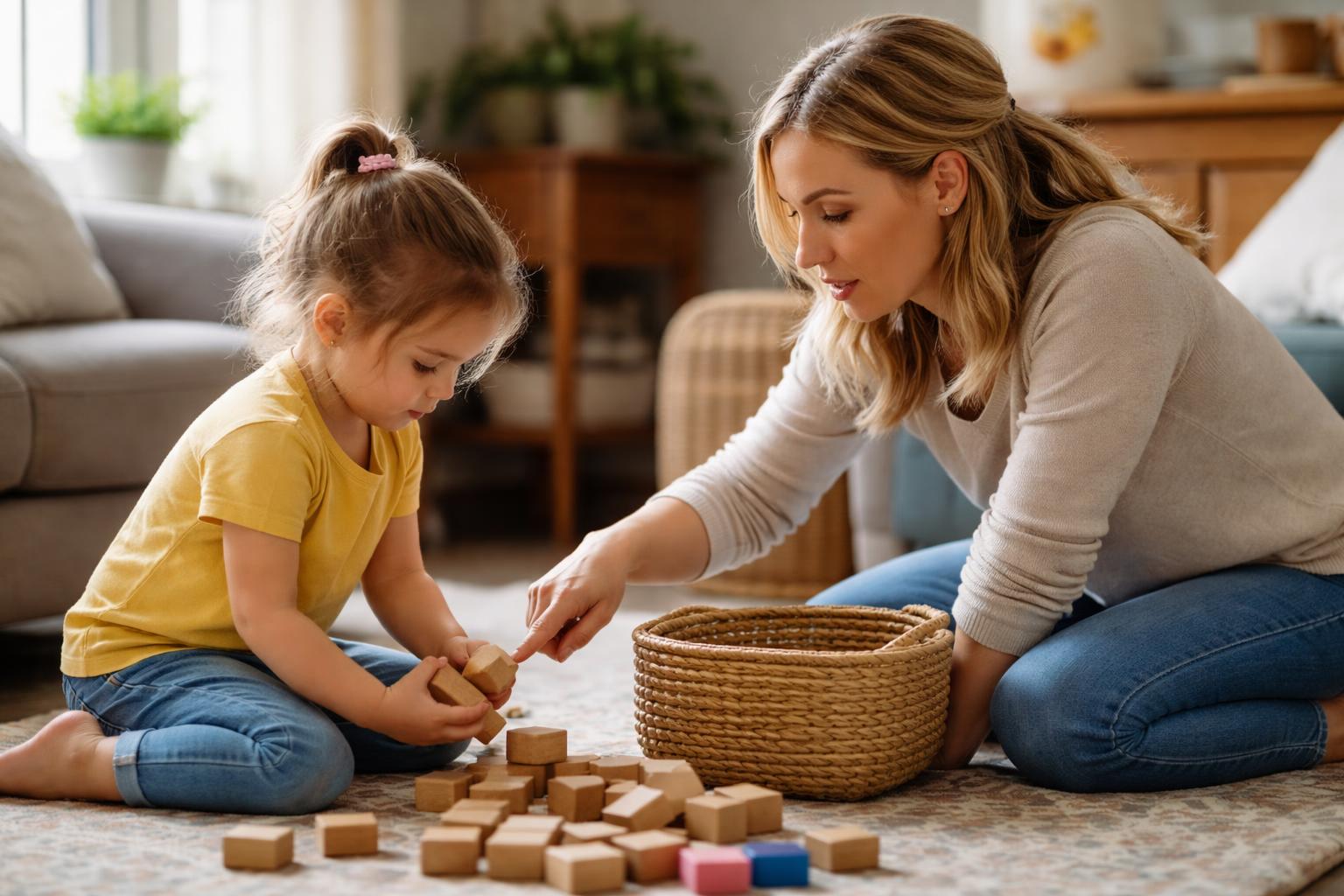
A lot of discipline stops at “don’t.” Younger children usually need the second half too. If they hit, show them how to ask for space. If they dump toys, guide them to pick them up. If they scream because playtime ended, help them stomp to the bathroom, carry one toy to the shelf, or choose the blue pajamas or the green ones. Correction sticks better when it points toward the behavior you want.
Use consequences that connect to the moment
Positive discipline is not consequence-free. It just favors consequences that make sense. If your child throws the toy, the toy gets put away for now. If they splash water onto the floor, they help wipe it up. If they refuse to leave the playground, you help them leave and talk less on the way to the car. Connected consequences are usually more effective than random punishments because they teach cause and effect in a way young children can follow. If you want more examples, natural consequences that actually work can help.
Keep routines doing some of the heavy lifting
Many behavior battles are really transition battles. When the order of the day always feels surprising, younger children resist more. A simple morning routine, cleanup routine, or bedtime routine reduces the number of decisions your child has to make while dysregulated. That is part of why the power of routine shows up in so many calmer households. Predictability does not solve every problem, but it prevents a lot of unnecessary ones.
Repair after the hard moment
Once your child is calm, circle back briefly. This is not the time for a courtroom speech. It is the time for one useful takeaway: “Next time you’re mad, stomp your feet instead of throwing,” or, “When I say cleanup, you can ask for help, but the blocks still need to go back.” Repair also means reconnecting. A hug, a book, or a reset activity helps your child learn that correction does not threaten the relationship.
If yelling has started creeping into these moments, it helps to simplify your approach and borrow a few strategies from how to discipline without yelling. Kids this age usually need less intensity and more consistency.
Common Mistakes to Avoid
Talking too much in the heat of the moment
When children are dysregulated, extra words usually bounce off. A short limit plus one next step is more useful than a five-minute explanation about gratitude, respect, and how hard you work.
Expecting one correction to fix a repeating behavior
Younger children learn through repetition. If you have to guide the same cleanup routine, gentle hands reminder, or bedtime limit many times, that is not always a sign your child is manipulating you. Often it is just how learning looks at this age.
Using shame to get quick compliance
Embarrassing a child, calling them bad, or acting personally offended can sometimes stop behavior in the moment, but it often adds more emotion without building more skill. You want your child to think, “I know what to do next time,” not, “Something is wrong with me.”
Saving all your structure for the worst moments
Discipline goes better when your child already knows the routine, the phrasing, and the follow-through on calmer days. If every limit appears only when everyone is overwhelmed, the lesson feels chaotic instead of dependable. And if big feelings are a regular flashpoint in your house, managing tantrums and meltdowns is worth reading alongside this.
Simple Plan to Try This Week
If your current discipline style feels messy or inconsistent, do not overhaul everything at once. Try this for one week:
- Pick one behavior that happens often, like throwing toys, refusing cleanup, hitting when frustrated, or bolting at transition time.
- Write one short limit you will use every time, such as “I won’t let you hit” or “Toys need to be picked up before we start something new.”
- Choose one connected consequence ahead of time so you are not inventing one while annoyed.
- Decide on one replacement skill to coach, like asking for help, using gentle hands, carrying one toy at a time, or taking three dragon breaths.
- Practice the routine once when your child is calm, not only when the behavior is already happening.
- At the end of each day, ask yourself whether you stayed clear and consistent, not whether your child was perfect.
This kind of small reset works better than chasing a big parenting breakthrough. Younger children usually improve when the adults around them get more predictable. You are building habits, not winning arguments.
Helpful Tools
You do not need special products to use positive discipline well. Still, a couple of simple tools can lower friction when younger children are still learning routines and transitions.
- Time Timer Original can help some kids see how long cleanup, getting dressed, or brushing teeth will last without hearing constant reminders from you.
- Visual Schedule for Kids can make the morning or bedtime routine more visual, which is often easier for younger children than a long string of spoken directions.
FAQ
Is positive discipline the same as being permissive?
No. Positive discipline still includes limits, follow-through, and consequences. The difference is that it aims to teach without humiliating the child or turning every correction into a battle.
What age counts as younger children here?
This approach is especially useful for preschoolers and early elementary kids, roughly ages two through seven, though the exact strategies can shift depending on your child’s development and temperament.
What if my child laughs when I set a limit?
That does not always mean they think the situation is funny. Some kids smile, laugh, or act silly when they feel overwhelmed. Stay calm, keep the boundary, and move to follow-through instead of getting pulled into a reaction.
How long does positive discipline take to work?
Usually longer than parents hope and shorter than it feels in the moment. The goal is not instant obedience. It is more steady progress over repeated situations. You are teaching skills that need practice.
What if I lose my temper sometimes?
Most parents do. Repair matters. You can come back and say, “I was too loud. I’m going to try that again.” That models accountability while still keeping the limit in place.
Positive discipline for younger children works best when it is simple, calm, and boring in the most useful way. You set the limit, help your child through the moment, and repeat the lesson more times than seems reasonable. That does not mean it is not working. It means your child is still learning. Keep the boundary, keep the relationship, and let consistency do the slow work.