
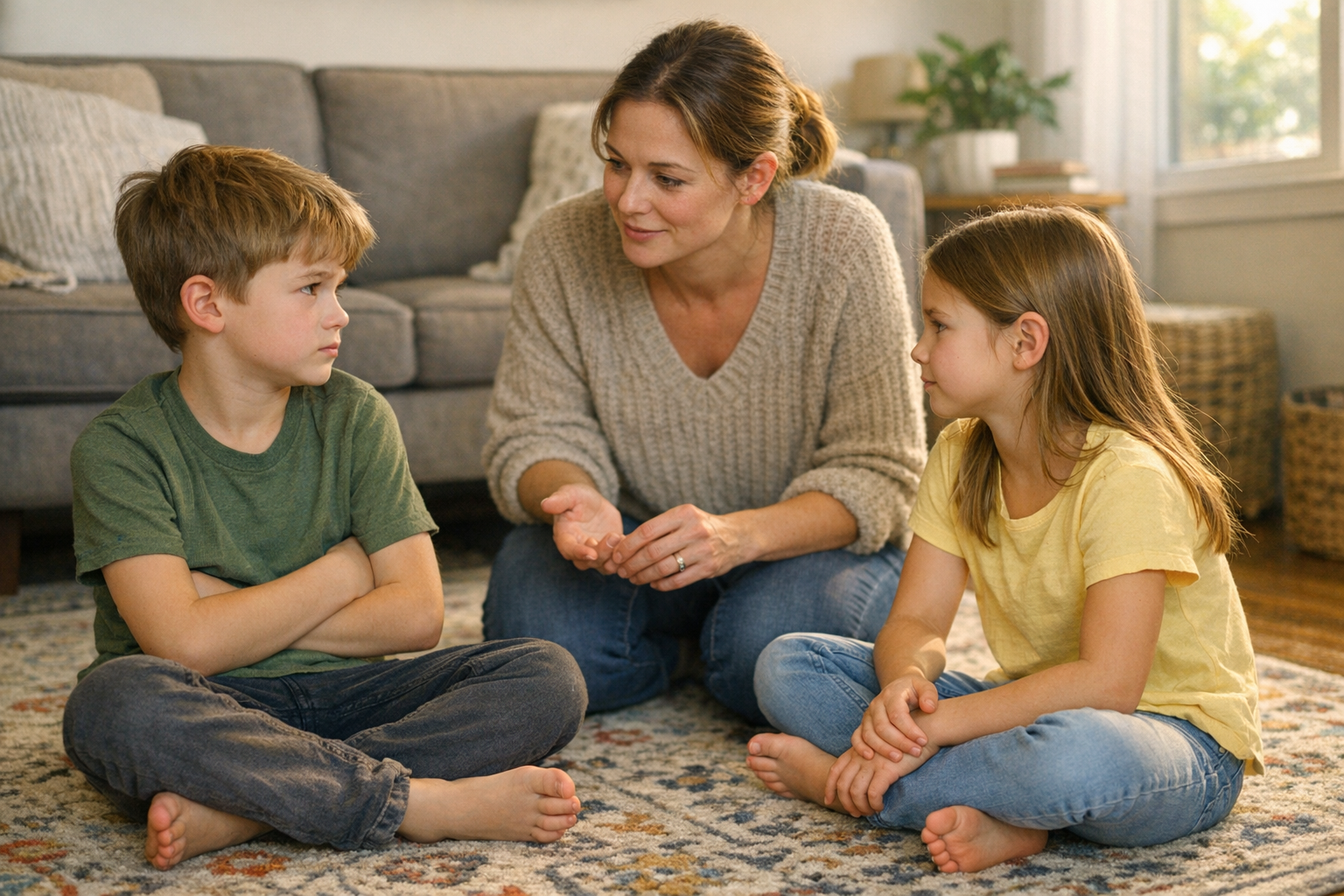
One minute your kids are building a blanket fort together, and the next they are fighting over who touched whose pillow. That swing can make sibling relationships feel confusing for parents. You want your children to be close, support each other, and maybe even enjoy being in the same room for more than six minutes. Instead, you may be living with constant tattling, competition, jealousy, and arguments over things that seem tiny from the outside.
The hard part is that sibling conflict is normal and exhausting at the same time. It does not automatically mean your children are headed for a bad relationship. It also does not mean you have to shrug and wait it out while your house sounds like a referee whistle factory. Parents can do a lot to shape the tone of sibling life at home without trying to control every disagreement.
A healthy sibling relationship is not one with zero conflict. It is one where children feel secure enough to compete less, communicate better, repair after conflict, and slowly build trust over time. That takes practice. It also takes adults who know when to step in, when to stay out, and how to avoid accidentally feeding the rivalry themselves.
This guide pulls the big picture together. If your children are fighting often, acting jealous, or struggling to connect, start here. Then use the more focused articles linked throughout to go deeper on the specific pattern you are seeing in your home.
Why sibling relationships get strained so easily
Siblings share a lot: space, toys, routines, parents, attention, and family identity. That much overlap creates plenty of chances for friction. Children are not just learning how to manage their own feelings. They are doing it while another child is sitting in their seat, touching their things, getting praised for different strengths, or needing your attention at the exact wrong moment.
Development plays a big role too. Younger children are still building impulse control and perspective-taking. Older children may feel bossed around by a younger sibling or burdened by expectations to be more mature. Big age gaps can create misunderstandings. Small age gaps can create constant competition. Different temperaments add another layer. A loud, fast-moving child and a quieter, more sensitive sibling may clash even when neither is trying to be difficult.
Parents also usually see only the surface behavior first. One child grabs. Another screams. Someone slams a door. But underneath, sibling conflict is often about feeling displaced, misunderstood, compared, or unsure of how to solve a problem without adult backup. That is why reducing conflict is not just about stopping arguments. It is about helping each child feel secure and capable inside the relationship.
What parents often get wrong
A lot of sibling advice gets too simplistic. It tells parents to make everybody share, stay neutral at all times, or hand out identical consequences and call it fair. Real family life is messier than that. Kids do not need a parent who treats every conflict like a courtroom. They need a parent who notices patterns, protects safety, teaches skills, and keeps the family climate from turning mean.
One common mistake is expecting fairness to look identical. Sometimes one child needs more help because they are younger, more impulsive, or in a harder season. Equal is not always fair. Another mistake is forcing closeness. Children cannot be lectured into warmth. They usually get there by experiencing less competition, more repair, and more opportunities to succeed together.
Parents also accidentally fuel rivalry when they compare siblings out loud, even positively. Comments like “Why can’t you be easygoing like your sister?” or “Your brother never makes a fuss about this” can land like rankings. Kids hear who wins and who loses. Over time, that turns normal differences into identity battles.
Start by lowering the competition in your home
The fastest way to improve sibling relationships is often to reduce the sense that your children are competing for your approval, your attention, or their place in the family. That does not mean giving each child identical minutes with you or narrating every decision. It means helping each child feel seen in a way that is not measured against the other.
Try to notice specific effort without stacking siblings side by side. Instead of “Why can’t you clean up like your brother?” say, “You put the markers away the first time I asked. That helped.” Instead of “Your sister is always kinder,” say, “I noticed you made room for your sister on the couch.” Those shifts sound small, but they matter.
It also helps to build regular one-on-one connection with each child. Ten calm minutes reading, walking, cooking, or talking can lower the desperation that sometimes drives sibling battles. Children who trust that they still have access to you often stop fighting quite so hard to prove it.
If the day-to-day fighting itself is your biggest problem, this article on handling sibling rivalry with calmer, more intentional strategies is a useful next read because it breaks down the common triggers and the home routines that help lower the heat.
Teach each child the skills the relationship actually needs
Sibling relationships do not improve because children magically become nicer. They improve because children slowly learn the building blocks of living closely with another person. That includes waiting, asking for a turn, coping with disappointment, hearing no, repairing after a mistake, and noticing another person’s feelings. Those are big skills. Most children need them taught directly and practiced often.
One of the most useful places to start is language. Many sibling fights escalate because children do not know what to say before they grab, shout, or complain. Practice simple phrases during calm moments: “Can I have a turn when you are done?” “I do not like that.” “Please give it back.” “I need space.” “Can you help us solve this?” These phrases are far more useful than telling kids to “work it out” without any tools.
Communication matters outside conflict too. Children who feel listened to by adults often become better listeners with siblings. They learn how to name feelings, ask better questions, and respond without assuming the worst. That is why effective communication with kids fits naturally into sibling work. The way you talk with your child becomes part of how they learn to talk with each other.
Empathy is another core skill. Siblings do not need to agree on everything, but they do need some ability to notice how their actions land. Teaching empathy is not about forcing a child to apologize on cue while still furious. It is about helping them slowly understand impact. This guide on teaching empathy through everyday conversations and activities can help you build that part of the relationship in a way that actually sticks.
Know when to step in and when to back off
Parents often feel stuck between two extremes: becoming a full-time referee or stepping back so far that cruelty gets treated as normal sibling stuff. Neither extreme works very well. Children need room to practice small disagreements, but they also need adults to protect the emotional tone of the house.
Step in quickly when there is hitting, intimidation, relentless teasing, property destruction, or a clear power imbalance. Safety comes first. You do not need a long lecture in the moment. Separate, calm, and reset. Later, when everybody is regulated, help them revisit what happened and what they can do next time.
Back off more when the issue is low-stakes and both children are reasonably matched. If they are arguing over which game to play or who sits where, try coaching instead of solving. Ask what the problem is, what each child wants, and what solutions they can think of. The goal is not perfect fairness every time. The goal is helping them build conflict muscles.
If conflict is constant and explosive, the more direct advice in sibling rivalry: how to help your kids get along can help you sort out when the pattern is still typical and when your family needs more structure and mediation than you are currently using.
Jealousy is often the hidden engine
A lot of sibling conflict is really jealousy wearing a disguise. It may show up as tattling, scorekeeping, interrupting, babyish behavior, or huge reactions to small differences. One child sees the other getting help, praise, or closeness and translates it into a threat: maybe I matter less right now. Once that insecurity is active, even ordinary moments can spark drama.
That does not mean parents should scramble to make every detail exactly even. Usually it works better to name the feeling and hold the limit at the same time. “You wanted me with you too. I am helping your brother right now, and I will be with you next.” “You are upset your sister got to choose first. You may be upset, and you may not grab.” Children calm faster when they feel understood without being allowed to run the house.
Jealousy also gets louder during transitions: a new baby, a new school year, a parent working more, illness, family stress, or one child suddenly needing extra support. Parents often focus on the visible behavior and miss the question underneath it, which is usually some version of: do I still have my place here?
If that pattern sounds familiar, read how to handle jealousy between siblings. It is especially helpful when one child becomes clingy, bossy, or unusually reactive after a family shift or after a sibling starts getting more attention.
Use family routines to protect the relationship
Sibling relationships usually get worse when everyone is tired, rushed, hungry, and tripping over each other. That is not a deep psychological mystery. It is family life. Routines cannot erase differences in personality, but they can remove a lot of unnecessary friction.
Think about the times your children fight most. Is it during morning rush, late afternoon hunger, bedtime chaos, or long unstructured stretches? Small changes in routine can have a big effect. Snacks before homework, clearer cleanup expectations, predictable turn-taking during screen time, and a calmer bedtime flow all reduce the number of collisions your kids have to manage.
Shared rituals can help too. Reading together after dinner, a weekly movie night, two-kid cleanup races with a parent nearby, or a goofy family check-in question at bedtime can give siblings more low-pressure chances to be on the same side. The point is not to manufacture magical bonding moments. It is to increase the number of interactions that are not about fighting over access to you or to a limited resource.
What to do after a bad fight
Many parents focus all their attention on stopping fights and too little on what happens after. The repair phase matters. Once everyone is calm, help each child describe what happened without turning it into a prosecution. What were you trying to do? What upset you? What did you do next? What could you try next time instead?
Be careful not to force a rushed apology just to create a neat ending. A muttered sorry with no ownership is usually for the adults, not the relationship. Better repair often looks like one child returning an item, helping rebuild something they knocked over, or practicing a better phrase for the next round. Sometimes it also looks like a simple apology after the child actually understands what went wrong.
Parents can repair too. If you yelled, took sides too quickly, or made a comparison you regret, own it plainly. That models accountability without weakening your authority. Children learn a lot about relationships from seeing adults fix mistakes instead of pretending they never happen.
A practical plan for the next two weeks
If sibling tension is high in your house, do not try to fix everything by tomorrow. Pick a short plan and stay steady.
Days 1 to 3: observe the pattern
Notice when the fights happen most, what the children are fighting about, and which child tends to escalate in which way. You are looking for triggers, not villains.
Days 4 to 6: reduce one obvious stress point
Add one routine support: earlier snack, clearer turn-taking rule, separate quiet time, or more parent help during a rough transition.
Days 7 to 10: teach two replacement phrases
Practice short, usable lines during calm moments. Keep it light and repeat them often.
Days 11 to 14: build one positive shared experience
Choose something cooperative and short: baking, watering plants, building a fort, or working together on a simple challenge. End before anyone gets fried.
At the same time, protect one-on-one connection with each child, even if it is brief. That balance matters more than parents sometimes realize.
Common mistakes that make sibling tension worse
Comparing children. Even when you mean to motivate, comparison tends to deepen rivalry.
Demanding instant sharing. Kids often do better with turns, timers, and support than with a blanket command to share everything cheerfully.
Solving every disagreement yourself. Over-helping can keep children dependent on your referee role.
Ignoring repeated meanness. Not every fight is serious, but repeated humiliation or aggression should not be waved off as normal sibling stuff.
Expecting friendship on your timeline. Some siblings grow close quickly. Others build trust slowly. The aim is a safer, warmer relationship, not a forced best-friend story.
When to get extra support
If sibling conflict is becoming aggressive, relentless, or emotionally damaging, it is worth getting more help. Talk with your pediatrician, a child therapist, or another qualified family professional if one child seems consistently targeted, one child is fearful at home, or the level of conflict is affecting sleep, school, or overall well-being. You do not need to wait for a crisis to ask for guidance.
Extra support also makes sense when a child has a developmental, emotional, or sensory need that changes the balance in the home. In those cases, sibling strain may be real without being anyone’s fault. A professional can help you build routines and language that fit your actual family instead of generic advice.
Conclusion
Sibling relationships are rarely smooth all the time. They are built in the middle of ordinary family mess: jealousy, turn-taking, hurt feelings, repairs, and the thousand tiny moments that teach children what belonging feels like. Your job is not to eliminate conflict completely. It is to create a home where conflict does not constantly turn into contempt.
When you lower unnecessary competition, teach the skills kids are missing, protect safety, and make room for repair, sibling relationships usually get better in slow but real ways. That progress may not look dramatic from one day to the next. It often looks like shorter fights, gentler language, faster recovery, and small moments of teamwork showing up where they used to clash.
If your children are struggling right now, that is not proof that the relationship is broken. It is usually a sign that the relationship needs more structure, more coaching, and less accidental fuel. Keep going. This is learnable work.
If this helped, read these next:
- How to handle sibling jealousy before it takes over the day
- Practical ways to reduce sibling rivalry at home
- Better communication habits that help kids resolve conflict
Explore more parenting advice here: