
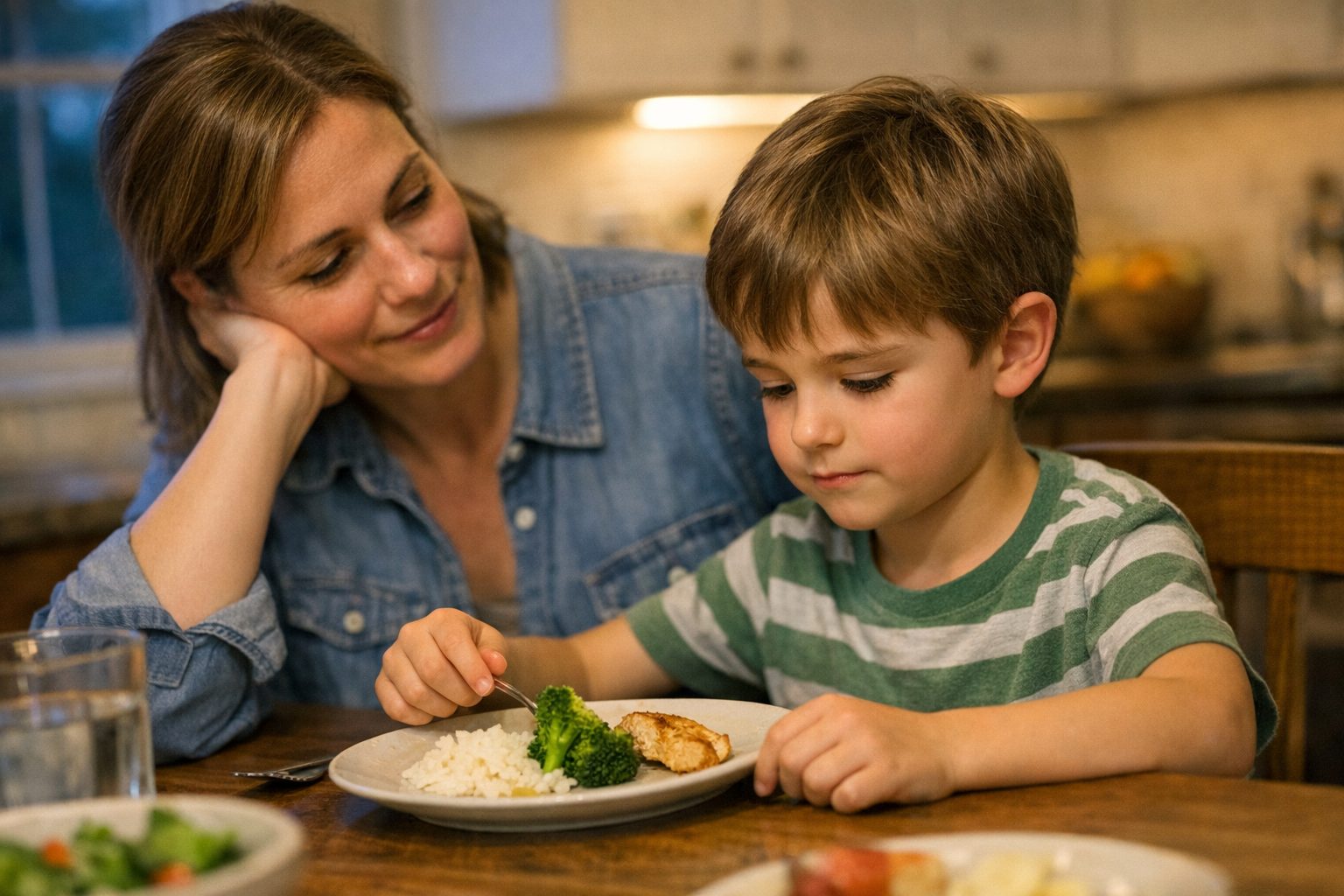
One night your child happily eats strawberries for dinner. The next night those same strawberries are “too wet,” the pasta is touching the peas, and you somehow end up negotiating over three bites of chicken while your own food goes cold.
If that sounds familiar, you are in very good company. Picky eating is one of those parenting problems that can feel surprisingly personal. It is easy to worry that you are doing something wrong, that your child will never eat normally, or that every meal is turning into a tiny power struggle you are destined to lose.
The encouraging truth is that picky eating is common, especially in young children, and it usually responds better to calm structure than to pressure. This guide is meant to be a hub you can actually use: why picky eating happens, what helps, what tends to backfire, and which next steps are most worth your energy.
Why picky eating feels so intense
Food happens multiple times a day, every day. That means even a small struggle gets repeated often enough to wear everyone down. When a child refuses dinner, asks for snacks ten minutes later, or melts down because the apple is sliced the wrong way, parents do not just feel inconvenienced. They feel worried.
Part of that worry comes from what food represents. Eating is tied to growth, health, family routines, and the hope that your child will be nourished and okay. So when meals go sideways, it is understandable that parents feel frustrated faster than they do in other areas.
It also helps to remember that picky eating is not always about defiance. Development, sensory preferences, shifting appetite, and a child’s need for control can all play a role. If the whole table is tense, the broader ideas in practical ways to make mealtimes easier when food turns into a battle can help lower the temperature before you try to fix everything else.
Why kids become picky eaters
Many children become more cautious around food as toddlers and young kids. That caution can show up as refusing mixed dishes, rejecting foods they ate last week, demanding the same few favorites, or getting overwhelmed by smell, texture, or color. A child who loves crunchy foods may resist anything mushy. Another may only want foods separated and predictable.
Appetite changes matter too. Children do not eat in a straight line. They may eat a lot one day and almost nothing the next. Growth spurts, tiredness, stress, illness, and activity all affect intake. When parents expect a steady adult-style appetite, normal variation can start to look like a crisis.
Control is another big factor. Children have very little say over most of their lives. Food is one of the few places where they can say no and mean it. The more adults chase, bargain, or pressure, the more powerful that no can become.
This is one reason picky eating often improves when families stop treating every meal as a test. The goal is not to win one dinner. The goal is to make food feel safe, predictable, and low enough in pressure that children can gradually expand.
Start with the parts of mealtime you can control
Parents cannot force hunger, taste preference, or readiness. What parents can control is the structure around eating. That means deciding when food is offered, what is offered, and where meals happen. Children then decide whether to eat and how much from what is available.
This division of responsibility is not magic, but it helps. It gives adults a clear job and takes some of the emotional panic out of the table. You are not trying to command bites into your child’s body. You are creating the conditions where eating is more likely to go better over time.
That might look like:
- serving regular meals and snacks instead of all-day grazing
- including one familiar food at the meal when possible
- keeping screens off during meals
- staying calm when your child says no
- not turning every refusal into a negotiation
When the structure improves, the food struggle usually gets a little less loud.
Why routines matter more than many parents expect
Picky eating is often partly a food issue and partly a rhythm issue. A child who has been snacking all afternoon may not be ready for dinner. A child who is overtired may have less flexibility with new foods. A child who never knows when the next meal is coming may cling hard to favorite foods because they feel reliable.
That is why why daily routines help picky eaters feel more settled around food is so relevant. Predictable routines take pressure off children’s nervous systems. When meals and snacks happen in a familiar pattern, hunger has time to build, transitions get easier, and food stops feeling so random.
You do not need an elaborate schedule. Often a few anchor points are enough: breakfast, lunch, one or two planned snacks, and dinner at roughly expected times. That kind of rhythm gives children more chances to arrive at the table ready to eat.
What to do at the table
Once you have some structure, the next step is changing how food is presented.
Serve one safe food
A safe food is something your child usually accepts, like rice, bread, fruit, yogurt, or plain pasta. This does not mean making a separate meal. It means making sure the family meal contains at least one thing that does not feel risky.
Use tiny portions for less familiar foods
A large serving of an unfamiliar food can feel overwhelming. One green bean or one spoonful of soup is easier to tolerate than a giant pile.
Keep new foods on the plate without forcing bites
Exposure matters. Children often need to see a food many times before they are willing to taste it. Looking at it, touching it, smelling it, or licking it can all be progress.
Stay neutral
Neutral sounds like, “You do not have to eat it,” or, “This is what we are having tonight.” It does not mean cold or detached. It means steady. Children usually eat better when parents act less alarmed.
If mealtime tension is already high, go deeper with practical ways to make mealtimes easier when food turns into a battle. That article is especially useful when the problem is not just selectivity, but the whole emotional atmosphere around dinner.
Use curiosity instead of pressure
Children are more likely to engage with food when curiosity is allowed to count as progress. Instead of focusing only on bites swallowed, you can invite low-pressure interaction:
- “Does it smell sweet or salty?”
- “Is that crunchy or soft?”
- “Want to dip it and see if that changes it?”
- “Should we cut it into smaller pieces next time?”
This approach works especially well with fruits and vegetables, which are often where picky eating concerns show up first. For more concrete ideas, easy ways to offer more fruits and vegetables without a fight covers simple tactics like dips, presentation changes, mixing produce into familiar foods, and letting kids help with prep.
Not every family needs to hide vegetables in sauces forever, but it is reasonable to use familiar bridges while your child builds tolerance. The important part is keeping the bridge calm and sustainable, not sneaky in a way that makes you feel like every meal is a secret mission.
Watch snacks, because they can quietly derail dinner
Some picky eaters are not impossible eaters. They are just full. A child who has had crackers, pouches, milk, and a granola bar between school and dinner may not have much reason to engage with a fuller meal at 6:00.
That does not mean snacks are the enemy. It means they should work for you instead of against you. Planned snacks help children stay regulated and prevent desperate hunger. Random grazing often wipes out appetite for dinner.
This is where healthy snack ideas that do not ruin dinner can be genuinely helpful. Snacks that include protein, fiber, or a mix of foods usually hold children better than constant crunchy filler. Think yogurt and berries, apple slices with nut butter, cheese and crackers, or vegetables with hummus instead of a long trail of snack foods that never quite adds up to a real eating opportunity.
If your child does best when foods stay separate, a divided container like the Bentgo Kids Lunch Box can be a useful optional tool. It is not a cure for picky eating, but it can make snacks and lunches easier for kids who strongly prefer foods not to touch.
Think bigger than one meal
Picky eating is easier to manage when you stop measuring success by tonight’s dinner alone. The real question is not “Did my child eat the broccoli?” It is “Are we building a healthier pattern over time?”
That bigger pattern is why how healthy habits make picky eating easier over time belongs in this conversation. Eating is part of a wider system of routines, sleep, stress, hydration, movement, and repetition. Kids do better when the overall family rhythm is steady enough that meals are not happening in constant chaos.
Sometimes the best progress comes from non-food changes around food:
- more consistent meal times
- better spacing between snacks and dinner
- less distracted eating
- more involvement in grocery shopping or cooking
- more repeated exposure to familiar-plus-new combinations
Those shifts are not flashy, but they create momentum.
What usually makes picky eating worse
- Pressure bites. Requiring bites often increases resistance, especially for anxious or sensory-sensitive kids.
- Bribing with dessert. This can make dinner feel like the obstacle course between your child and the real prize.
- Cooking a separate backup meal every time. That teaches children they can wait out the family meal.
- Huge portions of unfamiliar foods. More food does not create more willingness.
- Treating every refusal like an emergency. Parents’ visible stress often amplifies the whole pattern.
It can also backfire when adults expect improvement to happen fast. Picky eating usually changes more slowly than parents want. The wins often look small at first: fewer arguments, one extra accepted food, a calmer plate, a child who tolerates seeing something new without a meltdown.
A practical plan for this week
If meals are wearing everyone out, try this simple one-week reset:
1. Pick three safe foods
Write down foods your child usually accepts and keep them in rotation as anchors during meals.
2. Tighten snack timing
Offer a real snack after school, then give hunger time to return before dinner.
3. Add one tiny exposure food each day
Think one cucumber slice, one bite-sized roasted potato, or one spoonful of soup. Keep expectations low.
4. Involve your child in prep
Let them rinse berries, stir yogurt, tear lettuce, sprinkle cheese, or choose between two vegetables.
5. Practice one calm phrase
Use the same neutral response when food is refused. Consistency helps more than lectures.
6. Repeat, do not retreat
If a food went badly yesterday, offer it again later in a smaller and calmer way instead of abandoning it for a month.
7. Judge the week, not one dinner
Ask whether meals felt less tense, not whether your child suddenly became adventurous.
When to get more help
Many picky eating phases are normal. Still, it is worth talking with your pediatrician if your child has a very limited diet, poor weight gain, signs of pain with eating, trouble chewing or swallowing, extreme anxiety around food, or ongoing feeding struggles that are making daily life hard. Some children also benefit from support from a qualified feeding therapist, dietitian, or other specialist.
Asking for help is not overreacting. It is just another way of supporting your child well.
Conclusion
Helping picky eaters is rarely about finding one perfect trick. It is usually about lowering pressure, improving rhythm, offering repeated exposure, and staying steady enough that food stops feeling like a battlefield. You do not need to force a dramatic turnaround by next week. You just need to keep making meals a little calmer, a little more predictable, and a little easier for your child to approach.
That kind of progress may look small in the moment, but it adds up. Over time, calmer meals often create the exact conditions picky eaters need most.
If this helped, read these next:
- How to make mealtimes easier when food turns into a battle
- Easy ways to offer more fruits and vegetables without a fight
- How healthy habits make picky eating easier over time
Explore more parenting advice here: