
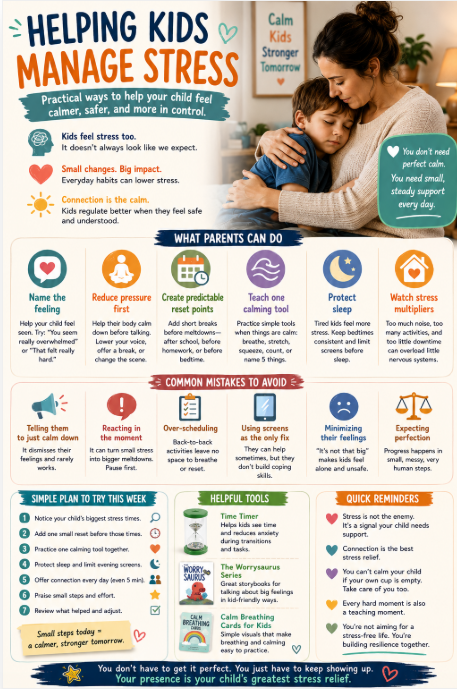
Helping Kids Manage Stress
Your child melts down over socks, forgets everything you just said, and starts crying because the toast broke in half. On the surface it looks like “bad behavior,” but sometimes it is just a small nervous system waving a white flag.
Stress in kids does not always look the way adults expect. Some children get clingy. Some get snappy. Some complain about stomachaches right when it is time for school, bedtime, or a busy activity. Others seem extra silly, extra loud, or suddenly unable to handle things that usually feel easy. Parents often see the behavior first and the stress second.
If that sounds familiar, you are not failing and your child is not broken. Kids live in the same noisy world we do. They feel rushed mornings, packed schedules, friendship drama, family tension, poor sleep, and the pressure of being told to “calm down” while their body is doing the exact opposite. The good news is that most stress support starts with ordinary daily habits, not perfect parenting. Small, steady changes can make home feel safer and calmer for everyone.
Why This Happens
Children have stress responses just like adults, but they usually do not have the words, perspective, or self-control to explain what is happening in the moment. A parent might think, “This is not a big deal,” while a child’s body is already racing ahead with too much, too fast, I can’t do this.
Stress can build from obvious things, like a move, a new school, a tough friendship, or a scary news story. But it also builds from smaller repeated pressures: being overtired, not knowing what comes next, having too little downtime, hearing constant corrections, or feeling like every part of the day is a hurry. Kids are especially sensitive when their schedule changes faster than their coping skills can keep up.
Another reason stress gets missed is that it can borrow the clothes of other problems. A stressed child may look “defiant,” distracted, dramatic, or lazy. They may argue about homework, stall at bedtime, or explode over tiny disappointments. That does not mean every difficult moment is caused by stress, but it does mean parents often get better results when they ask, “What is this behavior protecting my child from right now?” instead of jumping straight to punishment.
Stress also tends to show up in the body before it shows up in words. You may notice sleep problems, headaches, tummy complaints, nail biting, extra tears, or a sudden need for more reassurance. If you are already working on calmer family habits, this broader guide on managing stress together can help you zoom out and see the family pattern around those moments.
What Parents Can Do
Name the feeling without making it bigger
Kids calm faster when they feel understood. That does not mean turning every rough moment into a long emotional interview. It can be as simple as, “Your body seems really wound up,” or, “I think this day started feeling hard before we even left the house.” That kind of language tells your child you see the stress underneath the behavior.
If your child is young, keep it concrete: “Too many things at once,” “That felt surprising,” or “Your body needs a reset.” Older kids may respond to, “You seem overloaded,” or, “I wonder if this is one of those days where everything feels louder.”
Reduce pressure before you try to teach
When a child is already dysregulated, lectures bounce off. The first job is helping the body come down a notch. Offer a drink of water. Sit nearby. Lower your voice. Dim the lights a little. Take a walk to the mailbox. Let them hold a pillow and breathe with you instead of telling them to go calm down alone.
Parents sometimes worry this is “giving in.” It is not. It is triage. A child who feels safer is easier to guide, correct, and teach five minutes later.
Create predictable reset points in the day
Some kids need help before the meltdown, not just after. Look for the pressure points that repeat: after school, before homework, transitions between activities, bedtime, and rushed mornings. Add a simple reset ritual there. It might be ten quiet minutes after school, a snack plus outside air before homework, or music and dimmer lights before bed.
Predictable structure helps because children do less coping work when they know what comes next. If mornings are one of the biggest triggers, this article on building a morning routine that energizes kids and parents can help you remove some of the chaos that fuels stress before the day even gets moving.
Teach one calming tool at a calm time
Children rarely learn self-regulation in the middle of a spiral. Practice simple tools when things are already okay. Try shoulder rolls, blowing out pretend birthday candles, squeezing a pillow for ten seconds, tracing fingers while breathing, or naming five things they can see. Keep it light. You are building muscle memory, not running a workshop.
If your family wants a gentle way to make this more normal, these simple ideas on mindfulness for kids can give you a few low-pressure routines that fit everyday life.
Protect sleep like it matters, because it does
A tired child is usually a more fragile child. Stress feels bigger when the body is already running low. If your child is suddenly more reactive, clingy, or explosive, sleep is one of the first things worth checking. Bedtime drift, late screens, and overstimulating evenings can turn a manageable day into a hard one fast.
If this sounds like your house lately, it is worth revisiting why sleep matters and looking for one or two changes you can actually keep.
Watch the invisible stress multipliers
Not every trigger is dramatic. Sometimes it is the accumulation of background static: constant noise, too much screen time, overscheduling, sibling friction, hungry afternoons, or no real downtime. You do not need a perfect minimalist home or a screen-free life. You just need to notice what makes your child’s body stay revved.
For some families, a better media rhythm makes a surprising difference. This guide on setting healthy screen time limits can help if your child seems more edgy, reactive, or dysregulated after a lot of device time.
Use repair after hard moments
Even supportive parents lose patience. Even well-loved kids have ugly meltdowns. What matters is what happens after. Once everyone is calmer, circle back with something simple: “That was rough. Let’s talk about what your body needed sooner.” Repair teaches children that stress does not make them bad and conflict does not mean connection is gone.
Over time, these repair conversations help kids build self-awareness. They start to notice, “I get extra cranky when I’m hungry,” or, “School picture day made me nervous all morning.” That is real progress, even if it does not look neat.
Common Mistakes to Avoid
Parents do not make these mistakes because they do not care. They make them because stressed behavior is exhausting. Still, a few patterns tend to make things worse:
- Asking too many questions in the moment. A flooded child usually cannot explain themselves clearly while upset.
- Treating every stress response as misbehavior. Boundaries still matter, but a consequence without regulation often misses the real problem.
- Talking too much. When kids are overloaded, fewer words usually work better than more words.
- Waiting until the explosion to think about prevention. The routine before the hard moment often matters more than your response during it.
- Expecting kids to use calming tools they have only heard about once. These skills need practice when the house is calm, not only when everyone is already at the edge.
It also helps to avoid assuming you need to remove all stress from your child’s life. That is not the goal and it is not possible. The goal is helping your child feel supported enough to move through ordinary stress without falling apart every time something feels hard.
Related:
Simple Plan to Try This Week
If you want something realistic, not Pinterest-perfect, try this one-week reset:
- Pick one daily stress hotspot, such as after school, homework time, dinner, or bedtime.
- For three days, just observe. Notice what happens right before the stress spikes: hunger, noise, rushing, sibling conflict, screens, or unclear expectations.
- Add one reset before that hotspot. Think snack, outside time, quiet play, water, cuddling, or a five-minute sit-down.
- Choose one calm-down tool to practice when your child is already regulated. Keep it short and repeat it daily.
- Use one simple phrase during hard moments, like “Your body needs a reset” or “Let’s get calmer first, then talk.”
- At the end of the week, ask yourself what reduced pressure the most. Do more of that before changing five other things.
This plan works because it is small enough to repeat. Kids do not usually need a huge emotional makeover. They need adults who notice patterns, lower unnecessary pressure, and stay steady enough to help them recover.
FAQ
How can I tell if my child is stressed or just having a bad day?
One hard day happens to everybody. Stress is more of a pattern. You may notice repeated meltdowns around the same situations, more body complaints, sleep changes, clinginess, irritability, or a lower frustration threshold than usual.
What should I say when my child is overwhelmed?
Use short, calming language. Try, “I’m here,” “Let’s get your body calmer first,” or, “Too much at once, huh?” Save the problem-solving for later, when your child can actually think.
Can screens make stress worse?
They can for some kids, especially if screen time replaces sleep, movement, downtime, or face-to-face connection. Fast-paced content can also leave some children feeling more revved up than relaxed.
Should I worry about stress if my child seems fine at school?
Not necessarily, but it is worth paying attention. Some children hold it together all day and fall apart at home because home is where they finally feel safe enough to unload. That does not mean the stress is fake. It often means home is the release valve.
When is it time to get extra support?
If stress seems intense, lasts for weeks, interferes with sleep, school, eating, or friendships, or you are seeing a sharp change in your child’s usual behavior, it is reasonable to talk with your pediatrician, school counselor, or another trusted professional. You are not overreacting by asking questions.
Helping kids manage stress is usually less about finding a magic script and more about making everyday life feel a little safer, slower, and more predictable. Notice the patterns, soften the pressure where you can, and remember that a calmer child is often built one ordinary moment at a time.