
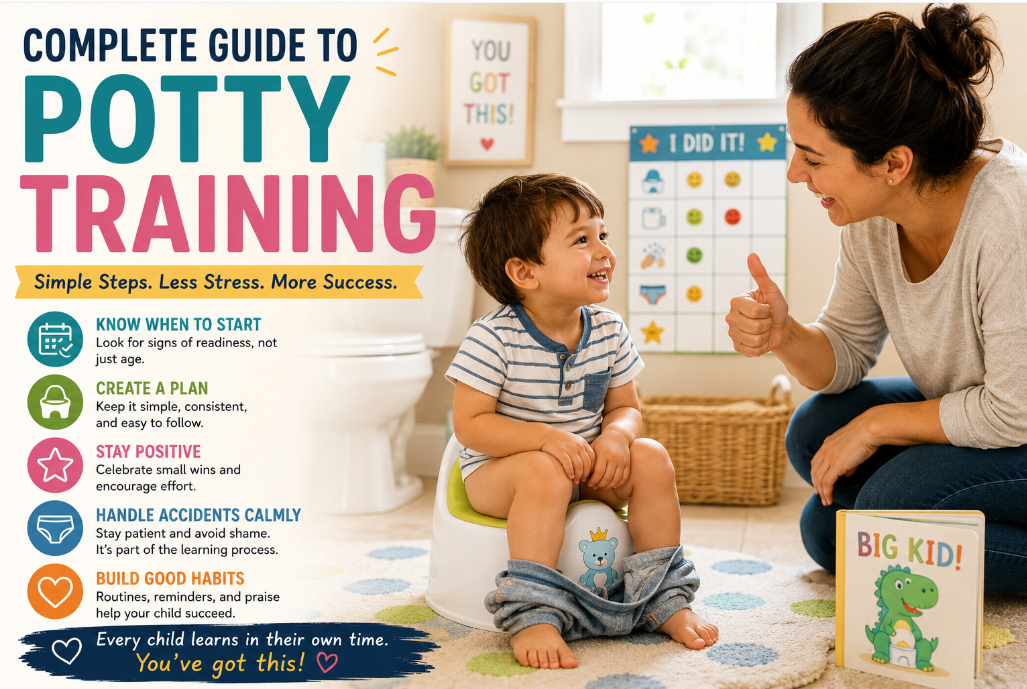
Potty training can make even steady parents feel unsure of themselves. One week your child seems interested, sits happily on the potty, and tells you when they need to go. The next week they refuse to try, have accidents all over the house, or insist diapers are the only acceptable option. It can feel confusing because progress rarely happens in a straight line.
If you are in that stage, you are not behind and your child is not broken. Potty training is one of those parenting jobs that blends physical readiness, emotional readiness, timing, routine, and plain old temperament. Some kids want independence right away. Others are cautious, stubborn, sensitive, or simply not interested yet. Most families see at least a few setbacks, power struggles, and messy days.
The goal is not to force your child through a milestone on the fastest possible timeline. The goal is to help them build a new body skill without turning the bathroom into a daily battle. That usually means watching for readiness, setting simple expectations, creating a predictable routine, and responding calmly when the process gets bumpy.
This guide brings those pieces together. You will find practical advice for knowing when to start, how to begin, what to do about accidents and resistance, and how to stay supportive without becoming permissive or overwhelmed.
When Potty Training Usually Goes Better
Parents often feel pressure to start potty training because another child in the family did it earlier, daycare is asking, or a grandparent keeps bringing it up. Those outside pressures are real, but they are not the best way to decide when your own child is ready.
Most children do better when potty training starts during a relatively calm stretch of family life. If your child is sick, moving homes, adjusting to a new sibling, starting childcare, or going through another major change, it may help to wait a bit if you can. A child who already feels stretched tends to have a harder time learning a new routine that requires body awareness, stopping play, and tolerating mistakes.
Readiness is not one magical sign. It is more like a cluster of clues. Your child may stay dry for longer periods, notice when they are wet or dirty, hide to poop, ask questions about the toilet, dislike dirty diapers, or want to copy older siblings and adults. They do not need to have every sign, but some basic interest and awareness help.
It also helps to remember that potty training is not just physical. Children need enough emotional flexibility to handle small frustrations and enough communication to understand what is happening. That is one reason supporting your child through big emotions during frustrating stages fits this topic so well. Potty training often brings embarrassment, disappointment, and resistance right to the surface.
Start with a Simple, Predictable Plan
Once you decide to begin, simplicity helps. Potty training usually goes better when parents stop trying ten different methods at once. Your child does not need a complicated system. They need a clear routine they can understand.
Start by deciding a few basics:
- what words you will use for body parts, pee, poop, and the potty
- when your child will be invited to try the potty
- what clothing makes the process easier
- how you will respond to success, refusal, and accidents
Keeping those pieces steady reduces confusion. Predictability matters because young children cope better when they know what comes next. If routines are hard in your house generally, the power of routine for smoother behavior and easier transitions explains why consistency helps children feel safer and more cooperative.
Many families do well with natural potty moments built into the day, such as after waking up, before leaving the house, before bath, or after meals. Those times are easier than constantly asking, “Do you have to go?” every fifteen minutes, which can annoy both you and your child.
A simple visual can help some children understand the sequence: pants down, sit, wipe, flush, wash hands. If your child responds well to concrete cues, a Visual Schedule for Kids can make the routine feel less like nagging and more like a predictable process they can follow.
Set Expectations Without Turning It Into a Power Struggle
Potty training is one of the easiest places for parents and children to lock horns. A child wants control over their own body. A parent wants progress, cleanliness, and fewer diapers. That mix can turn ordinary bathroom moments into a test of wills.
The most helpful approach is calm clarity. You want expectations that are firm enough to guide the process but not so intense that your child starts refusing just to protect a sense of control.
This is where setting clear boundaries and expectations with young children is especially useful. Potty training usually goes better when the limit sounds simple and predictable: “Pee and poop go in the potty.” “We sit on the potty before we leave.” “Dirty clothes get changed right away.” Clear language is easier for a child to absorb than long explanations or emotional speeches.
Choices can also reduce resistance without giving away the whole structure. For example:
- “Do you want the little potty or the toilet seat insert?”
- “Do you want to try now or after this book?”
- “Do you want me to help with your pants or do it yourself?”
Those are real choices inside a parent-led plan. They support independence without making potty training optional in every moment.
If your child flat-out refuses sometimes, that does not automatically mean you need to quit the entire process. It may mean you need fewer reminders, better timing, or a softer tone. But if every attempt is becoming a full-scale battle and your child seems distressed rather than merely stubborn, it can be wise to pause for a short time and reset.
Build the Routine Around Real Life, Not Wishful Thinking
One reason potty training can fall apart is that parents make a plan that sounds good in theory but does not match real family life. A routine that only works when everyone is home, calm, and perfectly focused will usually collapse by Tuesday.
Instead, think in anchors. Try the potty after wake-up, before the car, before nap or quiet time, after dinner, and before bed. Those repeated moments are easier to keep than a vague goal of “use the potty all day.”
Creating healthy daily routines that children can actually follow is relevant here because potty training is really a body-care routine as much as it is a milestone. The more repeatable the steps are, the less mental effort your child needs to use each time.
Keep clothes practical too. Easy-on, easy-off pants matter more than cute outfits for a while. If your child cannot get to the potty in time because the clothes are too complicated, the problem may not be motivation at all.
Transition help is useful for children who melt down when play has to stop. A visual timer can reduce some arguing because the warning becomes visible instead of purely verbal. A Time Timer Original can be genuinely helpful for children who handle transitions better when they can see how much time is left before a potty break, cleanup, or leaving the house.
What to Do About Accidents
Accidents are part of potty training for almost every child. They are not proof that the whole effort is failing. They are information. The question is not just, “Why did this happen?” but “What does this tell me about the current plan?”
Some accidents happen because a child is deeply absorbed in play. Some happen because they waited too long, were overtired, got scared by a public toilet, or did not have enough help getting clothes off quickly. Some happen because the child was showing early signs they needed to go, but the adults did not notice yet.
Your response matters a lot here. Calm cleanup teaches more than shame. Keep it matter-of-fact: “Your pants are wet. Let’s get cleaned up.” If there is something to learn, keep it short and save most of the teaching for after the child is regulated.
This is also where many parents end up yelling because they are already tired, behind schedule, or cleaning the third mess of the day. If that pattern is creeping in, disciplining without yelling during repetitive hard moments is a strong companion read. Potty training rarely improves when children start associating the bathroom with fear, anger, or humiliation.
Try to avoid:
- calling the child lazy, stubborn, or naughty
- making them sit for long periods as punishment
- lecturing in the middle of the accident
- comparing them to siblings or classmates
- acting shocked by setbacks that are developmentally common
Children usually learn faster when adults treat accidents as a manageable part of learning instead of a character flaw.
Poop Can Be the Hardest Part
Many children learn to pee in the potty before they are comfortable pooping there. That does not mean you are doing something wrong. Pooping asks for a different kind of body awareness and a different kind of letting go. Some children feel vulnerable sitting still. Others are worried about the splash, the sound, or the strange feeling of parting with something from their body. Some children hold poop because they had one painful bowel movement and now expect the next one to hurt too.
If your child seems scared of pooping on the potty, stay gentle and curious. Ask simple questions. Notice whether constipation might be part of the picture. Hard stools can make potty training much harder because children start avoiding the toilet to avoid pain. If your child is withholding poop, seems uncomfortable regularly, or has persistent pain, it is smart to speak with your pediatrician.
Do not force long sits or turn bowel movements into a showdown. For many children, pressure makes withholding worse. Small steady steps help more: regular toilet opportunities, good hydration, fiber-rich foods, and an emotionally calm bathroom routine.
Night Training Usually Comes Later
Parents often hope daytime and nighttime potty training will happen together, but they do not always. Staying dry overnight is influenced partly by development and sleep patterns, not just effort. A child who does well during the day may still need a pull-up or diaper at night for a while, and that can be completely normal.
It helps to separate the two in your mind. If your child is mastering daytime potty use, that is real progress even if the bed is still wet in the morning. Keep bedtime bathroom habits simple, protect the mattress, and avoid framing nighttime wetness as a failure.
If your child was dry at night for a long stretch and starts wetting again suddenly, or if you have concerns about sleep, constipation, pain, or frequent daytime accidents after earlier progress, it is worth checking in with a pediatrician.
How to Handle Resistance Without Backing Yourself Into a Corner
Resistance during potty training does not always mean the same thing. Sometimes a child is saying, “I am not ready.” Sometimes they are saying, “I do not want to stop playing.” Sometimes they are saying, “I feel pressured and I want control back.”
That is why emotional tone matters so much. supporting your child through big emotions connects directly to potty training because frustration and shame can make children dig in harder. If a child feels cornered, they may refuse even when they physically can do the skill.
When resistance shows up, ask yourself a few practical questions:
- Am I reminding too often?
- Is the child being asked at bad times, like in the middle of deep play?
- Have I turned every accident into a big reaction?
- Is my child showing fear, pain, or sensory discomfort?
- Would a short pause reduce tension and help us restart more calmly?
Sometimes the best reset is not quitting forever. It is backing off the pressure for a few days while keeping the language neutral and the environment supportive.
Common Mistakes That Make Potty Training Harder
Parents do not sabotage potty training on purpose, but a few patterns make the process more stressful than it needs to be.
Starting because of pressure alone
If the schedule is driven only by outside comparison, you may end up in a longer struggle than if you had waited for a better window.
Talking about it all day
Constant reminders can make a child tune out or start resisting automatically.
Expecting zero accidents immediately
Early success is often uneven. Progress and setbacks can live in the same week.
Using shame as motivation
Embarrassment may create short-term compliance, but it often damages trust and makes bathroom anxiety worse.
Ignoring constipation or discomfort
A child who expects pain is not simply being difficult. Physical issues can stall the whole process.
Making parents the whole system
When the routine depends entirely on repeated adult talking, children have a harder time owning the skill over time.
A Practical Potty Training Plan Parents Can Actually Use
If you want a realistic reset, try this approach:
- Pick a calmer window. Avoid starting during major family upheaval when possible.
- Watch for readiness clues. Interest, awareness, and longer dry stretches help.
- Create a short routine. Use predictable potty times anchored to the day.
- Keep expectations clear. Use simple language and limited, useful choices.
- Respond calmly to accidents. Clean up, adjust, and move on.
- Protect the relationship. Do not let the bathroom become a battleground.
- Get medical advice when needed. Ask your pediatrician about pain, withholding, constipation, or regression that worries you.
You do not need a perfect method to help your child learn. You need steadiness, repetition, and a willingness to adjust based on what your child is showing you.
Conclusion
Potty training is messy mostly because it asks a lot of young children all at once. They are learning body awareness, timing, transitions, clothing skills, emotional control, and recovery from mistakes in a part of life that can feel private and vulnerable. No wonder it takes time.
The families who tend to get through it most smoothly are not the ones who force it hardest. They are the ones who stay observant, keep the routine simple, set clear expectations, and avoid turning setbacks into shame. Your child does not need perfection from you. They need a calm guide who can hold the plan steady while still noticing when the plan needs to change.
With patience, practice, and the right timing, most children get there. And when the process feels harder than expected, slowing down and making it less emotional often helps more than pushing harder ever will.
If this helped, read these next:
- Use routine to make potty training feel more predictable
- Set clear expectations without turning the potty into a battle
- Handle potty training setbacks without yelling
Explore more parenting advice here: