
By 7:42 a.m., one child is still barefoot, another is arguing about brushing teeth, and you are somehow debating for the third time this week whether shoes belong on the couch. That is usually the moment parents realize the house does not need more lectures. It needs clearer rules.
Household rules sound simple until real life gets involved. One day you let roughhousing slide because everyone is in a good mood. The next day you shut it down immediately because you are exhausted and dinner is burning. Kids notice that kind of inconsistency fast. They are not being manipulative masterminds. They are doing what children do: testing where the edges are and trying to figure out what actually matters.
If you feel like you are repeating yourself all day, the problem may not be that your child never listens. It may be that the rules are too vague, too numerous, or enforced differently depending on the moment. Creating consistent household rules does not mean turning your home into a boot camp. It means making family expectations clear enough that kids know what to expect and parents do not have to reinvent the response every single time.
When the bigger issue is general pushback, this guide on dealing with defiant behavior can help you separate ordinary testing from deeper power struggles. For day-to-day family life, though, solid house rules are often the missing piece.
Why This Happens
Kids do better when expectations are predictable. That is true for preschoolers, elementary-age kids, and even tweens who act like they do not care what the rules are. Predictability helps children feel safe. It also reduces the mental load of constantly guessing what will get them in trouble.
Many household rules fail for three common reasons:
The rules are not specific enough
“Be good” means almost nothing to a child. “Use walking feet indoors” is much easier to understand. “Be respectful” may be a worthy goal, but children need to know what respectful behavior looks like in your house. Does it mean no interrupting? No yelling across rooms? Knocking before entering a bedroom? Specific rules are easier to follow because they are easier to picture.
There are too many rules
Some homes accidentally become a running list of corrections: no jumping there, no crumbs here, no loud voices now, no toys in that room, no cups upstairs, no this, no that. Kids tune out when every minute comes with a new restriction. A shorter list of important rules works better than twenty loosely enforced ones.
Parents enforce them differently from day to day
This is the big one. If pajamas at breakfast are fine on Saturday but a battle on Monday, children learn that rules are flexible when adults are tired, rushed, or distracted. Again, that does not make them sneaky. It makes them observant. Consistency matters because it lowers confusion. It also lowers arguing, which is one reason discipline without yelling becomes much more realistic when expectations are already clear.
What Parents Can Do
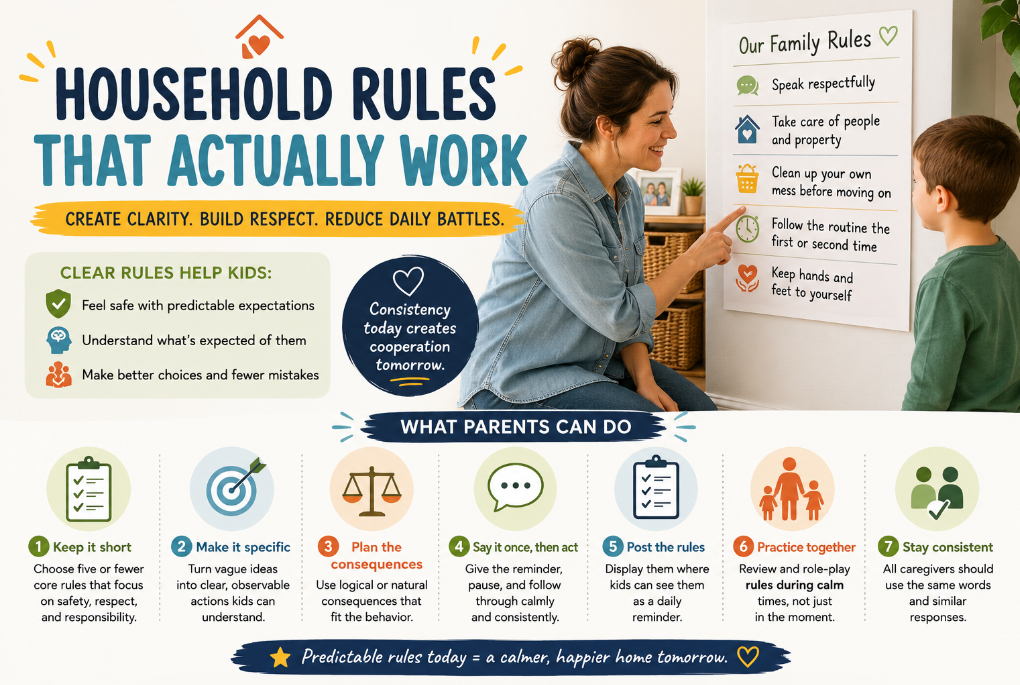
1. Choose five or fewer core rules
Start with the rules that affect daily peace and safety. In many families, that means things like:
- Speak respectfully.
- Take care of people and property.
- Clean up your own mess before moving on.
- Follow the routine the first or second time you are asked.
- Keep hands and feet to yourself.
Your list may look different, but try to keep it short. If every annoyance becomes a rule, the important ones lose weight.
2. Turn vague ideas into observable actions
Children need examples. Instead of “be respectful,” say, “Use a calm voice, no name-calling, and answer without shouting.” Instead of “be responsible,” say, “Put your backpack on the hook, lunchbox on the counter, and shoes by the door.”
If a child says, “I was being nice,” that often means the rule is still too fuzzy. Make it concrete enough that both of you can tell whether it happened.
3. Decide in advance what happens when a rule is broken
The best consequence is usually the one that makes sense, not the one that sounds toughest. If toys are thrown, the toys are put away for a while. If a child leaves markers uncapped, markers take a break until the next art time. If homework gets ignored until bedtime, free time the next day may need to wait until homework is done.
That is where natural consequences that actually work can be useful. The goal is not to “win.” The goal is to help the child connect behavior to outcome.
4. Say the rule once, then act
Many of us accidentally teach kids that the real instruction comes on the fourth reminder. If the rule is “Shoes go on the rack when you come in,” try this: “Shoes go on the rack.” Pause. If the shoes stay in the middle of the hallway, follow through calmly: “I’m moving them to the rack with you now,” or “We are stopping here until the shoes are put away.”
Long speeches usually invite more arguing. Short, steady follow-through is clearer.
5. Post the rules where kids can see them
A short visual list on the fridge or near the front door cuts down on the “I forgot” problem and makes the rules feel stable instead of random.
6. Practice during calm times
If you only talk about rules when someone is already upset, they start to sound like threats. Walk through them when the house is calm. “Show me what happens after school” works better than another lecture in the middle of chaos.
7. Make sure all caregivers are using the same script
Consistency gets much easier when the adults use similar words and similar responses. You do not need identical styles, but it helps if everyone agrees on the basics.
If routines are part of the problem, the power of routine is worth reading too. Rules work best when they are tied to a predictable rhythm of the day.
Common Mistakes to Avoid
Changing the rule in the middle of enforcing it
If you say screen time is done after one warning, then give four more warnings, you are not being kind. You are accidentally teaching your child to wait you out. It is better to choose a realistic limit and stick to it.
Using rules only when you are frustrated
When rules appear suddenly during stress, kids hear them as personal criticism. A rule should feel like a family expectation, not a mood swing.
Making consequences bigger than the behavior
Huge punishments for ordinary mistakes often backfire. A child who forgets to hang up a wet towel does not need a week-long ban from fun. Small, connected consequences are easier to repeat and easier for kids to understand.
Expecting instant success
Even good rules take practice. Progress usually looks like fewer reminders, not zero reminders overnight.
Confusing development with defiance
A four-year-old who interrupts is not necessarily being rude. Sometimes kids need skill-building, not harsher correction. Clear expectations paired with coaching tend to work better than shame.
Simple Plan to Try This Week
Day 1: Pick your top three pressure points
Do not start with every issue in the house. Pick the moments that drain the most energy, like morning readiness, respectful talking, and cleaning up after play.
Day 2: Write each rule in simple language
Try statements a child can picture:
- Backpacks and shoes go in their spots after school.
- We speak without yelling or name-calling.
- One activity gets cleaned up before the next one starts.
Day 3: Explain the rules at a calm time
Keep it short: “We are making the house easier to live in. These are the rules we are practicing this week.” Invite questions, but do not turn it into a long negotiation.
Day 4: Practice one routine
Do a quick run-through after school or before bedtime. Show, do, repeat. Kids often need to physically rehearse routines before they stick.
Day 5: Follow through with one calm response
Choose your script ahead of time. For example: “The rule is clean up before the next activity.” Then help the child complete it. The point is steady follow-through, not intensity.
Day 6: Notice what is working
Catch small wins. “You put your shoes away without being asked twice.” “You were frustrated, but you answered without yelling.” Specific praise helps children understand what to repeat.
Day 7: Adjust one thing, not everything
If a rule still is not working, make it clearer or easier to practice. Maybe the backpack hook is too high. Maybe “clean up your room” is too broad and needs to become “put dirty clothes in the hamper and books back on the shelf.”
Helpful Tools
Some families like having a visual reminder instead of repeating directions all day. These are optional, but they can support consistency:
- Melissa & Doug Responsibility Chart can be useful if your rules include daily jobs like putting shoes away, clearing dishes, or feeding a pet.
- Visual Schedule for Kids can help when the hardest part is getting children through repeated transitions without constant reminders.
FAQ
How many household rules should kids have?
Most families do better with a short list of core rules rather than a long list of small ones. Three to five is often enough to guide daily behavior without overwhelming everyone.
What if my child keeps arguing about the rules?
Stay calm and avoid debating in the moment. You can say, “You may not like the rule, but it is still the rule.” Then follow through. If needed, discuss it later when nobody is upset.
Should siblings have the same rules?
The main rules can stay the same, but expectations may need to match each child’s age and ability. A five-year-old and a ten-year-old may both clean up after themselves, but the older child can usually handle more independence.
What if my partner and I are not consistent?
Start by agreeing on just a few non-negotiables. You do not need identical personalities. You do need a shared plan for the rules that matter most.
How long does it take for new rules to stick?
Usually longer than parents hope. Expect practice, reminders, and some pushback. What matters is not instant perfection. It is that your child keeps seeing the same expectation and the same calm follow-through.
Consistent household rules are less about being strict and more about making family life less confusing. Children relax when they know where the lines are. Parents relax when every small problem does not turn into a fresh argument. Start small, keep the rules clear, and let repetition do the heavy lifting. If your family is still getting stuck in daily standoffs, this article on getting through power struggles may help you figure out what is happening underneath the conflict.