
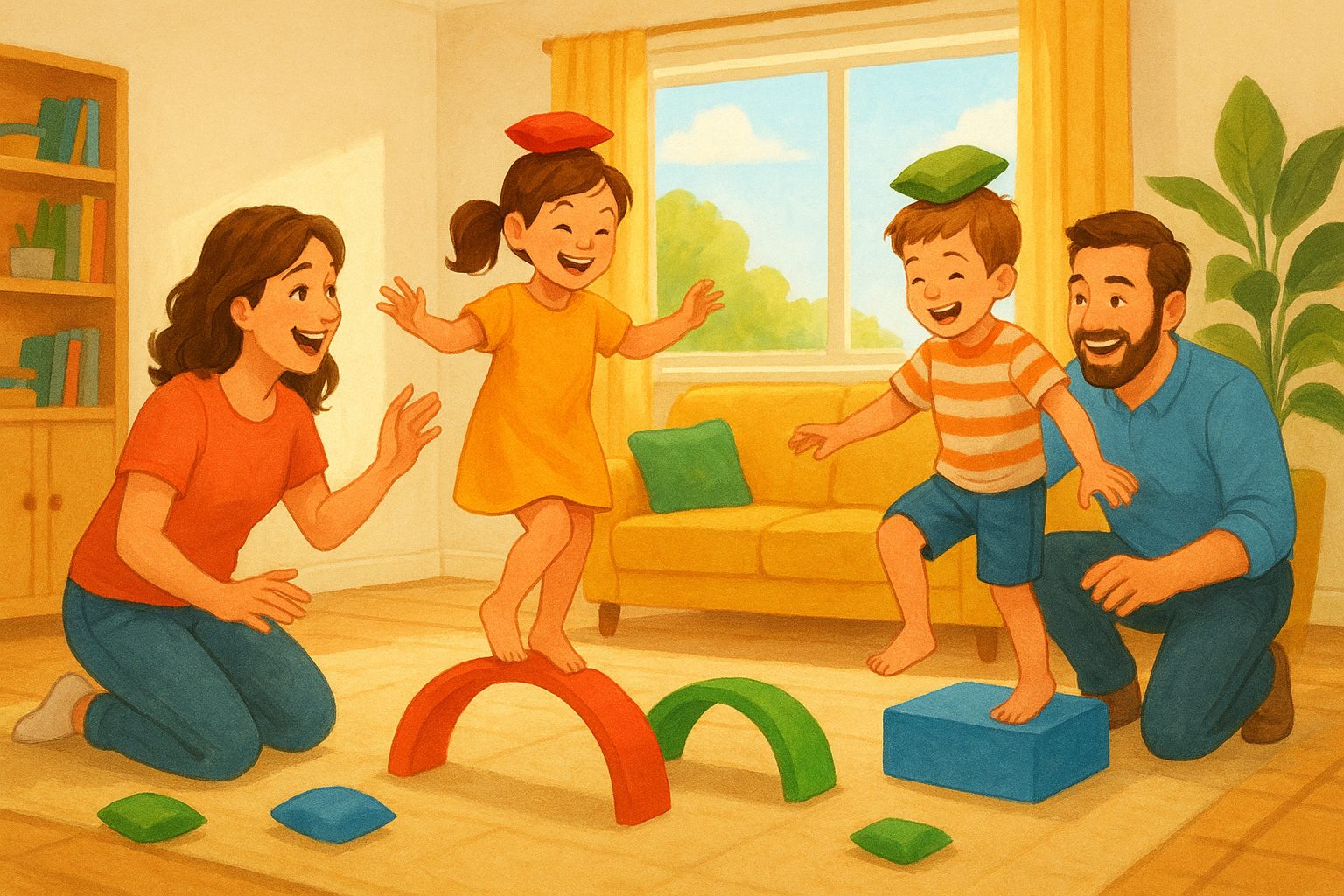
The floor is lava for exactly four minutes, then someone changes the rules, someone else accuses their brother of cheating, and now your “fun family activity” is one spilled bowl of pretzels away from mutiny. That is the funny thing about family challenges: kids usually love the idea, but the challenge has to be simple enough that everyone can actually enjoy it.
Family challenges can be a great way to break out of the usual after-school slump, pull everyone away from screens, and create the kind of memory kids bring up months later for no reason. They work especially well for families who want connection but do not have the energy for a big outing or a highly organized craft.
The trick is not making the challenge bigger. It is making it easier to join. A good family challenge gives kids something playful to do together, lets parents participate without running the whole show, and ends before anyone is too tired or overstimulated. If your family already enjoys simple connection rituals, small family bonding activities can blend nicely with short, repeatable challenges like these.
Why This Happens
Kids are wired to love games, competition, novelty, and movement. That is the good part. The hard part is that many children also struggle with frustration, waiting, flexibility, and losing gracefully. So the exact thing that makes a family challenge exciting can also make it wobble fast.
A seven-year-old may be thrilled by a timed cleanup race right up until a younger sibling gets in the way. A preschooler may adore a sock-toss game until they miss twice in a row and decide the whole thing is unfair. Even older kids can get prickly if the challenge feels too babyish, too hard, or too much like one more thing parents are making them do.
That does not mean family challenges are a bad idea. It just means the best ones are built around real family life. The winning formula is usually:
- clear rules
- short rounds
- lots of movement or silliness
- more laughing than scoring
- an easy exit before moods turn
Think of them less like a serious contest and more like a playful reset button. On a rainy afternoon, these can even work alongside creative indoor activities when everyone needs structure but not another long project.
What Parents Can Do
Choose challenges kids can understand in one sentence
If you need a long explanation, the challenge is probably too complicated. “Who can carry three stuffed animals across the room without dropping them?” works. “We are going to do stations, and then each person gets points based on time, but there are bonus rounds” usually does not.
Simple rules help younger kids join faster and keep older kids from arguing over loopholes. Try challenges like:
- backward walking race to the couch
- paper airplane distance contest
- who can build the tallest pillow tower in two minutes
- sock basket toss
- silent cleanup challenge for five minutes
- family dance freeze contest
Keep the challenge short on purpose
Parents often stretch a fun idea until it stops being fun. One ten-minute challenge usually goes better than a forty-minute “family game event.” Stop while everyone still wants one more round. That is how you get kids asking to do it again tomorrow.
A good rule of thumb is to aim for 5 to 15 minutes per challenge. If the energy is still good, do a second round or switch to something calmer, like one of these easy movie night ideas for the rest of the evening.
Mix teamwork with light competition
If every challenge has only one winner, somebody may end up feeling defeated by round three. Team challenges can save the mood. Instead of “Who wins?” try “Can we do this together before the timer ends?”
Examples:
- Can the whole family put away 20 things in five minutes?
- Can everyone cross the room using only pillows as stepping stones?
- Can you build one giant blanket fort before the song ends?
- Can the family find five red things in the house faster than yesterday?
Team-style challenges help siblings cooperate instead of turning every activity into a courtroom case. They also work well if you have a wide age gap.
Make the prize the fun, not the stuff
Not every challenge needs a prize bag, candy, or a new toy. In fact, once rewards get too big, the mood can shift from playful to intense. Kids start focusing on who got more instead of enjoying the activity.
Better rewards are tiny and social: choosing the next song, getting the first turn, picking dessert, or deciding the next challenge. If you want an easy grab-and-go option for challenge nights, the Family Adventure Challenge Book can help with ready-made ideas without making parents invent everything from scratch.
Use everyday moments instead of waiting for the perfect setup
Family challenges do not need a special day, matching supplies, or a Pinterest plan. Some of the best ones happen in the gap between dinner and bedtime, while waiting for a sibling to finish getting dressed, or when everyone is sliding into cranky mode on a Saturday afternoon.
That is why challenge activities pair so well with ordinary routines. You can turn cleanup, getting outside, or settling into the evening into something lighter. If your family likes keeping simple traditions alive, a short challenge can become one of those family traditions worth starting that kids come to expect.
Have a few low-prep favorites ready
You do not want to reinvent family fun every time boredom hits. Keep a short mental list or write a few challenge ideas on slips of paper in a jar. Then when someone says, “There is nothing to do,” you are not starting from zero.
Good repeatable options include:
- minute-to-win-it cup stack
- living room obstacle course
- towel folding race
- guess the sound with eyes closed
- scavenger hunt by color or shape
- family board-game showdown
If your kids especially love games, something like Exploding Kittens Family Edition can be a fun optional tool for a challenge night because it is quick to set up and silly enough to keep the mood light.
Common Mistakes to Avoid
Making it too competitive. Some competition is fun. Too much turns a playful activity into a meltdown machine. If one child always wins or one child cannot handle losing yet, shift to team goals.
Choosing challenges that are uneven by age. A toddler cannot compete fairly with a ten-year-old in most physical or skill-based games. Adjust the rules, create partners, or give different versions of the same task.
Overexplaining everything. Kids tune out fast. Explain the challenge, demonstrate once, and start.
Trying to salvage the mood after it has clearly crashed. If somebody is already crying, angry, or too tired, the challenge is done. Ending early is not failure. It is good reading of the room.
Using challenges only when you want kids to behave better. If every “fun challenge” is secretly a cleanup strategy, kids will notice. Sometimes do it purely for connection.
Simple Plan to Try This Week
If you want to make this work without overthinking it, try this very doable plan:
Day 1: Pick three challenge ideas
Choose one movement challenge, one silly challenge, and one teamwork challenge. Keep supplies basic: socks, pillows, paper cups, painter’s tape, or stuffed animals.
Day 2: Introduce one challenge at a low-stress time
Do not debut it when everyone is already hungry and tired. Try it after school with a snack or before bath when energy is still decent.
Day 3: Keep it under ten minutes
Even if it goes well, stop early. Say, “That was fun. We’ll do another one tomorrow.” Leaving kids wanting more helps this become a habit instead of a one-time idea.
Day 4: Let a child choose the next challenge
Give two or three options so they have ownership without total chaos. You might say, “Do you want the sock toss, the obstacle course, or the mystery sound game?”
Day 5: Try one teamwork version
See whether the family can beat the clock together. This is especially useful if competition tends to make siblings spiral.
Weekend: Make it a repeatable family ritual
Pick one slot that naturally fits your week: Friday after dinner, Saturday morning, or Sunday before screen time. If you already rotate seasonal activities, this can fit right in with a bigger list of summer bucket list ideas or other family plans.
Helpful Tools
You do not need to buy anything to make family challenges work, but a couple of tools can make them easier:
- Family Adventure Challenge Book — helpful if you want ready-made ideas that feel fun instead of repetitive.
- Exploding Kittens Family Edition — a quick, playful game that works well when you want a challenge night without setting up a full activity.
FAQ
What age are family challenges best for?
They can work for a wide range of ages, but the challenge should match your youngest participant. Preschoolers usually do best with movement and silly tasks, while older kids can handle strategy or timed rounds.
What if my kids fight during every challenge?
Switch to cooperative challenges for a while. Keep rounds shorter, reduce scoring, and choose tasks where everyone works toward the same goal.
Do family challenges have to be educational?
No. They can build problem-solving, communication, and flexibility naturally, but they do not need to feel like a lesson to be worthwhile.
How often should we do family challenges?
Once or twice a week is plenty for most families. The goal is to keep them enjoyable, not turn them into another obligation on the calendar.
What if one child never wants to join?
Keep the invitation light. Let them watch, help judge, or choose the next round. Sometimes kids join once they see the energy is playful and low-pressure.
Family challenges do not need to be polished to be memorable. A two-minute sock toss, a silly race down the hallway, or a “can we all clean this room before the timer ends?” moment can do more for connection than a perfectly planned activity that leaves everyone exhausted. Start small, stop early, and let the fun stay a little messy. And if you want more simple ways to build that easy family closeness, these family bonding activities are a good next place to look.