
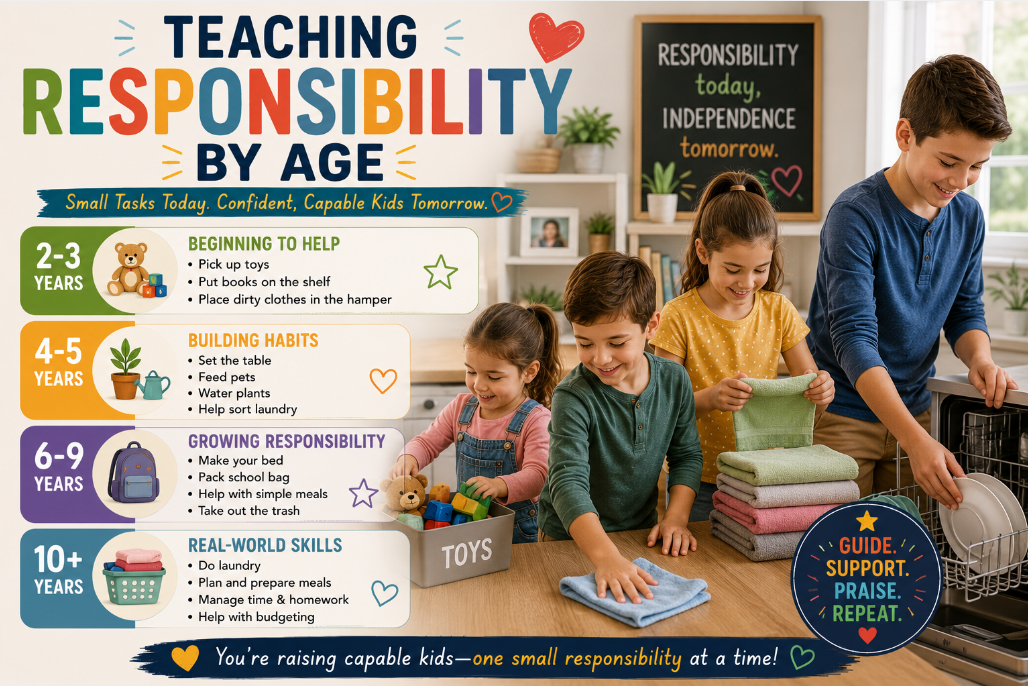
Responsibility is one of those parenting goals that sounds simple until you try to teach it in real life. Most parents do not actually want a child who follows a checklist like a robot. They want a child who notices what needs to be done, follows through without a huge fight, and slowly grows into someone who can handle more of life on their own.
That is why teaching responsibility by age matters. A toddler cannot manage the same expectations as a third grader, and a ten-year-old still needs more coaching than many adults remember. When expectations are too low, kids miss chances to grow. When expectations are too high, everybody ends up frustrated.
The sweet spot is giving children jobs they can really do, teaching the skill behind the job, and staying consistent long enough for the habit to stick. If you have been wondering what responsibility should actually look like at different ages, this guide will help you build it in a realistic way.
Why responsibility can feel so hard to teach
Parents usually are not struggling because they forgot to make a chore chart. They are struggling because responsibility is bigger than chores. It includes following routines, handling belongings, doing a task without arguing every time, and learning that actions affect other people.
Children also develop these skills gradually. Young kids live in the present. Older kids may understand expectations but still need reminders, structure, and practice. Some children resist because they want control. Some avoid tasks because they are unsure how to start. Others are used to adults stepping in before they have to figure things out.
That is why responsibility grows best inside a calm, predictable family structure. Kids do better when the rules make sense, the jobs are clear, and the adults do not change the plan every other day. If your home needs a stronger foundation first, this guide on setting clear boundaries and expectations with young children can help you build the kind of consistency responsibility depends on.
What responsibility really means at each stage
Responsibility should match development, not wishful thinking. A good rule is this: give your child a job they can learn with support, repeat often enough to remember, and complete with growing independence over time.
Ages 2 to 3: joining in
At this age, responsibility is mostly about participation. Toddlers can put toys in a bin, carry a diaper to the trash, place napkins on the table, or help put books back on a shelf. The goal is not perfect results. The goal is learning that they are part of the family and that everyone helps.
Use short instructions, simple routines, and plenty of demonstration. You are building the habit of helping, not testing independence.
Ages 4 to 5: simple follow-through
Preschoolers can usually handle a few small repeatable jobs like putting dirty clothes in the hamper, feeding a pet with supervision, clearing their plate, watering a plant, or helping pack their backpack. At this stage, they can begin connecting a task to a daily routine.
They still need reminders, but they are ready to hear, “This is your job,” and start seeing themselves as capable.
Ages 6 to 8: daily ownership
Early elementary kids can usually manage more consistent expectations. Think making the bed, unpacking school items, putting shoes and coats away, helping sort laundry, wiping the table, or getting ready for school with less hands-on help. This is a good age to teach responsibility for belongings and basic household contributions.
It is also a good age to connect effort to confidence. When children regularly do useful things, they start to feel trusted and competent. That is one reason age-appropriate responsibilities can build confidence so effectively.
Ages 9 to 12: growing independence
Older kids can usually handle jobs that require planning and follow-through, such as packing sports gear, helping prepare simple meals, unloading dishes, doing parts of their laundry, keeping track of homework materials, and managing parts of their morning routine. They are old enough for more independence, but they still need structure.
This is a great age to shift from constant reminders to systems. A posted checklist, a set pickup time, or a regular family expectation often works better than repeating yourself all evening.
How to teach responsibility without turning it into a daily battle
Many parents accidentally make responsibility feel like a power struggle. They ask, remind, warn, negotiate, and finally explode. The child learns that the task matters only when the adult is angry enough.
A better approach is to teach first, then expect, then stay steady.
Start by showing the task clearly. Do not just say, “Clean your room,” if your child has no idea what that means. Break it down. Show them how to put laundry in the basket, where toys belong, and what “finished” looks like. Children need practice, not vague speeches.
Then move into repeatable expectations. Instead of deciding in the moment, attach the task to a routine. Shoes go on the rack when you get home. Backpack gets unpacked before play. Towel gets hung up after bath. Repetition is what turns responsibility into normal life.
Finally, stay calm and predictable. If you are trying to build long-term responsibility, you do not need a dramatic reaction every time a child forgets. You do need follow-through. This is where a respectful, connected approach matters. If you want a broader framework for this, positive discipline is useful because it focuses on teaching, problem-solving, and accountability instead of fear.
Use consequences that teach instead of just punish
Responsibility grows when children experience the link between choices and outcomes. That does not mean setting kids up to fail or making everything harsh. It means letting the result make sense.
If your child leaves a wet towel on the floor, they come back and hang it up. If they forget a library book after one reminder, they may have to return it the next day. If they leave their bike out, they help clean it or lose access until it is put away properly. Those are teaching moments.
The key is keeping consequences safe, related, and calm. You are not trying to embarrass your child. You are helping them connect action and outcome. For a deeper look at how this works in family life, natural consequences that actually work gives solid examples of when to step back and when to step in.
Sometimes responsibility problems are really skill problems. A child who forgets homework every day may need a better launch routine, not a harsher lecture. A child who melts down at cleanup time may need help breaking the task into smaller steps. Consequences matter, but teaching matters more.
What to say when kids resist
Resistance is normal. Children test limits, complain, stall, and hope the adult will do it for them. The goal is not to find magic words that make every child cheerful about chores. The goal is to respond in a way that does not feed the fight.
Try language that is clear and boring:
- “Your dishes go in the sink before screen time.”
- “Toys get picked up before we start something new.”
- “I can help you start, but I am not doing it for you.”
- “You do not have to like the job. You do have to do the job.”
That last line is especially useful with older kids. Responsibility is not always fun. Part of maturity is learning that not every task needs to feel exciting before it gets done.
If your child responds only when there is a sticker, treat, or prize, it may be time to reset how motivation works at home. This breakdown of praise versus rewards can help you encourage effort without making every basic responsibility a transaction.
How to build motivation that lasts
Children are more likely to act responsibly when they feel capable, not constantly criticized. That does not mean praising every tiny move. It means noticing specific effort, improvement, and follow-through.
Instead of saying, “Good job,” try:
- “You remembered your backpack without me asking.”
- “You came back and fixed that when I reminded you.”
- “You kept going even though you did not want to do it.”
Specific feedback teaches children what responsibility looks like. It also helps them build internal pride instead of always waiting for a reward.
For some families, a simple visual system is useful while habits are forming. A basic responsibility chart can help younger children remember repeated tasks without constant verbal reminders. If you want one tool that can support this without taking over the whole article, the Melissa & Doug Responsibility Chart can be helpful for families working on regular chores and follow-through. It works best as a reminder tool, not as a substitute for teaching.
A practical plan for teaching responsibility by age
If you want this to work in real life, keep the plan simple.
1. Pick two or three core responsibilities first.
Do not hand your child a giant list and expect a personality change by Friday. Start with a small number of tasks that matter every day.
2. Tie each task to a routine.
Responsibility sticks faster when it has a home. Backpack after school. Hamper before pajamas. Pet care before breakfast.
3. Teach the task directly.
Show the steps. Practice together. Let your child try. Correct calmly. Repeat. Children often need more teaching than adults think.
4. Move from reminders to systems.
Use checklists, visual cues, or one consistent reminder instead of ten scattered ones.
5. Let children do what they can do.
If they are capable of finishing the task, resist the urge to jump in just because it is slower or messier than your version.
6. Review and adjust every few months.
As children grow, their jobs should grow too. Add one new responsibility at a time instead of changing everything at once.
When responsibility starts to support independence
One of the best signs that responsibility is working is when it spills into other parts of life. A child who learns to keep track of belongings may start managing school materials better. A child who learns to finish a household task may be more willing to tackle homework without waiting for rescue.
That is because responsibility and independence are closely connected. Kids do not become independent all at once. They become independent by practicing small acts of ownership over and over again. If that is an area you want to build more intentionally, helping kids become independent learners extends the same idea into schoolwork, problem-solving, and self-starting habits.
Responsibility also supports self-respect. Children feel better when they can contribute, handle some of their own tasks, and see themselves as useful members of the family. They may complain along the way, but most kids actually do well with the confidence that comes from being trusted.
Common mistakes that make responsibility harder
Doing too much for your child.
This is easy to fall into, especially when you are tired or in a hurry. But rescuing too often teaches children that responsibility belongs to the adult.
Expecting instant consistency.
Kids forget. They stall. They improve, then slide backward. That does not mean the plan is failing. It means they are learning.
Giving tasks without teaching skills.
Many children look defiant when they are actually overwhelmed or unsure how to begin.
Using shame.
Comments like “You are so lazy” or “Why can your sister do this and you cannot” do not build responsibility. They build defensiveness and discouragement.
Making every task negotiable.
If basic responsibilities get debated every day, children learn to wait out the adult instead of following through.
Relying on rewards for everything.
A reward can help launch a new habit sometimes, but children should not need a prize to put dirty socks in the hamper forever.
When to get extra support
If responsibility struggles seem extreme, it can help to look at the bigger picture. Sleep issues, stress, learning challenges, attention difficulties, or family transitions can all affect follow-through and daily functioning. If you are seeing big problems at home and school, or if simple routines feel impossible even with consistent support, it may be worth talking with your child’s teacher, school professional, pediatrician, or another qualified specialist.
That does not mean something is wrong with your child. It just means some kids need more tailored support to build the same skills.
It also helps to watch for timing. Some children handle responsibility much better when tasks happen before they are tired, hungry, or rushing out the door. A job that turns into a fight every evening may go much more smoothly if it happens fifteen minutes earlier with a clear cue and less pressure.
Conclusion
Teaching responsibility by age is really about handing children manageable pieces of real life and trusting that they can learn. Start small. Be clear. Teach the task. Stay consistent. Let consequences teach when appropriate. Notice effort. Add more responsibility as your child grows.
You do not need a perfect system or a child who never complains. You need steady expectations and enough patience to let practice do its job. Over time, those small daily responsibilities become something much bigger: confidence, follow-through, and the belief that “I can handle this.”
If this helped, read these next:
- How age-appropriate chores help kids feel capable and trusted
- Natural consequences that teach responsibility without constant fights
- How to motivate kids without turning every chore into a reward system
Explore more parenting advice here: