
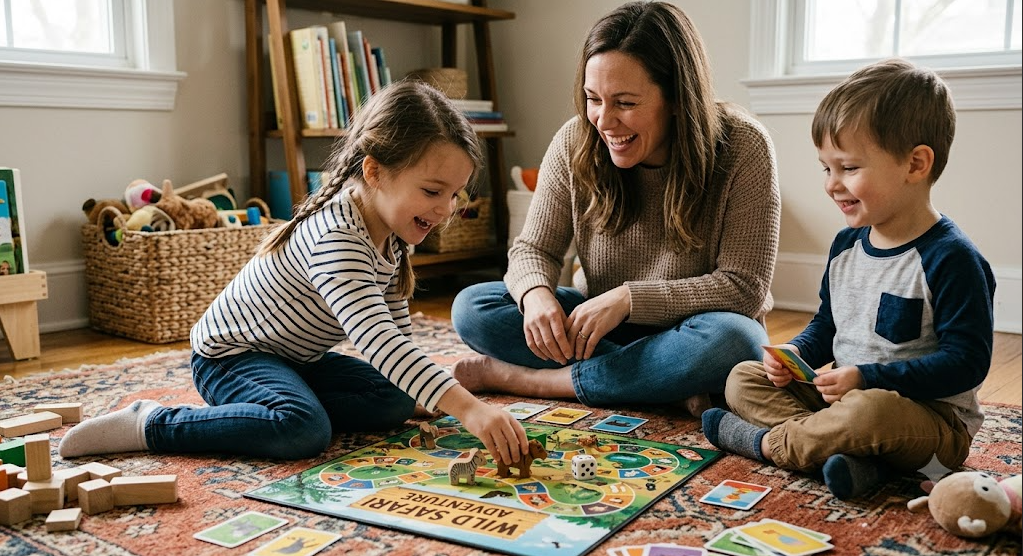
Some kids will happily spend twenty minutes figuring out the rules of a made-up backyard game, then groan the second you suggest a “learning activity.” That does not mean they dislike learning. It usually means they can tell when something feels playful and when it feels like extra work dressed up with bright colors. The sweet spot is finding educational games that feel fun first and still build real skills along the way.
If you have ever bought a “smart” game that got used once and then vanished under the couch, you are not alone. Parents often want games that help with reading, math, memory, or problem-solving, but kids are rarely impressed by a box that promises skill-building. They care about whether the game is easy to join, satisfying to play, and worth doing again.
That is why the best educational games are not always the flashiest ones. They are the ones that make children think without making them feel tested. They invite repetition, laughter, strategy, and little moments of success. Over time, those moments add up to real learning.
And if your child already does well with hands-on activities, you can build on that. A more playful home setup, like the ideas in creating a home environment that supports focused learning, often makes kids more open to games that stretch their thinking.
Why This Happens
Children learn best when they feel engaged, safe, and curious. When a game is enjoyable, their brains stay active longer. They are more willing to pay attention, try again after a mistake, and experiment with new ideas. That matters because many academic skills grow through repetition, and repetition is much easier when it feels fun.
Think about the difference between a child filling out ten addition problems on paper and the same child racing to combine number cards to reach a target score. The math may be similar, but the emotional experience is not. One can feel like a performance. The other feels like a challenge.
Educational games also work because they naturally build more than one skill at a time. A simple matching game can support memory, language, turn-taking, and patience. A word game might strengthen vocabulary while also teaching frustration tolerance. A building game can spark spatial reasoning, planning, and problem-solving all at once.
This is one reason building curiosity at home works so well for many families. Kids often stick with learning longer when discovery is built into the experience instead of added as a lecture afterward.
What Parents Can Do
Choose games by your child’s personality, not just their age
A quiet child who likes patterns may love puzzles, memory games, and logic challenges. A high-energy child may do better with games that involve movement, timed rounds, or hands-on pieces. A child who resists being corrected may respond better to cooperative games where everyone works toward a goal together.
Instead of asking, “What educational game should a seven-year-old play?” ask, “What kind of play keeps my child interested for more than five minutes?” That question usually leads you to better choices.
Look for one clear skill, not ten promises
Be skeptical of games that claim to teach everything at once. The strongest options usually do one or two things well. A reading game might build phonics or vocabulary. A math game might strengthen number sense or mental flexibility. A strategy game might improve planning and self-control.
When the goal is clear, it is easier to notice whether the game is actually helping. You also avoid the trap of buying something impressive-looking that is too complicated to enjoy.
Keep the first few rounds light
If your child senses that you are evaluating every move, the game can quickly stop feeling fun. Resist the urge to turn each mistake into a lesson. Early on, focus more on learning the routine, taking turns, and getting comfortable. You can always talk about strategies later.
For example, instead of saying, “No, that answer is wrong,” try, “Let’s test that and see what happens,” or, “Want to try another way?” That small shift keeps the mood curious instead of critical.
Rotate rather than overloading the shelf
Too many choices can make kids ignore all of them. Keeping just a few options accessible often works better than storing an entire tower of unopened “educational” purchases. Put out two or three games for a week or two, then swap them. Familiarity helps children get better at a game, and that growing competence is part of what makes them want to return to it.
Use games to connect, not just to improve performance
One of the biggest reasons children enjoy educational games is that someone is there with them. A ten-minute card game after dinner can do more for motivation than a much more expensive activity that feels solitary. If you need ideas that keep learning playful without a screen, these screen-free learning activities can help you widen the mix.
Notice what your child says after the game
The most helpful clues often come after play ends. Did they ask to do it again? Did they explain the rules to a sibling? Did they start inventing their own variations? Those are good signs that the game is landing well.
When kids start adjusting the rules, making predictions, or arguing for a strategy, they are often practicing flexible thinking. That same skill shows up in everyday tasks too, which is why it can help to pair game time with ideas from helping kids develop problem-solving skills through daily challenges.
Common Mistakes to Avoid
Buying for your ideal child instead of your actual child
It is easy to imagine your child sitting happily with a beautiful strategy game for half an hour. But if they are still learning how to handle losing or waiting, that may not be the best starting point. Meeting your child where they are usually works better than buying for the version of them you hope appears next month.
Turning every game into a lesson
If every round ends with a mini speech about what they should have learned, children start to feel managed. Let the game do more of the teaching. A few natural comments are plenty.
Picking games that are too long
Parents often overestimate how much patience children have after school or before dinner. Short games with a quick payoff usually get replayed more. Replays are where a lot of the learning happens.
Using games only when a child is struggling
If games appear only when school feels hard, children may see them as a hidden form of extra practice. Mixing them into ordinary family time keeps the experience lighter and more positive.
Simple Plan to Try This Week
If you want to test this without spending a lot of money or reorganizing your whole routine, keep it simple.
Step 1: Pick one skill
Choose one area your child could use more practice in, like early reading, number sense, memory, or problem-solving.
Step 2: Pick one game that matches your child’s style
Go for something short and approachable. If your child gets overwhelmed easily, skip anything with too many rules. If they love competition, choose a game with quick rounds. If they melt down when they lose, start with cooperative or solo challenge games.
Step 3: Schedule ten minutes three times this week
Short, predictable play works better than waiting for the perfect free afternoon. After dinner, before bath, or during a weekend reset can all work.
Step 4: Say less during the game
Keep your comments warm and brief. Try lines like, “You noticed that fast,” “That was a smart switch,” or, “Want another round?” Avoid correcting every detail.
Step 5: Watch for replay value
At the end of the week, ask yourself one question: did my child want to come back to it? If yes, that game is probably a keeper. If not, the issue may be the match, not the whole idea of educational games.
Helpful Tools
Most kids do not need special gear to learn well. Still, a couple of simple tools can make practice feel more like play and less like pressure.
LeapFrog LeapStart
If your child likes interactive practice, LeapFrog LeapStart can be an optional way to mix movement, tapping, and quick feedback into learning time. It works best when it feels like a fun choice rather than one more assignment.
Educational Flash Cards
If your child likes interactive practice, Educational Flash Cards can be an optional way to mix movement, tapping, and quick feedback into learning time. It works best when it feels like a fun choice rather than one more assignment.
FAQ
What makes a game educational without making it boring?
A game feels educational when it builds a real skill like memory, vocabulary, logic, or number sense. It avoids feeling boring when the play itself is enjoyable and the child does not feel constantly corrected.
How long should kids play educational games?
For many children, ten to fifteen minutes is enough, especially at first. Short sessions often work better than long ones because they end while the child is still interested.
Are screens necessary for educational games?
No. Screen-based games can be useful for some families, but many children learn just as well through card games, board games, matching activities, building challenges, and pretend play.
What if my child refuses every educational game I suggest?
Start by dropping the label. Offer a game because it is fun, not because it is “good for them.” You can also begin with activities that already resemble the play they naturally enjoy.
How do I know if a game is too hard?
If your child gives up quickly, needs constant help, or becomes more frustrated than engaged, it may be too advanced right now. Look for games where they can experience some success within the first round or two.
Educational games do not need to be perfect to be useful. They just need to give your child one more way to practice thinking, noticing, remembering, and trying again without feeling under a microscope. A simple game that gets replayed is often far more valuable than an elaborate one that gathers dust. And if you want to keep that momentum going, learning through play can help you carry the same playful energy into everyday learning at home.