
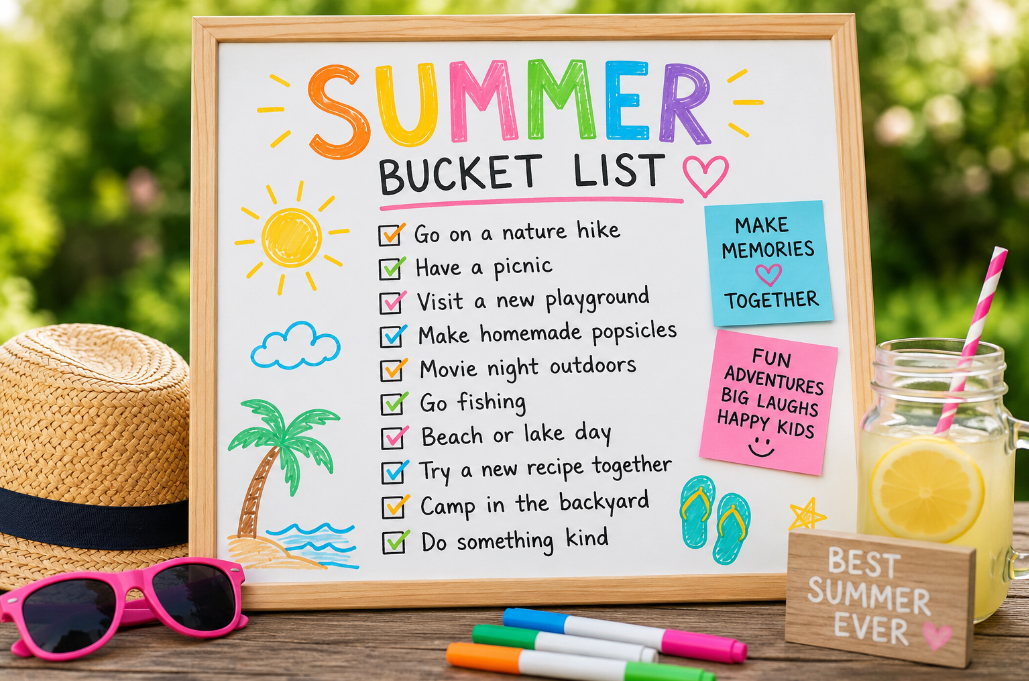
By mid-July, some houses start to sound the same: “I’m bored.” “We already did that.” “Can I have the tablet?” Summer can feel long even when you were desperate for a break from packed school mornings. A good bucket list gives families a simple answer before boredom takes over.
A summer bucket list does not need to be a giant Pinterest project or a schedule packed with expensive outings. Most kids do not need a perfect summer. They need a handful of things to look forward to, a little variety, and enough structure that every day does not slide into snacks, screens, and low-grade whining by 2 p.m.
The sweet spot is a list that feels fun but realistic. Think easy wins, a few bigger memory-makers, and enough flexibility that real family life can still happen. The goal is not to “make every moment magical.” The goal is to make summer easier to enjoy while it is actually happening.
Why Summer Boredom Shows Up So Fast
Summer boredom is not always a sign that kids are ungrateful or that parents are not doing enough. During the school year, children move through a built-in rhythm. Someone else decides when the day starts, when snack happens, what the plan is, and what comes next. Once summer arrives, all that structure disappears at once.
Some kids love the freedom for about two days and then start to unravel. They feel restless but cannot think of what to do. They want novelty, but they also want the comfort of familiar routines. That is why a bucket list helps. It gives summer enough shape to feel exciting without making every day feel overplanned.
It can also reduce pressure on parents. When ideas live on a shared list, you do not have to invent entertainment from scratch every afternoon. A bucket list becomes a menu instead of a rescue mission.
What Parents Can Do
Start with categories, not a giant master plan
Instead of trying to map out every day of the season, make a short list under a few simple headings: outside, at home, rainy day, with friends, helping others, and one bigger adventure. This keeps the list balanced and prevents it from turning into twenty expensive outings you never actually want to do.
For example, your outside list might include sprinkler time, chalk murals, evening walks, a playground you have never tried, and a backyard picnic dinner. Your at-home list might include blanket forts, kitchen experiments, movie night, and a read-aloud marathon.
Mix easy ideas with memorable ones
A useful bucket list needs quick, low-effort options. If every item requires packing a cooler, driving across town, and spending money, the list starts collecting guilt instead of check marks. Some of the best summer moments are tiny: popsicles on the porch, flashlight tag after dinner, breakfast for dinner, or letting the kids stay in pajamas until lunch on a slow day.
Then add two or three memory-makers that feel a little bigger. That might be a beach day, a family camping night in the yard, a train ride, or a “yes morning” where each child gets to pick one simple activity. The small things carry most of the season; the bigger ones give summer a few bright anchor points.
Let kids help choose
Children are far more likely to enjoy a bucket list they helped build. Ask each child for three ideas: one easy, one silly, and one special. You may get requests that are wildly unrealistic, but that is fine. Use those ideas to uncover the feeling underneath. “Go to Disney” may really mean “I want a huge exciting day.” “Sleep in a treehouse” may really mean “I want a weird and fun bedtime.”
When kids have a voice, they are also less likely to shoot down every suggestion you make later. They can point to the list and say, “Let’s do one of mine,” which is a lot better than “There is nothing to do.”
Keep a little rhythm in the week
Freedom works better when it has edges. You do not need a strict camp-style schedule, but repeating themes help. Maybe Monday is library day, Tuesday is water play, Wednesday is kitchen project day, and Friday is family movie night. That kind of loose rhythm makes summer calmer for everyone. If your house gets wobbly without a predictable start, this guide on building a morning routine that energizes kids and parents can help you create a simple summer version.
Use the bucket list to cut down on screen drift
Many families are not trying to ban screens completely. They just do not love how quickly an “easy summer day” can turn into hours of default scrolling or gaming. A visible bucket list gives you better options. Instead of saying “no screens” and bracing for the argument, you can say, “Pick one bucket list idea first.”
That shift matters. It moves the conversation from restriction to choice. Kids feel less controlled, and you are not stuck playing activities director with an empty brain.
Build in movement and mess on purpose
Summer usually goes better when children get chances to move, splash, dig, build, and be loud. A simple plan for active play can lower crankiness for the rest of the day. If you need a few ideas that burn energy without turning your living room upside down, this list of family-friendly exercises to keep everyone active at home is handy on hot afternoons or smoky air days.
Messy learning counts too. Sidewalk paint, homemade lemonade stands, bug hunts, baking, and backyard obstacle courses all belong on a good bucket list. If your kids love projects with a little wow factor, these fun science experiments you can do at home fit nicely into a summer plan without feeling like school in disguise.
Common Mistakes to Avoid
Making the list too long. A bucket list with fifty items stops feeling fun and starts feeling like unpaid event management. Ten to twenty ideas is plenty for most families.
Adding only expensive outings. Kids remember atmosphere more than price tags. Water balloons and dinner on a picnic blanket can beat a rushed day that cost a fortune.
Planning every item for parents instead of children. It is fine to include what you actually enjoy, but if the whole list is “educational” or “productive,” children will treat it like another assignment.
Forgetting quiet-day options. Some weeks are hot, rainy, or emotionally off. Keep a few calm ideas ready like puzzles, card games, a fort-and-books afternoon, or a simple family board game session. If you want fresh options, these educational games that encourage learning through play can work well when everyone needs a lower-key reset.
Trying to force fun when everyone is tired. Sometimes the best bucket-list choice is the easiest one. If the morning was rough, pick the porch popsicle, not the ambitious day trip.
Simple Plan to Try This Week
If your summer already feels a little shapeless, try this reset:
Day 1: Make the list together
Grab paper, a whiteboard, or the back of an old grocery list. Ask each child for three ideas and add two or three parent picks. Keep it visible.
Day 2: Pick one “easy win” activity
Choose something you can do with almost no prep, like sidewalk chalk, a bike ride, popsicles in the yard, or a dance party with the sprinkler.
Day 3: Add one home-based project
Try cardboard-box creations, a snack challenge, or one simple science activity. Do not overproduce it.
Day 4: Put one outing on the calendar
Schedule one special event for later in the week or later in the month. Anticipation is part of the fun.
Day 5: Create a boredom rule
When a child says, “I’m bored,” point to the list and have them choose one item before asking for a screen.
Day 6: Make room for rest
Pick a calm bucket-list idea like reading in a fort, cloud watching, or making smoothies. Kids need slower days too.
Day 7: Notice what actually worked
Not every idea needs repeating. Keep the ones that felt easy and joyful, and quietly retire the ones that felt like too much work for not much payoff. If summer has brought more tension than fun lately, this article on managing stress together is a good reminder that family connection matters more than checking off every plan.
Helpful Tools
You do not need extra stuff to make a summer bucket list work, but a couple of optional tools can make activity days easier.
- Family Adventure Challenge Book is a fun prompt if your family likes having ready-made adventure ideas instead of reinventing the wheel every weekend.
- Scavenger Hunt Cards can turn a walk, park trip, or backyard hour into an easy bucket-list win with almost no prep.
50 Summer Bucket List Ideas for Families
If you’re staring at a blank piece of paper wondering what belongs on your family’s summer bucket list, start here. Mix and match ideas that fit your budget, your children’s ages, and the amount of energy you realistically have. Remember, the goal is not to complete every item. The goal is to create opportunities for fun, connection, and memorable moments.
Outdoor Adventures
- Have a backyard picnic.
- Visit a playground you’ve never tried before.
- Go on a nature scavenger hunt.
- Fly a kite.
- Watch a sunset together.
- Take a family bike ride.
- Build a backyard obstacle course.
- Try a splash pad or water park.
- Go fishing.
- Take a family hike.
At-Home Summer Fun
- Build a giant blanket fort.
- Have a movie marathon day.
- Make homemade popsicles.
- Create a family talent show.
- Cook breakfast for dinner.
- Have a board game tournament.
- Make a time capsule.
- Sleep in the living room.
- Create a family photo challenge.
- Try a new recipe together.
Free or Low-Cost Activities
- Visit the local library.
- Attend a free community event.
- Explore a new neighborhood park.
- Feed ducks where permitted.
- Visit a farmers market.
- Have a chalk art contest.
- Watch airplanes at a nearby airport.
- Take a walk and photograph interesting things.
- Read books outside.
- Go cloud watching.
Memory-Making Experiences
- Camp in the backyard.
- Take a day trip somewhere new.
- Watch fireworks.
- Have a family game night championship.
- Let each child plan one family activity.
- Take a train ride.
- Visit a beach, lake, or river.
- Make a summer scrapbook.
- Write postcards to relatives.
- Create a family summer playlist.
Acts of Kindness
- Leave encouraging notes for neighbors.
- Donate toys no longer used.
- Bake treats for someone special.
- Help an elderly neighbor with yard work.
- Pick up litter at a park.
- Make thank-you cards for community helpers.
- Donate books to a local organization.
- Collect food for a food bank.
- Volunteer as a family.
- Surprise someone with an act of kindness.
Do not worry about completing every idea. Pick a handful that genuinely sound fun for your family and let the list evolve as summer unfolds. Sometimes the activities you remember most are the ones you almost skipped because they seemed too simple.
FAQ
How many items should be on a summer bucket list?
For most families, ten to twenty is enough. You want enough variety to stay interesting, but not so many items that the list feels like homework.
What if my kids are different ages?
Mix activities that work for everyone with a few child-specific picks. Water play, movie night, baking, scavenger hunts, and playground trips usually adapt well across ages.
Do bucket lists have to include expensive outings?
No. In fact, the best lists usually lean heavily on simple, repeatable activities. Expensive days can be fun, but they should not carry the whole season.
What if my child still says they are bored?
That is normal. A bucket list is a support, not a magic trick. Use it to offer choices, then let your child help decide. Sometimes boredom is just the pause before they re-engage.
Should I plan every summer day?
No. Most kids do better with a mix of open time and light structure. A few repeated rhythms plus a shared list usually works better than a tightly packed calendar.
Summer does not need to be flawless to be memorable. A good bucket list simply gives your family more ways to say yes to connection, movement, silliness, and slower moments that might have slipped by otherwise. Start small, keep it visible, and let the list serve your family instead of the other way around.